On this page
- How does Google rank real estate agents in local search?
- Should you have your own Google Business Profile or share your brokerage’s?
- How do you get more Google reviews without breaking the rules?
- Which local pages should a real estate agent’s website have?
- How do you get local links and citations as an agent?
- How does a local podcast help local SEO?
- How do you track local SEO results?
- What local SEO mistakes should real estate agents avoid?
- Next step: book one local interview this month
Local SEO for real estate agents means showing up when people in your area search Google for an agent. Google ranks local results on relevance, distance and prominence, and you can’t pay for a better spot. You earn it with a correct Google Business Profile, steady honest reviews, useful local pages and links from local websites.
Every rule below comes from Google’s own help pages, checked on 20 November 2026. Where Google doesn’t say something, we don’t either. Your brokerage and your state also have advertising rules, so check those before you change your profile or your website.
How does Google rank real estate agents in local search?
Google ranks real estate agents in local results on three things: relevance, distance and prominence. Google’s tips to improve your local ranking define each one, and the same page says “There’s no way to request or pay for a better local ranking on Google.”
- Relevance is how well your Business Profile matches what someone searched for. Complete, accurate details help Google match you.
- Distance is how far you are from the person searching. You can’t change it, but you can describe your service areas correctly.
- Prominence is how well-known you are. Google says it includes your review count and ratings, and “how many websites link to your business.”
Google’s own advice on the same page is plain: fill in your profile completely, verify it, keep your hours accurate, respond to reviews and add photos and videos. Ads are a separate, paid product. They don’t buy you a better spot in the local results.
Should you have your own Google Business Profile or share your brokerage’s?
Google’s guidelines name “insurance or real estate agents” as individual practitioners, so an agent can have a profile of their own. Whether you should depends on how your office is set up. All the rules below come from Google’s guidelines for representing your business.
A practitioner qualifies when they “operate in a public-facing role” and “can be contacted directly at the verified location during stated hours.” Support staff shouldn’t create their own profiles. The table shows what Google says for the three setups agents ask about most.
| Your situation | What Google’s guidelines say | Profile name |
|---|---|---|
| Several agents work from one brokerage office | The office has one profile for the location; each agent’s profile carries only the agent’s name | [Your name] |
| You’re the only agent at a branded office | Share one profile with the organization | [Brand]: [Your name], like Google’s example “Allstate: Joe Miller” |
| You work from home and meet clients elsewhere | Google’s service-area rules: if you don’t serve clients at that address, remove it and set service areas | Your real-world business name |
Three more rules matter for agents:
- Use your real-world name. Google says “Including unnecessary information in your business name isn’t permitted”, and its examples rule out taglines, location details and service descriptions.
- One profile only. “A practitioner shouldn’t have multiple Business Profiles to cover all of their specializations.” A luxury profile plus a first-time-buyer profile breaks this.
- No virtual offices or remote mailboxes. Google says a rented mailing address you don’t operate from “isn’t eligible for a Business Profile.”
If you don’t serve clients at your address, Google’s service-area help page says to remove the address from your profile. You can list up to 20 service areas, and the whole area “shouldn’t be more than about 2 hours of driving time” from your base.
To change any of this, go to your Business Profile and select Edit profile, then Save. Google reviews your changes before they go live, so don’t panic if an edit takes a while to show. Ask your broker before you set up a profile that uses the brokerage’s brand.
How do you get more Google reviews without breaking the rules?
You get more Google reviews by asking every client at the right moment, with a direct link, and offering nothing in return. Google’s tips to get more reviews say you can ask customers to use a Google link or scan a QR code, and that reviews “must reflect a genuine experience.”
Google’s Maps content policy lists what a business can’t do:
- offer “payment, discounts, free goods and/or services” for a review, or for changing or removing a negative one;
- “Discourage or prohibit negative reviews, or selectively solicit positive reviews from customers”;
- ask staff to collect a set number of reviews;
- post reviews that come from a conflict of interest, which Google says “may include current or former employment.”
That second rule kills review gating, the habit of sending a happy-or-not survey first and only giving the Google link to the happy clients. Ask everyone you closed with. Our review request scripts for Google and Zillow cover the wording and the timing.
Reply to reviews too. Google’s tips say to keep replies short and honest, skip promotions in replies, and never share a reviewer’s private details. On your own website, show reviews if you like, but don’t expect stars in search. Google’s review snippet rules say a business that controls the reviews about itself is “ineligible for star review feature” on pages marked up as LocalBusiness or Organization.
Which local pages should a real estate agent’s website have?
A real estate agent’s website needs a few local pages that someone in your area would actually use: one strong page for each area you serve, plus content about local people and places. Thin pages that swap one town name for another don’t count.
Google’s spam policies list “multiple domain names or pages targeted at specific regions or cities that funnel users to one page” as doorway abuse. So build fewer pages, and make each one worth reading:
- what the area looks like on the ground: housing types, commute routes, parks, local events, businesses you’d recommend;
- your own experience there: the streets you’ve sold on, the questions buyers ask you about it;
- local interviews and episode pages that feature people from that town.
Describe places, not people. Fair Housing advertising rules cover your website as well as your listings, so leave out who “fits” an area. Our list of Fair Housing words to avoid in real estate listings covers the phrases to watch. Ask your broker about anything borderline.
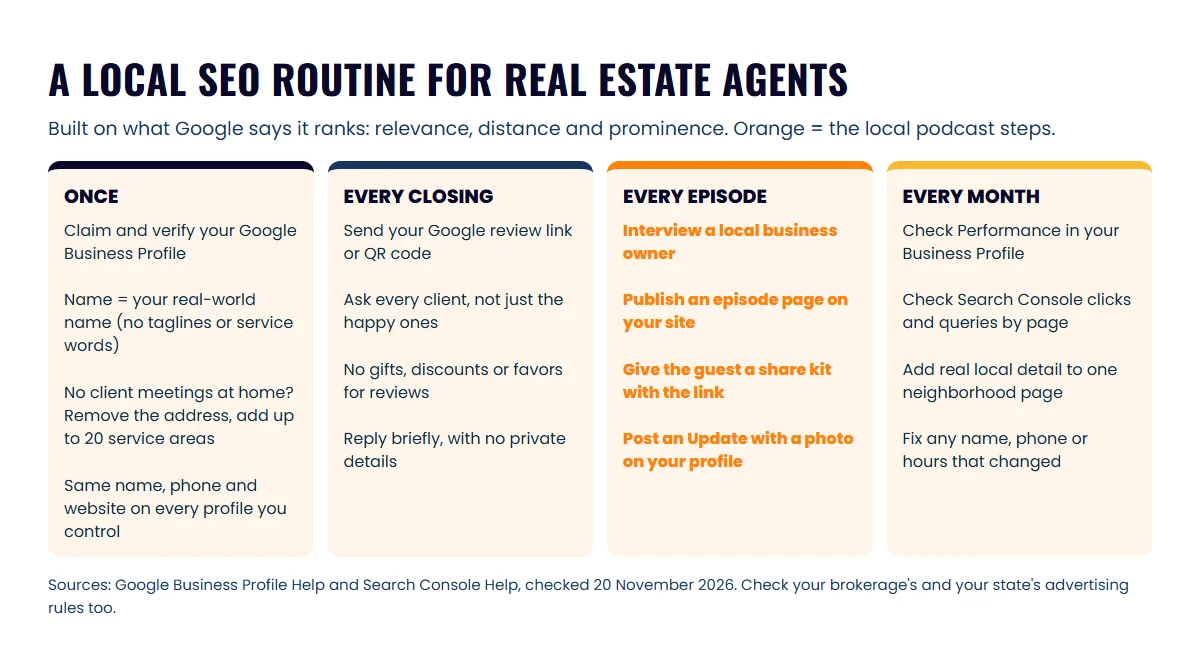
How do you get local links and citations as an agent?
Local links and citations for agents come from places your business already shows up: your brokerage roster, portal profiles, your REALTOR association and local partners. Google counts “how many websites link to your business” as part of prominence.
Start with the profiles you control. Use the same business name, phone number and website everywhere, so Google and people see one consistent business. Then look for links you’ve already earned and never claimed:
- Charities, teams and events you sponsor that list sponsors on their website.
- Local businesses you refer clients to, who might list you as a partner.
- Local blogs, newsletters and podcasts that cover your town.
- Business owners you’ve interviewed, who link to their own episode.
The last one is the easiest to repeat, and it’s where a podcast earns its keep.
How does a local podcast help local SEO?
A local podcast helps local SEO because each interview with a local business owner produces a local page, a link from another site and fresh material for your Business Profile. It also builds the relationship, which is the real point.
Here’s what one interview gives you:
- Episode page. The episode page on your site is real local content about a real local business. Our process for turning a podcast interview into an SEO blog post shows how to write it.
- Guest link. Guests share episodes they’re proud of. A guest share kit for local business owners makes it easy for them to link to the page from their own site.
- Profile post. Google lets you publish an Update with text, photos or video and a button. Posting a Business Profile Update about each episode, with a photo from the recording, puts it in front of people who find you on Search and Maps.
- Relationship. The owner now knows you and has a reason to mention you, and the episode, to their own customers.
If you want a plan for the interviews themselves, start with our guide to interviewing local business owners on your podcast and the case for a hyperlocal real estate podcast about your town. A niche local show can also help you own a local market as an agent. Our content lead generation guide for agents shows where it fits in the rest of your marketing.
How do you track local SEO results?
You track local SEO results in two free Google tools: the Performance view in your Business Profile and the Performance report in Search Console. Check both once a month and compare against the month before.
In your Business Profile, open Performance and pick a time period. Google’s performance help page lists interactions, searches (the terms people used to find you), views, directions, calls and website clicks. It also notes that “Only metrics that apply to your business appear.” In Search Console, the Performance report shows clicks, impressions, click-through rate and average position, grouped by query or page.
Look at your area pages and episode pages. If they get impressions for local searches but few clicks, rewrite the title and opening. Don’t expect a fixed timeline; Google doesn’t publish one.
What local SEO mistakes should real estate agents avoid?
The local SEO mistakes agents should avoid first are the ones that break Google’s own guidelines: a stuffed business name, an address you don’t work from, duplicate profiles and gated reviews. Each one is on the pages quoted above.
Use this checklist once a quarter:
- My profile name is my real-world name, with no taglines, service words or town names added
- I have one profile, not one per specialty
- My address is a place I actually meet clients, or it’s removed and my service areas are set
- I ask every client for a review, with no gifts, discounts or screening survey first
- My website doesn’t add review stars to my own business pages
- Each area page has real local detail, not a copy with a different town name
- My name, phone and website match on my profile, website, brokerage roster and portal profiles
- My broker has seen how my profile and website show the brokerage
Next step: book one local interview this month
Pick one local business owner you’d happily refer clients to and invite them onto your show for 30 minutes. Publish the episode page, send them the link, and post it on your Business Profile the same week. If you’d rather not edit and publish the episodes yourself, our podcast production services handle that part.
Frequently asked questions
Can I pay Google to rank higher in local search?
No. Google says there's no way to request or pay for a better local ranking. Google Ads are paid placements, which are separate from the local results your profile earns.
Does this advice apply to UK estate agents?
The Business Profile rules quoted here are Google's own guidelines, so they apply to UK estate agents too. Portals, associations and advertising rules differ, so swap in your local equivalents.
Can I add review stars to my own website?
You can show reviews, but Google says a business that controls the reviews about itself isn't eligible for the star review feature on pages that use LocalBusiness or Organization structured data.
How long does local SEO take to work?
Google doesn't publish a timeline, and we won't invent one. Track your Business Profile performance and Search Console clicks each month, and judge the trend over a few months rather than week to week.
Sources
- Tips to improve your local ranking on Google — Google Business Profile Help (accessed November 20, 2026)
- Guidelines for representing your business on Google — Google Business Profile Help (accessed November 20, 2026)
- Manage your service areas for service-area & hybrid businesses — Google Business Profile Help (accessed November 20, 2026)
- Edit your Business Profile — Google Business Profile Help (accessed November 20, 2026)
- Tips to get more reviews — Google Business Profile Help (accessed November 20, 2026)
- Prohibited & restricted content — Maps User Generated Content Policy Help (accessed November 20, 2026)
- Review snippet structured data — Google Search Central (accessed November 20, 2026)
- Spam policies for Google web search — Google Search Central (accessed November 20, 2026)
- Create & manage posts on your Business Profile — Google Business Profile Help (accessed November 20, 2026)
- Understand your Business Profile performance & insights — Google Business Profile Help (accessed November 20, 2026)
- Performance report (Search results): Overview and basic setup — Search Console Help (accessed November 20, 2026)
Done-for-you podcast production
Want a podcast that brings in referrals, not just downloads?
Icons of Real Estate plans, produces and publishes business-growing podcasts for agents. You record. We handle the rest.
Launch Your Podcast
Written by
Co-Founder and Podcast Guru, Icons of Real Estate
Tomás Fonseca co-founded Icons of Real Estate in 2021 and is its Podcast Guru. He has a background in marketing, with stints at companies like Nintendo and Ardor SEO, and is one of the hosts of the Icons of Real Estate Podcast.

How we research, write, fact-check and correct articles: our editorial standards.