On this page
- What makes a podcast guest call to action work?
- When should you give your call to action?
- What do you say when the host asks “where can people find you?”
- What if the host never asks where to find you?
- How do you make a salesy call to action sound helpful?
- What should go in the show notes?
- How do you keep your call to action compliant?
- How do you know whether your call to action worked?
- Next step
A podcast guest call to action for realtors is one specific, low-pressure next step you give listeners near the end of the interview. The best ones name the listener’s situation, offer a free resource like a checklist or local market report, and point to a short web address. Skip “call me for a free valuation.” Offer help, not a meeting.
The scripts below are written to be said out loud. Fill in the brackets, read them a few times before recording, and keep the wording loose enough that it sounds like you. How a single appearance turns into business over months is a bigger topic, covered in the agent’s guide to podcast guesting. Hosting your own show instead? Use the host-side call-to-action scripts, which cover intros, mid-episode asks and outros.
What makes a podcast guest call to action work?
A call to action works when a listener can act on it from memory, and wants to. Most listeners hear you while driving, walking or cooking. They can’t click anything, and they won’t write down a ten-digit phone number. So your ask has to be short, specific and worth remembering.
Build every call to action from three parts:
| Part | What it does | Weak version | Strong version |
|---|---|---|---|
| Situation | Tells the right listener “this is for you” | “If anyone needs help with real estate…” | “If you’ve owned your home for ten years or more and you’re starting to wonder about downsizing…” |
| Offer | Gives them one useful thing with no strings | “…give me a call.” | ”…I put together a one-page list of the decisions to make before you list.” |
| Address | Tells them where to get it, in words they can remember | “…my info is on my website, it’s yourname-realty-group-homes.com/resources/downloads.” | “…it’s at yourname.com/downsize.” |
A vanity address is a short web address that redirects to a longer page. It’s easier to say, easier to remember and easier to track. Set one up for each show if you can.
When should you give your call to action?
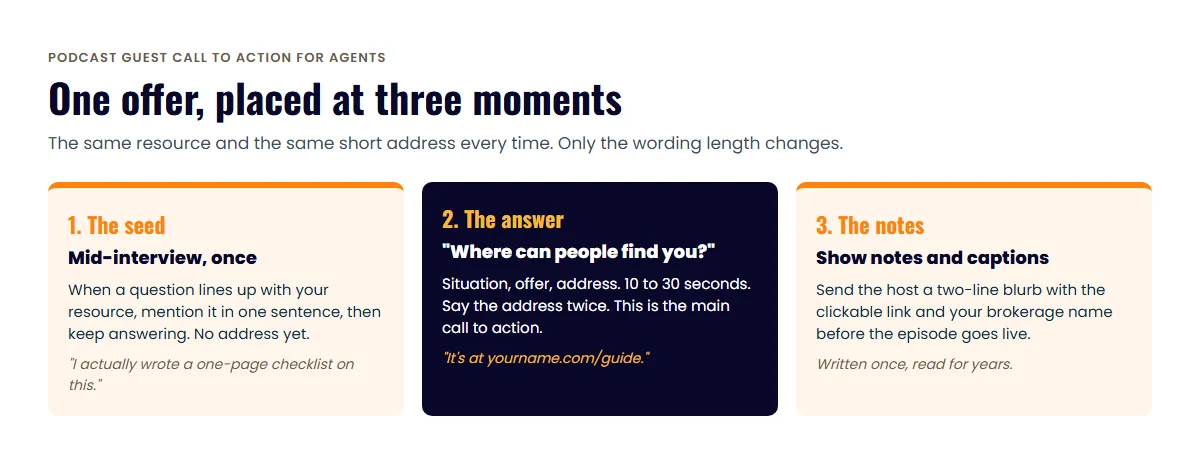
Give the same offer at three moments: once as a passing mention mid-interview, once in full when the host asks where people can find you, and once in writing in the show notes. The offer and the address never change. Only the length does.
The seed (mid-interview)
When the host asks a question your resource answers, mention it in one sentence and keep going. Don’t give the address yet. This plants the idea so the final ask doesn’t feel like it came out of nowhere.
The answer (end of the interview)
Most hosts close with some version of “Where can people find you?” That’s your slot. Use one of the scripts in the next section.
The notes (written)
The show notes stay on the episode page for years. Send the host your blurb before the episode goes live. The template is further down.
What do you say when the host asks “where can people find you?”
Answer with your situation line, your offer and your address, then say the address a second time. Have a 10-second version for hosts who wrap up fast and a 30-second version for hosts who give you room. Pick the offer that fits the show’s listeners. A consumer show, an agent show and an investor show each need a different one, and which guest spots actually produce leads breaks that down.
Notice what’s missing from every script: awards, sales volume and “I’m the best agent in town.” Your interview already did that work. The call to action just opens a door.
What if the host never asks where to find you?
If the host never asks where to find you, raise the plug slot during scheduling, before you record and not on air. Most hosts are happy to give you a plug slot, but some run tight shows and forget. A short note during scheduling settles it.
If the interview ends and the host still didn’t ask, use a wrap-up line when they thank you. Keep it to one sentence and don’t push.
If the host says no plugs, respect it. The show notes, your own promotion of the episode and the host relationship still do most of the work. Our 7-day plan for after the interview covers that part.
How do you make a salesy call to action sound helpful?
Swap the ask from “hire me” to “here’s something useful.” Listeners who aren’t ready to talk to an agent will take a checklist. Those same listeners will ignore a request to book a meeting. The table shows common salesy lines and how to rewrite them.
| Salesy line | Value-first rewrite | Why it works better |
|---|---|---|
| “Call me for a free home valuation.” | “I send a short note each month with what sold near you and for how much. It’s at [address].” | Gives value now. A local report also avoids implying your brokerage services cost nothing. |
| “If you’re looking to buy or sell, I’m your agent.” | “If you’re six months or more from a move, my checklist shows what to do first.” | Speaks to the large group that isn’t ready yet, instead of the few who are. |
| “I’m the number one agent in [town].” | Leave it out. | Rankings sound like an ad, and any claim you make has to be accurate and provable. |
| “Follow me on Instagram, Facebook, YouTube and TikTok.” | “Everything’s at [one address].” | One ask gets done. Four get forgotten. |
| “Give me a call at 555-0100.” | “It’s at [yourname.com/show], and my number is on that page.” | Addresses are easier to remember while driving, and you can track the visits. |
| “DM me ‘READY’ and I’ll get you pre-approved.” | “If you want to know the steps before you talk to a lender, my guide lays them out.” | You don’t pre-approve anyone, and tying yourself to a lender’s offer can raise RESPA questions. |
What should go in the show notes?
Send the host two lines and a link, written so they can paste it without editing. Put your brokerage name in it, because the notes are part of the advertisement. If a show sells guest spots or asks you to pay, the notes are where any disclosure would go too; read the case for and against paid guest spots before you agree.
Use your full tracked link here, not the vanity address, since readers can click. Your podcast guest bio should already be on the host’s desk; this blurb only covers the next step.
How do you keep your call to action compliant?
Treat your call to action as advertising, because it is. Four checks cover the common problems, and your broker’s and state’s rules sit on top of them. Haven’t cleared the appearance itself yet? Use this broker sign-off process for podcast appearances.
- Say your brokerage name. Standard of Practice 12-5 in NAR’s 2026 Code of Ethics requires REALTORS® to make their firm’s name readily apparent in advertising, and a podcast counts. Say it in your answer (“I’m with [Brokerage]”) and put it in the show notes and on your landing page. Many states have their own rules on top of this.
- Be careful with “free.” Standard of Practice 12-1 says REALTORS® must not represent that their brokerage services are free unless they’ll receive no compensation from any source. A free checklist is a free checklist. “My services are free to buyers” is a different claim. Offer the resource, not the service.
- Describe homes and places, not people. Under the Fair Housing Act, the protected classes are race, color, national origin, religion, sex, familial status and disability. “Great area for young families” points to familial status. “Homes within a mile of three parks” says the same thing with facts. Keep a list of Fair Housing swaps for podcast talk open while you write.
- Flag lender tie-ins. When the host is a loan officer or title rep and your offer is co-branded or shares costs, that’s a RESPA question. Get your broker’s answer before you record.
| Risky line | Safer version |
|---|---|
| “My services won’t cost you a thing.” | “My first-home guide is free at [address].” |
| “Perfect neighborhood for young professionals.” | “Homes within a 15-minute walk of the train station.” |
| “Get my guide and [lender name] will waive your fees.” | “Get my guide at [address].” (Cleared co-marketing only, with broker sign-off.) |
| “I’m a top agent in [town].” | “I’m [name] with [Brokerage], and I work mostly in [town].” |
How do you know whether your call to action worked?
Give each show its own address or tracked link and check the visits and sign-ups 30 days after the episode airs. If people visit but don’t sign up, fix the page. If nobody visits, fix the wording or the fit between offer and audience. The lead-tracking step in the guesting playbook shows how to tag each link, and add “Where did you hear about me?” to any form so the CRM records the show.
Next step
Pick one offer you can build this week, set up its short address, and write your 10-second and 30-second versions. Read them out loud until they sound like you. If you’d rather have someone else handle the pitching and scheduling so you can focus on the interview, Icons’ podcast guesting service books agents on shows through the ICONS Hub, and the paid plans include a speaker media kit with a one-sheet.
Frequently asked questions
Should I give my phone number as my podcast call to action?
Not as the main ask. A spoken phone number is hard to remember and impossible to track. Give a short web address on air and put your phone number on the page it leads to and in the show notes.
How long should my call to action be?
Ten to thirty seconds. Have a short version ready for hosts who wrap up fast and a longer one for hosts who give you room, and keep the offer and address identical in both.
Can I use the same call to action on every show?
You can keep the same resource, but change the situation line to fit each audience and give each show its own address. That way the offer fits the listeners and you can tell which episode sent each visitor.
Is it okay to promote a listing in my call to action?
Usually it's a poor fit, because the episode stays online long after the home sells. If you do mention one, you need the seller's permission and your broker's rules apply, so check with your broker first.
Sources
- 2026 Code of Ethics & Standards of Practice — National Association of REALTORS® (accessed October 6, 2026)
- Housing Discrimination Under the Fair Housing Act — U.S. Department of Housing and Urban Development (accessed October 6, 2026)
Podcast guesting for agents
Get booked on real estate podcasts
The ICONS Hub connects agents with real estate podcast hosts looking for expert guests.
Guest On The Network
Written by
Co-Founder and Podcast Guru, Icons of Real Estate
Tomás Fonseca co-founded Icons of Real Estate in 2021 and is its Podcast Guru. He has a background in marketing, with stints at companies like Nintendo and Ardor SEO, and is one of the hosts of the Icons of Real Estate Podcast.

How we research, write, fact-check and correct articles: our editorial standards.