On this page
- How does one podcast interview build a referral network?
- What happens before the 30 minutes start?
- What do the 30 minutes on the recording do?
- What happens to the network after the episode goes live?
- How does a podcast interview compare with a coffee meeting or a cold call?
- What can a year of interviews add up to?
- What does it look like when one interview pays off?
- Why do some interviews never turn into referrals?
- How do you keep the conversations coming every week?
A podcast interview builds a real estate referral network by turning a stranger into someone who owes you a favor and shares content with your name on it. The invite flatters, the 30 minutes create rapport, and the episode gives the guest reasons to share and stay in touch. Repeat weekly and partners pile up.
This page explains the mechanism: what one interview does to a relationship, who it reaches, and what a year of them adds up to. For the playbook (who to invite, scripts, tracking and RESPA), see building a referral network with referral-partner episodes.
How does one podcast interview build a referral network?
One podcast interview builds a referral network by giving you three things a coffee meeting can’t: an easy yes, a recorded conversation, and a shared asset. Each one moves the relationship further than the last.
Think about how most agents meet potential partners. You email a builder or a lender, ask for 20 minutes, and hope they see something in it for them. Usually they don’t. An interview flips that. You’re offering them a stage, so they say yes for their own reasons. Then you spend half an hour asking about their work, which almost nobody else does. Then you hand them a finished episode they’ll want to share.
The ICONS Podcast Framework sums it up as “One 25-minute conversation. Three wins.” You get the relationship and the content, the guest gets a stage and reach, and the audience gets real value. Structure matters more than length.
What happens before the 30 minutes start?
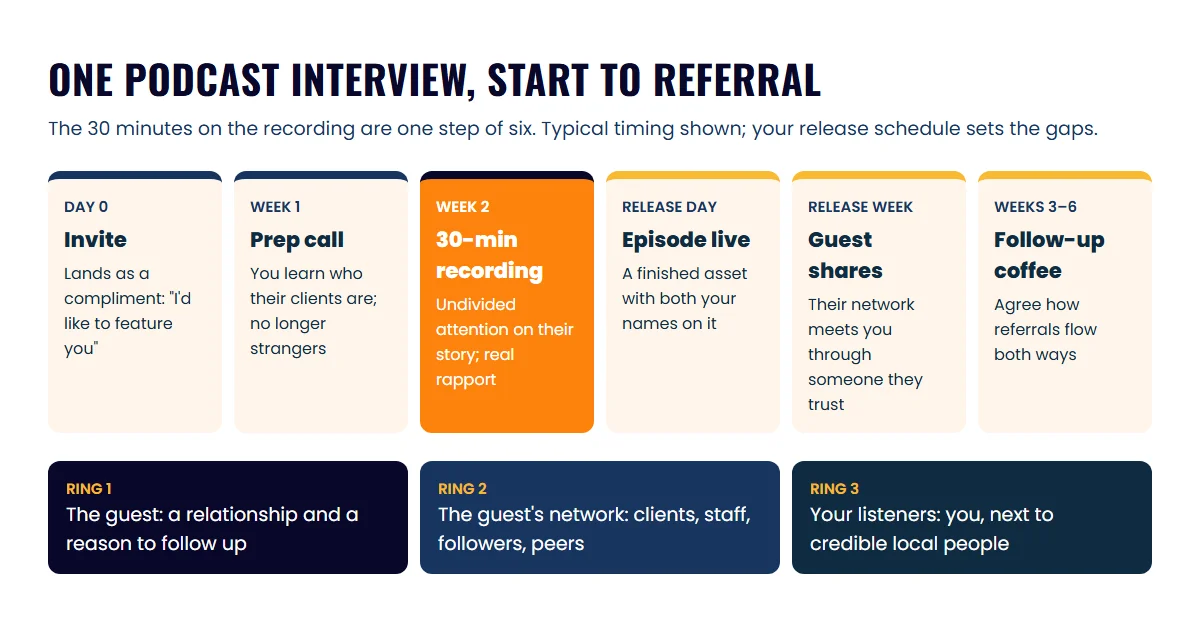
Before the recording starts, the relationship has already begun, because the invitation tells the guest you see them as an expert. Few people turn that down, and fewer forget who asked.
Three things happen in the days before you record:
- The invite lands as a compliment. “I’d like to feature you” opens doors that “can I pick your brain” closes.
- The prep call builds familiarity. A short check-in on topics means you’re no longer strangers when you hit record. How to prepare a podcast guest covers what to ask.
- You learn their business. Researching questions teaches you who their clients are, which tells you how referrals could flow both ways.
None of this feels like networking to the guest. It feels like being taken seriously.
What do the 30 minutes on the recording do?
The 30 minutes on the recording give the guest something rare: a professional’s undivided attention on their story. That focus is what turns a contact into a relationship.
In a normal meeting, both people are half-selling. On a recording, your only job is to make the guest look good. You ask about how they started, what they’ve learned, and what their clients get wrong. They talk, you listen, and they leave feeling understood. Good real estate podcast interview questions keep the guest talking about what they’re proud of.
You also learn more in 30 minutes than in a year of small talk. You hear how they work, who they serve and what they care about. That’s the information you need to send them business, and to know whether you’d trust them with your clients.
What happens to the network after the episode goes live?
After the episode goes live, the interview stops being a private conversation and starts reaching people you’ve never met. It spreads through three rings.
| Ring | Who it reaches | What it does for you |
|---|---|---|
| 1. The guest | The person you interviewed | A relationship, plus a reason to follow up |
| 2. The guest’s network | Their clients, staff, followers and peers | Introduces you through someone they already trust |
| 3. Your listeners | Your sphere and past clients | Shows you next to credible local people |
The second ring is the one most agents underrate. When a lender shares an episode, their followers see you vouched for by someone they already trust. A guest share kit makes that sharing easy, and the easier it is, the more often it happens.
Your own listeners matter too. A past client who hears you talking shop with the best builder in town learns that you’re connected. That memory is what makes them call you, and not the agent their cousin mentioned.
How does a podcast interview compare with a coffee meeting or a cold call?
A podcast interview beats a coffee meeting and a cold call on the two things that build referrals: how easily the other person says yes, and what both sides have afterward. Here’s how the three ways of meeting a potential partner compare.
| Cold call | Coffee meeting | Podcast interview | |
|---|---|---|---|
| Why they say yes | Rarely do | Politeness or curiosity | They get a stage and content |
| What they feel | Pitched | Neutral | Featured |
| What you learn | Little | Some | How they work and who they serve |
| What exists afterward | Nothing | A memory | An episode both of you share |
| Reason to follow up | Another pitch | “Let’s stay in touch” | Release day, clips, a thank-you |
The difference in the bottom row adds up over time. A coffee meeting fades. An episode keeps reminding the guest, and their audience, that you two know each other.
What can a year of interviews add up to?
A year of weekly interviews can add up to several real referral partners, and a five-year run can add up to a network. ICONS put numbers on that in its framework, using clearly stated assumptions.
For a show that releases one episode a week and keeps going, the math works out to:
- about 8 new referral partners a year;
- a network of 40 long-term partners by year five;
- 24 to 60 conversions from that network.
Those figures assume each partner sends just one referral over five years, and that agents convert referred leads at 20% on the low side and 50% on the high side. These are estimates from the free ICONS Podcast Framework, not a promise. Your guest choice and your follow-up decide where you land. To test your own numbers, the podcast ROI calculator works out how many closings a show needs to pay for itself.
Consistency is the condition. Steve Goldstein of Amplifi Media looked at podcasts listed in Apple Podcasts for RAIN News in 2021. In that count, 26% had released a single episode and 44% had stopped at three or fewer. A show that quits early never reaches the point where partners compound. How long a real estate podcast takes to generate business maps the realistic timeline.
What does it look like when one interview pays off?
One interview pays off when the guest turns out to be connected to something bigger than either of you expected. Two ICONS client stories show it.
Neither host could have predicted those outcomes when they sent the invite. That’s the point: you can’t know which guest matters most, so you keep having the conversations.
Why do some interviews never turn into referrals?
Some interviews never turn into referrals because the host treats the episode as the finish line. The recording opens the relationship; the follow-up is what keeps it alive.
Four causes come up again and again:
- No follow-up. No thank-you, no share links on release day, no coffee afterward. Your guest assumes you got what you wanted.
- No shared clients. A guest whose customers never buy or sell homes can be a great episode and a dead end for referrals. Lenders, builders, attorneys, movers and agents in other markets share clients with you.
- Interviewing for the audience only. Big names in other states make good content. Local owners whose customers move make better partners.
- Stopping too soon. Eight partners a year assumes 52 episodes a year.
Fix those four and most interviews will at least give you a warm contact, even when they don’t send a deal.
How do you keep the conversations coming every week?
Keeping a weekly run of interviews going is mostly a booking and production problem, not a talent problem. Hosts who last make recording the only job on their plate.
Book guests a month ahead so a cancellation doesn’t stop the show. Batch two recordings in one afternoon. Hand off editing, publishing and clips so release day doesn’t depend on your calendar. When you want a bigger name on the list, inviting a high-profile guest onto a real estate podcast covers the cold ask.
Prefer to only show up for the conversation? ICONS podcast production books your guests for you. In the service’s words: “We find and book your ideal guests and handle all the scheduling back-and-forth.” The ICONS network behind it spans 120+ agent podcasts.
Frequently asked questions
Do my podcast guests need to be in real estate?
No. Lenders, inspectors, builders, attorneys and local business owners all share clients with you. What matters is that their customers buy, sell or move.
How soon after an interview should I follow up?
Send a thank-you within a day of recording and again when the episode goes live with the share links. Ask for a short coffee or call within a few weeks of release.
Does the guest's audience size matter?
Less than you'd think. A guest with a small but loyal local following can be worth more than a big name in another state, because their contacts can become your clients.
Sources
- 12 CFR 1024.14 Prohibition against kickbacks and unearned fees — Consumer Financial Protection Bureau (accessed October 21, 2026)
- Steve Goldstein: Why there really aren't 2 million podcasts — RAIN News (accessed October 21, 2026)
Done-for-you podcast production
Want a podcast that brings in referrals, not just downloads?
Icons of Real Estate plans, produces and publishes business-growing podcasts for agents. You record. We handle the rest.
Launch Your Podcast
Written by
Co-Founder and Podcast Guru, Icons of Real Estate
Tomás Fonseca co-founded Icons of Real Estate in 2021 and is its Podcast Guru. He has a background in marketing, with stints at companies like Nintendo and Ardor SEO, and is one of the hosts of the Icons of Real Estate Podcast.
How we research, write, fact-check and correct articles: our editorial standards.