On this page
- How saturated is the market for real estate agents?
- Why do most real estate agents look the same to clients?
- What actually makes a real estate agent stand out?
- How do you check whether your market already has a real estate podcast?
- Which podcast angles stand out in a saturated market?
- How long does it take a podcast to set you apart?
- How do you use a podcast to stand out at a listing appointment?
- What if you don’t want to host your own show?
- Next step
To stand out as a real estate agent in a saturated market, stop competing on what every agent offers and become known for one specific conversation in your town. A local podcast does that well. Few agents host one, fewer keep publishing, and every episode adds a local guest who now knows your name.
If your town has an agent on every corner, you already know the problem. Sellers interview three of you, and all three say “local expert,” “full service” and “proven marketing plan.” The client picks on price or gut feel. Standing out means giving them something else to pick on.
How saturated is the market for real estate agents?
The market for real estate agents is crowded by any measure. There are far more licensed agents than homes changing hands each year, so most agents compete for a small share of a fixed number of deals.
The numbers make this concrete. NAR reported 1,438,569 members in June 2026. Existing homes were selling at a seasonally adjusted annual rate of 3.99 million in September 2026, according to NAR’s quick real estate statistics.
Why do most real estate agents look the same to clients?
Most real estate agents look the same because their marketing describes the same services in the same words on the same channels. To a seller, ten “just listed” posts and ten market updates are interchangeable.
Some common reasons:
- Same claims. “Local expert,” “top producer” and “white-glove service” appear on nearly every bio.
- Same content. Monthly market stats that anyone with MLS access can post.
- Same channels. Instagram and Facebook, with the same templates and the same music.
- No proof of thinking. A client can’t hear how you reason through a pricing call before they hire you.
None of this is bad marketing. It’s just marketing that blends in, because everyone does it.
What actually makes a real estate agent stand out?
A real estate agent stands out by passing three tests: specific, seen often and proven. The table shows common moves that fail those tests and a stand-out version of each.
| Common move | Why it blends in | Stand-out version |
|---|---|---|
| “Local market expert” bio | Every agent claims it | Known for one niche or area, with episodes to prove it |
| Monthly market update post | Anyone with MLS access can post it | An interview with a builder or appraiser explaining what the numbers mean locally |
| “Just sold” posts | Shows you’re busy, not why to hire you | A past client explaining, in their own words, how the sale went |
| Door hangers and farming mail | Reaches people, says little | A local show the neighbors’ favorite business owners appeared on |
| Paid social ads | Any competitor can outbid you | Guests who share their episode with their own customers |
The right column has one thing in common: other people are part of it. That’s what makes it hard to copy. The idea of becoming the town’s local host is laid out in the personal branding playbook for agents. The rest of this article is about finding the gap in your market.
How do you check whether your market already has a real estate podcast?
You check whether your market has a real estate podcast by searching the main podcast apps and YouTube for your town’s name, then noting who publishes and when they last did. It takes about ten minutes.
- Search Apple Podcasts and Spotify for “[your town] real estate,” “[your town] podcast” and “[your county] homes.”
- Search YouTube for the same phrases, plus “living in [your town].”
- List every show an agent or brokerage hosts. Note the host, the format and the guest types.
- Check the last publish date. A show that hasn’t published in 60 days is stalled, whatever its episode count.
- Note the angle. Market updates? Agent interviews? Local businesses? Your opening is usually whatever nobody covers.
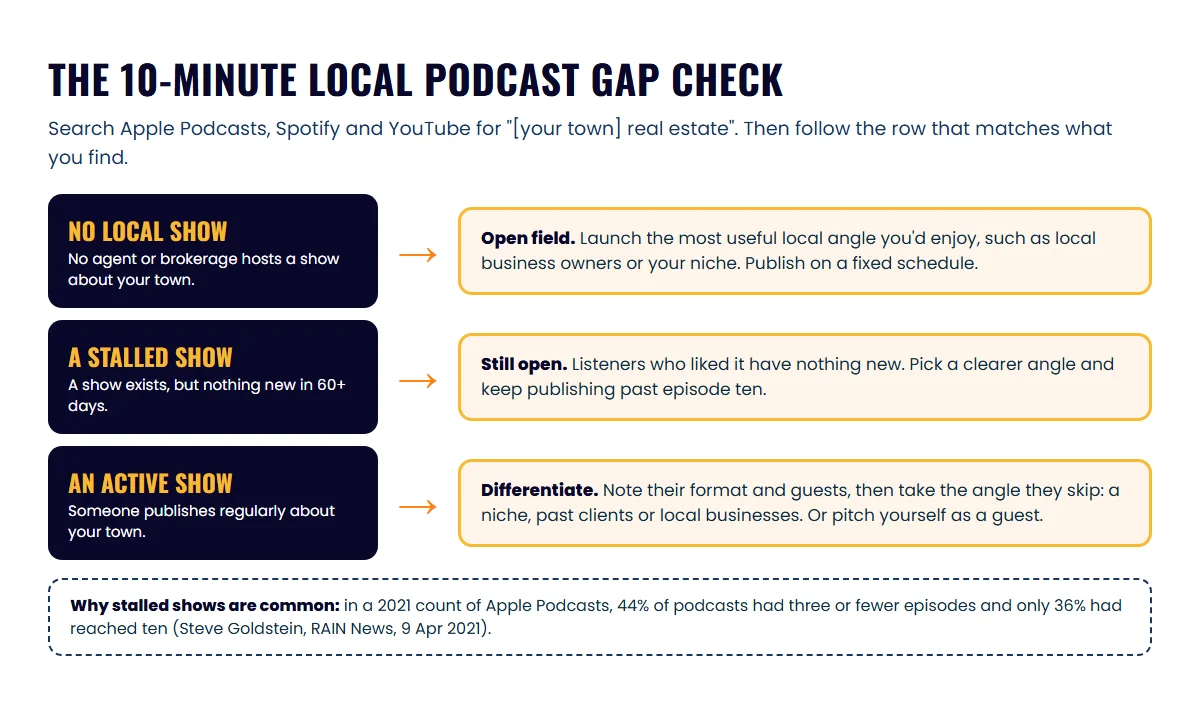
Stalled shows are common. In Steve Goldstein’s 2021 count of Apple Podcasts for RAIN News, 44% of all podcasts had three or fewer episodes, and only 36% had reached ten. Many local real estate shows you find will have stopped.
Which podcast angles stand out in a saturated market?
The podcast angles that stand out are the ones built around other local people or one specific niche. Market-update shows hosted by an agent talking alone are the most common format, so they’re the hardest place to stand out.
| Angle | How crowded it usually is | Why it works or doesn’t |
|---|---|---|
| Solo market updates | Crowded | Easy to copy, no guest to share it |
| Agent-to-agent interviews | Moderate | Good for referrals, less interesting to local buyers |
| Local business owner interviews | Open in most towns | Guests share with their customers, and you meet the town |
| Niche show (downsizers, probate, investors, relocation) | Open | Clear audience, easy to be first |
| Past client stories | Open | Proof in clients’ own words, with their permission |
For concepts by niche, see real estate podcast concepts by niche. For the most common open angle, read how to interview local business owners on your real estate podcast. Client stories need care and consent, covered in past client interview episodes.
One rule applies to every angle: talk about homes, businesses and places, never about who lives where. Fair Housing rules apply to your show the same way they apply to a listing description, so check your broker’s advertising policy.
How long does it take a podcast to set you apart?
A podcast sets you apart within a few months locally, because most competitors either don’t host one or stop. Real business results usually take longer, often six months to a year of steady episodes.
The first signs are people mentioning an episode at a listing appointment or a guest sending someone your way. The timeline for a podcast to generate business breaks down what to expect. What matters most is not stopping. A show that keeps going for a year is uncommon in most markets, and that alone sets you apart. The case for treating that show as part of your long-term business is in how top-producing agents build a business beyond the grind.
How do you use a podcast to stand out at a listing appointment?
Use your podcast at a listing appointment as proof you’re already part of the town, not as a pitch. Sellers who interview three agents remember the one who showed them something different.
A few ways agents put the show to work:
- Send an episode before the meeting. Pick one that fits the seller, such as a talk with a local builder for a seller weighing repairs. Your seller hears how you think before you arrive.
- Name your guests. “I had the owner of the hardware store on last month” says more about your local network than “I know the area.”
- Offer a feature. Some agents invite a seller’s favorite local business onto the show. Keep it to the business and never promise anything in return for a listing.
- Leave a one-page episode list. Titles and guest names show consistency at a glance.
None of this replaces your pricing and marketing plan. It gives the seller one more reason, besides price, to choose you.
What if you don’t want to host your own show?
If you don’t want to host, guest on other people’s shows first. A guest spot costs you an hour, borrows someone else’s audience and gives you recorded proof to share.
Start with podcast guesting for real estate agents. Guesting is also a good way to test whether you enjoy the format before you commit to a show. Either way, hosting or guesting builds the kind of brand rivals can’t buy, which is covered in building a defensible personal brand with a podcast.
Next step
Run the ten-minute check for your town today and write down the angle nobody covers. If it’s an angle you’d enjoy talking about twice a month, that’s your show. If you want to record and leave the editing and publishing to someone else, see how podcast production for real estate agents works.
Frequently asked questions
Is it too late to start a real estate podcast in my city?
Usually not. Even where a show exists, check when it last published and what it covers. A stalled show or a show with a different audience leaves room for yours.
Should I copy the format of a successful podcast in my market?
No. Pick an angle that show doesn't cover, such as a niche or a guest type. Two shows with the same format split one audience; two with different angles can both grow.
Does a podcast work for agents who are new to a market?
Yes. Interviewing established local people gives you introductions and credibility you haven't had time to earn through closings.
Sources
- Experienced Realtors Anchor the Industry as Housing Affordability Remains Top Hurdle — National Association of REALTORS® (accessed October 21, 2026)
- Quick Real Estate Statistics — National Association of REALTORS® (accessed October 21, 2026)
- Steve Goldstein: Why there really aren't 2 million podcasts — RAIN News (accessed October 21, 2026)
Done-for-you podcast production
Want a podcast that brings in referrals, not just downloads?
Icons of Real Estate plans, produces and publishes business-growing podcasts for agents. You record. We handle the rest.
Launch Your Podcast
Written by
Co-Founder and Podcast Guru, Icons of Real Estate
Tomás Fonseca co-founded Icons of Real Estate in 2021 and is its Podcast Guru. He has a background in marketing, with stints at companies like Nintendo and Ardor SEO, and is one of the hosts of the Icons of Real Estate Podcast.

How we research, write, fact-check and correct articles: our editorial standards.