On this page
- Which AI images are safe to use in real estate marketing?
- What do NAR’s rules say about edited listing photos?
- Why must an AI-edited listing photo never stand in for the real property?
- How do you label an AI image?
- Where do AI images help a real estate podcast or brand?
- What should your AI image policy say?
- Next step
AI images can be used in real estate marketing on two conditions: label them as AI, and never present an AI-generated or AI-edited image as the actual property. A listing photo with a swapped sky, added furniture or removed defects needs a disclosure. Not legal advice: check your MLS, broker and state rules.
Most pages on this topic are tool round-ups. What an agent needs is a rule for each kind of image, the words to put under it and a policy a broker can sign. Those are below. Visual consistency is part of the content-first personal branding playbook; honesty about what’s real is part of the brand too.
Which AI images are safe to use in real estate marketing?
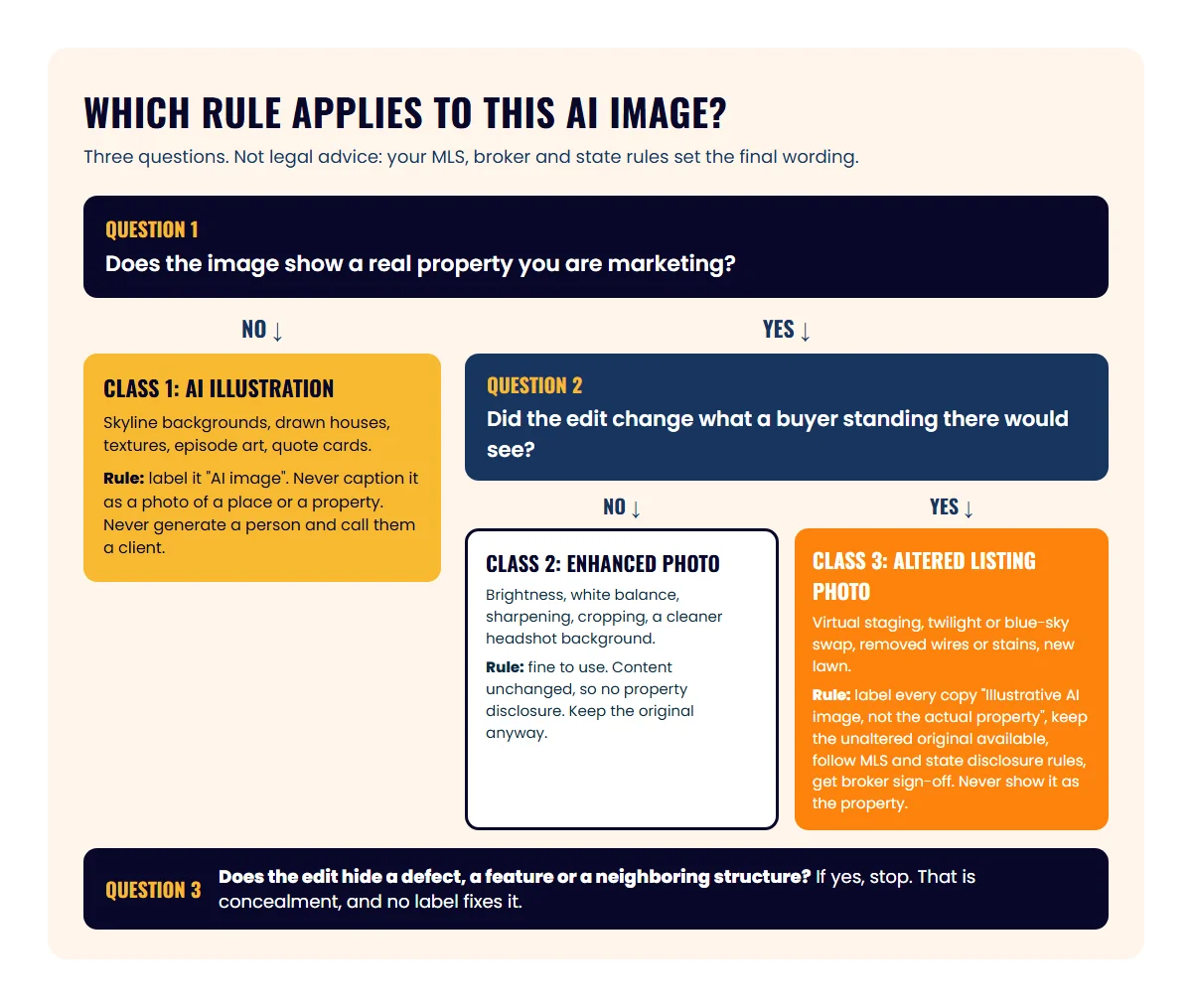
AI images fall into three classes for a real estate marketer: illustrations of nothing real, real photos that AI has enhanced, and real listing photos that AI has altered. The rule gets stricter as you move down the list.
Here’s the sorting table, with the rule for each class:
| Class | Examples | OK to use? | What to do |
|---|---|---|---|
| AI illustration | A skyline background for episode art, a drawn house on a quote card, an abstract texture | Yes | Label it as an AI image; never caption it as a photo of a place or a property |
| Enhanced real photo | A sharpened or brightened headshot, a guest photo with the background removed, a corrected white balance | Yes, with care | Keep the content unchanged; no new features, no new face; no property disclosure needed |
| Altered listing photo | Virtual staging, a twilight or blue-sky swap, removed wires or stains, a changed lawn | Only with disclosure, and never as the actual property | Label every copy, keep the unaltered original available, follow MLS and state rules, get broker sign-off |
The third class is where agents get into trouble, and it’s where the rules below apply in full.
What do NAR’s rules say about edited listing photos?
NAR’s Code of Ethics doesn’t mention AI by name, but Article 12 and its Standards of Practice already cover the problem. Article 12 of the 2026 Code of Ethics requires REALTORS® to “present a true picture” in advertising, marketing and other representations, and Standard of Practice 12-10 lists “use of misleading images” among the ways a REALTOR® can mislead consumers. Standard 12-8 extends the true-picture duty to your website.
NAR’s own staging guidance is more direct. Its June 2025 article on virtual staging says: “make sure listing photos that have been virtually staged are clearly labeled as such,” and recommends staging tools that provide disclaimers for MLS compliance.
State law is catching up. A February 2026 REALTOR® Magazine piece on picture-perfect listing photos reports that a California law in force since January 1 requires disclosures on listings with digitally altered images, plus access to the original unaltered photos, and that Wisconsin has similar requirements coming in 2027. The same article points to Article 2, which asks REALTORS® to “refrain from exaggerating, misrepresenting or concealing pertinent facts.”
Your MLS almost certainly has its own photo rules on top of these. Read them, and ask your broker which disclosure format the office uses. Treat this page as a list of questions for them, not as legal advice.
Why must an AI-edited listing photo never stand in for the real property?
An AI-edited listing photo must never stand in for the real property because a buyer relies on listing photos to decide whether to visit, what to offer and what they’re getting. An image that shows a furnished room that’s empty, a green lawn that’s brown or a clean ceiling that leaks is a representation about the property, and if it’s wrong, it’s a misrepresentation.
The edit doesn’t need to be dramatic. A twilight sky sells a mood; removed power lines sell a view that doesn’t exist. Both are the kind of change buyers notice when they pull up and the photo doesn’t match. Each one is also an invitation to the complaint, or the claim, that Article 12 is written to prevent.
A quick test for any edit: would a buyer standing in that spot see what the image shows? If yes, you’ve corrected a photo. If no, you’ve altered it, and it needs a label and an original beside it.
Three habits keep you on the right side of the line:
- The unaltered photo is always available. In the MLS, in the listing’s photo set, and on request. Some states now require this; it’s good practice everywhere.
- The label travels with the image. A disclaimer in the MLS remarks doesn’t help on an Instagram post or a podcast thumbnail. Every copy carries the label.
- Nothing hidden. Don’t use AI to remove a crack, a stain, a neighboring building or anything a buyer would want to know about. That’s concealment, not styling.
How do you label an AI image?
You label an AI image with a short, visible line that says what the image is, placed on or directly beside every copy of it. “Illustrative AI image, not the actual property” is the wording to use for anything that could be mistaken for a photo of a property; “AI image” is enough for an obvious illustration.
The label goes in four places, depending on where the image appears:
Two more rules make the label worth having. Don’t bury it in a hashtag or a hover state, and don’t rely on a platform’s automatic AI tag, which can be missed or stripped when the file is re-saved. Write it yourself, every time.
Some editors help with the second rule. In ICONS Design Studio, Icons’ own design editor for podcast graphics, a PNG or JPG export that contains an AI picture carries an embedded “made with AI” tag, and the editor offers the caption “Illustrative AI image, not the actual property” to place on the design. AI edits keep the original picture, so the unaltered version is always there. Two limits apply: the embedded tag is in PNG and JPG exports, not in PDF, GIF or MP4, and an embedded tag is not a visible label. Add the caption anyway.
Where do AI images help a real estate podcast or brand?
AI images help most where there’s no property to misrepresent: episode art, quote cards, carousel backgrounds and video thumbnails for a podcast or personal brand. A labeled AI skyline behind an episode title puts nobody at risk; the same skyline pasted behind a listing does.
Good uses for an agent’s content:
- Episode art and thumbnails. A themed illustration for a “first-time buyer” or “market update” episode, labeled as AI, instead of a stock photo. The podcast cover art size guide covers the files you’ll need.
- Quote cards and carousels. Textured or abstract backgrounds behind a guest’s words. Keep the quote exact; a made-up quote is a bigger problem than any image.
- Guest photo clean-up. Removing a busy background from a real headshot or sharpening a small photo. The person stays the same.
- Audiogram and clip backgrounds. Illustrations behind captions and waveforms. The clip workflow for realtors shows where those graphics fit.
Uses to refuse, even with a label:
- A generated “client” or “happy family” used as a testimonial or a before-and-after
- A generated neighborhood scene captioned as your market
- Any generated or altered image of a property you’re marketing, presented as the property
- Anything that describes who lives in an area rather than what the area is like; the Fair Housing checklist for podcasts applies to images as much as to words.
If your production team makes your thumbnails and carousels, tell them which rule applies to each image. Icons of Real Estate’s production team delivers reels, carousels and thumbnails from every episode, and the episode’s own guest and property photos stay exactly as supplied.
What should your AI image policy say?
Your AI image policy should fit on one page and answer five questions: which images need a label, what the label says, where the originals live, who approves property images, and what’s never allowed. Write it once, get your broker to sign it, and hand it to anyone who makes graphics for you.
- Every AI-generated image carries an “AI image” label on or beside it, on every platform
- Any AI-altered image of a property carries “Illustrative AI image, not the actual property” and the MLS disclosure wording
- The unaltered original of every edited listing photo is kept and available to buyers
- No AI edit removes, hides or disguises a defect, a feature or a neighboring structure
- No AI-generated people are used as clients, guests or testimonials
- The broker reviews every altered property image before it’s published anywhere
- MLS photo rules and state disclosure laws are checked at least once a year
- Quotes on quote cards match the recording word for word
- The policy applies to freelancers and production partners, not just the agent
The same discipline runs through the rest of your advertising. The real estate podcast compliance map lists the other rules an agent touches, and the listing-mention rules for podcasts cover what the seller must agree to before a property appears in your content at all.
Next step
Open the last ten graphics you posted and sort each one into the three classes above. Label the ones that need it, pull any altered property image that’s standing in for the real thing, and send the policy checklist to your broker this week. Your MLS, your broker and your state rules decide the final wording; this page is a starting point, not legal advice.
Frequently asked questions
Do I have to label an AI-generated background on a podcast graphic?
Label it. A skyline or interior that never existed isn't a property photo, so the risk is low, but a short 'AI image' note costs nothing and keeps your habit consistent for the images where it matters.
Is a twilight edit of a listing photo allowed?
Treat it as an altered image: label it, keep the original available to buyers, and check your MLS and state rules. The edit must not hide a defect or add anything that isn't there. Your broker makes the final call.
Can I sharpen or brighten a real headshot with AI?
Enhancing a real photo of a real person, without changing what they look like, is generally fine and needs no property disclosure. Generating a new face or a fake 'client' is not fine, and never use one as a testimonial.
Does an automatic platform AI label count as disclosure?
Don't rely on it. Some platforms add their own tags, but they can be missed or stripped. Write your own label in the caption, the remarks or on the image itself.
Sources
- 2026 Code of Ethics & Standards of Practice — National Association of REALTORS® (accessed October 9, 2026)
- Rethinking Virtual Staging for Today's Real Estate Agents — National Association of REALTORS® (accessed October 9, 2026)
- Are You 'Catfishing' Buyers With Picture-Perfect Real Estate Photos? — REALTOR® Magazine (accessed October 9, 2026)
Done-for-you podcast production
Want a podcast that brings in referrals, not just downloads?
Icons of Real Estate plans, produces and publishes business-growing podcasts for agents. You record. We handle the rest.
Launch Your Podcast
Written by
Co-Founder and Podcast Guru, Icons of Real Estate
Tomás Fonseca co-founded Icons of Real Estate in 2021 and is its Podcast Guru. He has a background in marketing, with stints at companies like Nintendo and Ardor SEO, and is one of the hosts of the Icons of Real Estate Podcast.
How we research, write, fact-check and correct articles: our editorial standards.