On this page
- What does the grind look like for a top-producing agent?
- What separates a top producer from a business owner?
- What are the four layers of a real estate business beyond the grind?
- Where does a podcast fit in a top producer’s business?
- How much time does a podcast take a busy agent?
- Is a podcast worth it for a top-producing agent?
- A 90-day plan to start building beyond the grind
- Next step
Top-producing agents build a business beyond the grind by moving their income off their own hours. That takes four layers: a written system, delegated admin work, a network of referral relationships and media they own. A podcast fits the last two. Each episode adds a relationship and a piece of content, for about an hour a week.
Most agents who reach top-producer status got there by being the hardest-working person in their market. That is also the trap. The book of business is real, but it lives in your phone, your memory and your calendar. Take three weeks off and the pipeline notices.
What does the grind look like for a top-producing agent?
The grind is a business where every closing traces back to something you personally did that month: a call, a showing, a coffee, a follow-up. Your income tracks your hours, and the hours don’t scale.
Most of your business already comes from relationships, which helps. In NAR’s 2026 Member Profile, the typical REALTOR earned 28% of their 2025 business from repeat clients and another 22% from referrals by past clients. For a top producer with years of closings, that share is usually higher.
The problem is how those relationships are maintained. For most busy agents it’s memory, birthday texts and the occasional pop-by. That works until you get busy, which is exactly when it matters.
Experience pays off over time, too. NAR found REALTORS with 16 or more years in the business earned a median of $88,500 in 2025, against $59,200 for all members (2026 Member Profile). The question is whether those years build an asset or just a longer list of contacts only you can work.
What separates a top producer from a business owner?
A top producer is paid for effort; a business owner is paid for assets that keep working. The table compares the two on the questions that matter to a solo agent.
| Question | Top producer (the grind) | Business owner |
|---|---|---|
| Where do new clients come from? | Whoever you called, texted or met this month | Referral partners, past clients and an audience that finds you |
| What happens if you take three weeks off? | The pipeline dries up a month later | Episodes, partners and follow-up keep running |
| What do you own? | A license, a database and a reputation in people’s heads | Systems, relationships and a library of content with your name on it |
| How do you grow? | Work more hours | Add partners and audience without adding hours |
| Who knows how you think? | Only clients who worked with you | Anyone who has heard you talk |
You don’t have to pick one column forever. Most agents move from left to right one layer at a time.
What are the four layers of a real estate business beyond the grind?
A real estate business beyond the grind has four layers: systems, delegation, relationships and owned media. The first two protect your time. The second two create new demand without more prospecting.
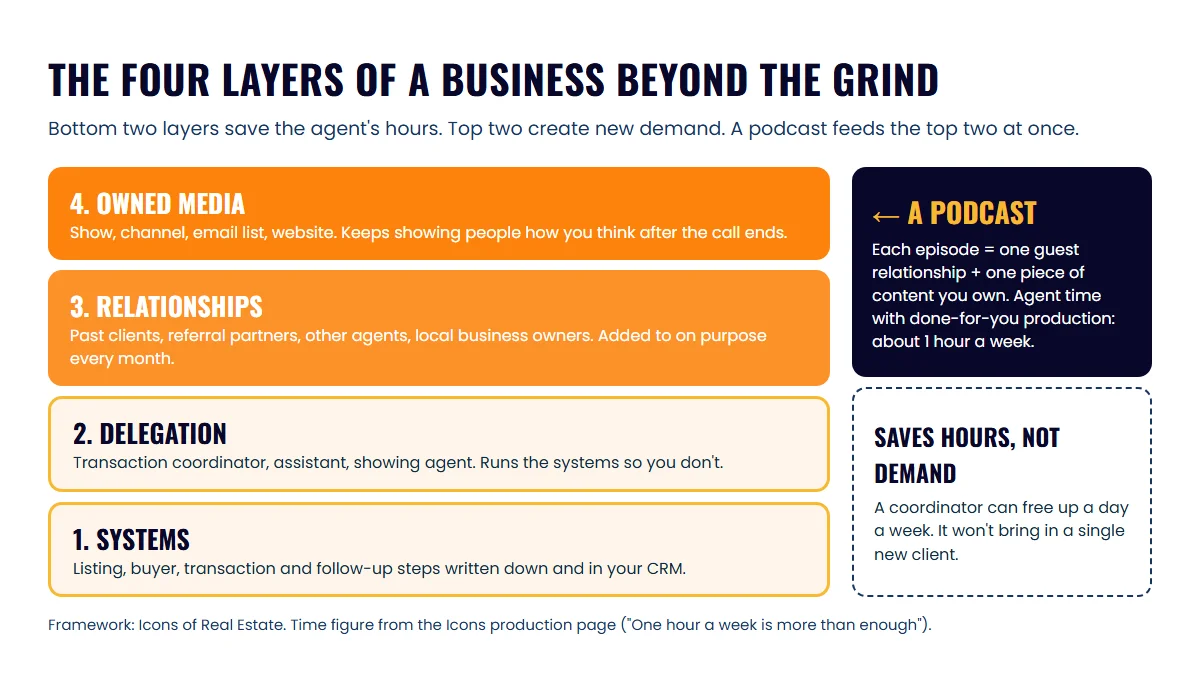
- Systems. Your process written down: listing checklist, buyer onboarding, transaction timeline, follow-up schedule in a CRM. If it only exists in your head, it isn’t a system yet.
- Delegation. People who run the systems: a transaction coordinator, an assistant, a showing agent. This is where most “build your business” advice stops, usually with “hire a team.”
- Relationships. A deliberate network of people who send you business: past clients, other agents, lenders, attorneys, builders, local business owners. Deliberate means you add to it every month, rather than waiting for the phone to ring.
- Owned media. Content and an audience that belong to you: a show, a channel, an email list, a website. It keeps showing people how you think after the conversation ends.
Systems and delegation are essential, and they have a ceiling. A transaction coordinator saves you ten hours a week. They don’t bring you a single new client. Growth beyond the grind comes from layers three and four.
Where does a podcast fit in a top producer’s business?
A podcast fits in the relationship and owned-media layers at the same time. Every interview is a reason to spend 30 to 45 minutes with someone who can send you business, and the recording becomes content you keep.
That’s the core of how Icons thinks about podcasting: the conversation is the asset and the content is the byproduct. For a top producer, the relationship side usually matters more.
- New partners on purpose. You can invite the estate attorney, the builder, the relocation lead at a big employer or a top agent in a feeder market. Few people say no to being featured. Planning those referral-partner episodes is a skill of its own, and agent-to-agent referral episodes cover the out-of-area side.
- A reason to stay in touch. Sending a past client a new episode is easier than a “just checking in” text, and it says something.
- Content you keep. Each episode becomes clips, posts and a page on your site. If you own the show, the back catalog stays yours.
Icons’ production page is clear that the client keeps the show itself, its feed, its listeners and every past episode. That matters for a business owner. An asset you don’t own isn’t an asset. The sibling guide on building a defensible personal brand with a podcast goes deeper on what to own and why.
How much time does a podcast take a busy agent?
A podcast takes a busy agent about one hour a week when production is done for them. The agent records the conversation; producers handle booking, editing, publishing and clips.
That’s how Icons describes its own production service: the agent shows up to record, and the team does everything after that. The same page puts the client’s weekly time at about an hour. Doing it yourself is a different job. Editing, publishing and cutting clips can take several hours per episode, which is how many agent shows die by episode ten.
If you’re already working 60-hour weeks, the honest comparison is your hourly value against the production cost. Work through the numbers in how much time a podcast takes per week, then decide whether to hire a podcast producer or do it yourself.
Is a podcast worth it for a top-producing agent?
A podcast is worth it for a top-producing agent when the relationships it creates are likely to produce at least one or two extra transactions a year. For most agents with a solid average commission, that is a low bar.
The risk is real too. A podcast won’t fix a weak follow-up system, and it pays back slowly. Expect months, not weeks, before the first deal you can trace to an episode. The podcast ROI calculator guide explains which inputs to be conservative on.
A 90-day plan to start building beyond the grind
Start with one layer at a time, and leave the podcast until your systems can handle more business. Here is a realistic order for a solo agent.
- Weeks 1–2: write down your process. Listing, buyer, transaction and follow-up steps. Put the follow-up schedule in your CRM.
- Weeks 3–4: hand off one job. Usually transaction coordination. Measure the hours you get back.
- Weeks 5–6: map your relationships. List your top 20 referral sources from the last two years and the 20 people you wish were on that list.
- Weeks 7–8: choose your show. Pick a format that serves the second list, such as local business owners, partners or past clients. Check the personal branding playbook for positioning.
- Weeks 9–12: record your first episodes. Book four guests from your wish list. Send each one their episode and clips when it goes live.
If your market is crowded with agents doing the same thing, read how to stand out in a saturated market with a podcast before you settle on a show angle.
Next step
Write down the 20 people you wish sent you business. If at least five of them would say yes to a 30-minute interview, a podcast is a practical way to build the relationship layer of your business. If you’d rather only show up and record, see how done-for-you podcast production works.
Frequently asked questions
Do I need to build a team to get beyond the grind?
No. A team is one way to delegate, and it brings management work with it. Many solo agents get most of the benefit from a transaction coordinator, a documented process and a steady source of referrals.
Can a podcast replace my referral business?
No, and it shouldn't try. A podcast feeds your referral business by adding new relationships and giving past clients something to share. The referrals still come from people who trust you.
What if I stop the podcast after a year?
You keep what you built: the guest relationships and the back catalog. If you own the show and its feed, the episodes keep working in search and in your follow-up after you stop recording.
Sources
- The Feature Sheet: 2026 Member Profile — National Association of REALTORS® (accessed October 21, 2026)
- Experienced Realtors Anchor the Industry as Housing Affordability Remains Top Hurdle — National Association of REALTORS® (accessed October 21, 2026)
Done-for-you podcast production
Want a podcast that brings in referrals, not just downloads?
Icons of Real Estate plans, produces and publishes business-growing podcasts for agents. You record. We handle the rest.
Launch Your Podcast
Written by
Co-Founder and Podcast Guru, Icons of Real Estate
Tomás Fonseca co-founded Icons of Real Estate in 2021 and is its Podcast Guru. He has a background in marketing, with stints at companies like Nintendo and Ardor SEO, and is one of the hosts of the Icons of Real Estate Podcast.

How we research, write, fact-check and correct articles: our editorial standards.