
On this page
Agents are leaving Keller Williams, but it’s still the biggest U.S. real estate franchise. KW’s own releases show about 159,000 agents worldwide in December 2025, down from 194,453 in September 2022. Agents we’ve interviewed who left named a ceiling on their growth, slow tech or a poor fit with the franchise model, not the training.
Keller Williams doesn’t publish a reason for the drop, and nobody publishes a reliable survey of why individual agents leave. So this guide sticks to three things you can check: KW’s own numbers, how its money model works in its own words, and what agents who left told us on the record.
How many agents have left Keller Williams?
Keller Williams had about 35,000 fewer agents worldwide at the end of 2025 than in September 2022, a drop of about 18%. These are net figures: new agents joining are offset against agents leaving.
The counts come from KW itself. Its YTD ‘22 results reported 194,453 agents worldwide as of 30 September 2022, with 177,377 of them in the U.S. and Canada. The About section of its March 2025 release said 165,000 affiliated agents. By its December 2025 release the figure was 159,000.
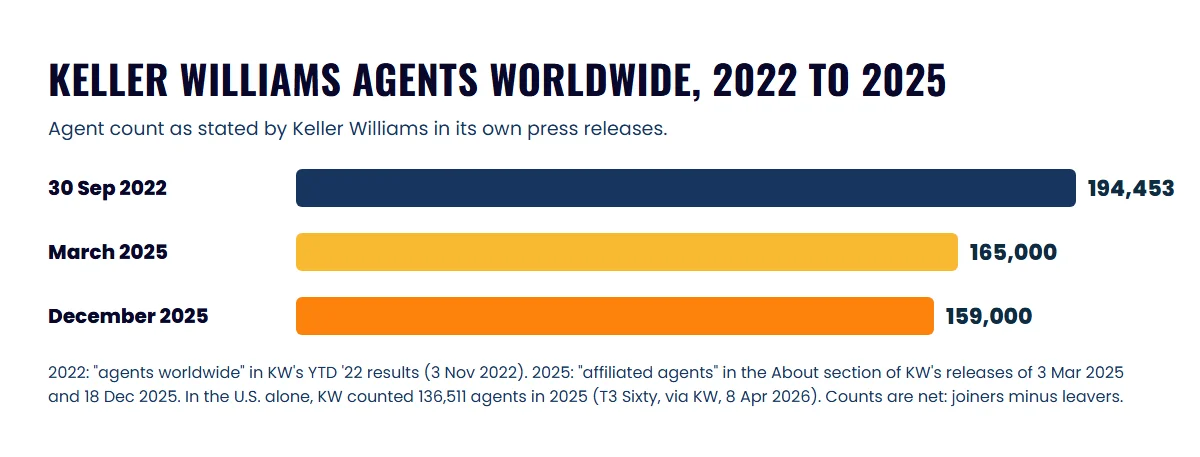
Two cautions. The 2025 figures are rounded company boilerplate, not audited counts. And the growth is now outside North America: the same December 2025 release says KW had more than 17,600 international agents and expanded into eight new international regions that year.
KW is still large in its home market. In April 2026 it reported 136,511 U.S. agents for 2025, $370.7 billion in U.S. sales volume and 796,658 transaction sides. It said T3 Sixty ranked it the No. 1 U.S. real estate franchise by all three measures for the ninth straight year.
What changed at Keller Williams in 2025 and 2026?
Keller Williams took outside investment and changed its CEO in 2025, then added new leaders for agent recruiting in 2026. Agents deciding whether to stay should know about both.
On 3 March 2025, KW announced an investment from funds managed by Stone Point Capital. It didn’t disclose the size of the stake or the terms. In the same release Christopher Czarnecki joined as CEO and president, and the release named Gary Keller as co-founder and executive chairman. Keller said the company would explore new ways for top agents and franchisees to share in its future success. The release didn’t say how.
On 23 July 2026, KW announced four leadership roles, including co-heads of U.S. growth and attraction and a head of digital and social for growth and attraction. The job titles make recruiting and keeping agents a stated priority.
How does the Keller Williams split, cap and profit share work?
At Keller Williams your commission is split between you and your market center until you reach your cap. KW doesn’t publish one national split or cap on its own sites, so ask your market center for its terms. Blog posts that quote a single KW split can’t be checked.
KW describes the model on its profit share page. When deals close, agents “who haven’t yet met their cap pay company dollar to their Market Center.” The market center uses that money to run the office. Part of what’s left over as profit is shared with agents who brought other productive agents into the company, across seven levels.
That last point is why profit share comes up so often when agents compare KW with eXp. KW’s program shares the office’s profit after expenses. At eXp, as the former KW agent quoted below puts it, “the money is split first” and the company runs on what’s left. An agent’s profit share at KW therefore depends partly on how well their market center controls its costs, which is outside their own control.
Before you compare offers, get your market center’s split, cap, monthly fees and profit share vesting rules in writing. Compare them with a brokerage whose terms are public. eXp’s U.S. policies dated 15 September 2025, for example, set an 80/20 split until you pay $16,000 a year, plus monthly and per-deal fees. Our guide to eXp’s split, cap and fees walks through it.
Why do agents say they leave Keller Williams?
Agents we’ve interviewed who left KW named three reasons: a ceiling on their own growth, an office slow to adopt new tools, and a poor fit with the franchise model. Both also gave KW credit for what it taught them. These are individual stories, not a survey.
A ceiling on growth. Joanne Bolt spent 17 years at Keller Williams before moving her team to eXp. She told us on Episode 3 of the Icons of Real Estate podcast that she “had really hit what I felt was a glass ceiling.” She was offered a team leader role she didn’t want, while she wanted to coach and start a podcast. “Everywhere I looked to expand my business in a different direction I kept hitting a roadblock,” she said.
Technology. When COVID hit, her team was already working on Zoom and Slack and was teaching its KW office how to use them. “I don’t want to be at a broker that has to pivot to catch up,” she said. “I’d rather be somewhere that’s already ahead of the game.”
Profit share. Bolt also compared her KW profit share with her eXp revenue share. With about the same number of agents in each downline, she said her monthly KW profit share was “about a fourth” of her eXp revenue share. That’s one agent’s experience, and it depends on her office and her downline.
The franchise model. Shane Mast spent about seven years at Keller Williams Eugene and two and a half at Keller Williams Roseburg in Oregon before starting his own brokerage. On our episode with him he called KW a “great training company” and said he was glad he started there. But for the way he wanted to run his business, “it wasn’t a good fit at being part of a franchise.” He wanted agents to keep more of their money, so his brokerage uses low splits and low caps.
Notice what neither agent blamed: the training. That matches the question many new agents ask, whether KW is good for beginners. For a lot of agents it’s where they learned the business. The reasons to leave tend to come later, once an agent has a team, a downline or a plan KW’s structure doesn’t fit.
Should you leave Keller Williams? Questions to ask first
Leave Keller Williams only if another offer is clearly better on your own numbers, not because of a headline split or a recruiter’s pitch. Price every offer the same way, then talk to your market center before you sign anything.
- Your real cost last year: company dollar paid, cap, monthly fees and any team splits, from your own statements
- Profit share: what you received in the last 12 months, and the written vesting rules if you leave
- The other offer in writing: split, cap, post-cap fees and monthly fees, priced on your last 12 months
- Pending deals and listings: what moves with you and what stays with the market center
- Your agreement: notice period and any fees owed when you leave
- What you’d lose: coaching, leads, tools and the people around you, and what each is worth to you
Agents leaving other brands ask the same questions. See why agents are leaving REMAX and why agents are leaving eXp. If you close only a few deals a year, the best brokerage for part-time agents guide covers fixed fees.
What moves with you when you leave?
Your personal brand moves with you when you leave Keller Williams; the KW brand, and usually your listings, stay with the market center. The more clients know you by name, the less you have to rebuild.
Our guide to your personal brand vs. brokerage brand covers how to keep the two apart before you move. For the full plan, start with personal branding for real estate agents. Being heard on other agents’ podcasts is one low-effort way to stay known by name through a switch, and podcast guest booking for agents handles the outreach for you.
Frequently asked questions
Is Keller Williams still the biggest real estate company?
By U.S. agent count among franchise brands, yes. KW reported 136,511 U.S. agents in 2025 and said T3 Sixty ranked it the No. 1 U.S. real estate franchise by agents, transaction sides and sales volume for the ninth year running.
Who owns Keller Williams now?
Gary Keller, its co-founder and executive chairman, and funds managed by Stone Point Capital, which invested in March 2025 for an undisclosed stake. Christopher Czarnecki became CEO and president at the same time.
Is Keller Williams good for new agents?
Both former KW agents we quote in this article credit its training. Whether it suits you depends on your market center: its split, cap, fees and coaching vary by office, so compare the written terms with other offers.
Do you keep Keller Williams profit share after you leave?
KW's own profit share page doesn't spell out what happens when you leave. It describes the program and says the business takes care of its people after they stop producing. Ask your market center for the written vesting rules before you decide.
Sources
- Keller Williams Reports YTD '22 Results, 3 November 2022 — Keller Williams (accessed November 17, 2026)
- Keller Williams Announces Strategic Partnership to Accelerate Growth, 3 March 2025 — Keller Williams (accessed November 17, 2026)
- Keller Williams Expands to Bulgaria Marking a Historic Year of International Growth, 18 December 2025 — Keller Williams (accessed November 17, 2026)
- Keller Williams Ranked No. 1 Real Estate Franchise in America Again, 8 April 2026 — Keller Williams (accessed November 17, 2026)
- KW Announces Key Leadership Appointments to Accelerate Growth, 23 July 2026 — Keller Williams (accessed November 17, 2026)
- Profit Share — KW Thrive (Keller Williams) (accessed November 17, 2026)
- Empowering Women Through Different Opportunities in Real Estate with Joanne Bolt, Episode 3 — Icons of Real Estate (YouTube) (accessed November 17, 2026)
- Shane Mast: Why 'Just Enough' Isn't Enough for Success in Real Estate, EP1 — Icons of Real Estate (YouTube) (accessed November 17, 2026)
- eXp Realty (USA) Policies and Procedures, version 09.15.2025 (Exhibit 10.14 to the 2025 Form 10-K) — U.S. Securities and Exchange Commission (accessed November 17, 2026)
Done-for-you podcast production
Want a podcast that brings in referrals, not just downloads?
Icons of Real Estate plans, produces and publishes business-growing podcasts for agents. You record. We handle the rest.
Launch Your Podcast
Written by
Co-Founder and Podcast Guru, Icons of Real Estate
Tomás Fonseca co-founded Icons of Real Estate in 2021 and is its Podcast Guru. He has a background in marketing, with stints at companies like Nintendo and Ardor SEO, and is one of the hosts of the Icons of Real Estate Podcast.

How we research, write, fact-check and correct articles: our editorial standards.