
On this page
- How many agents have left REMAX?
- Why are agents leaving REMAX, according to the company?
- How does the REMAX commission split work?
- What changed in REMAX fees in 2025?
- How do REMAX fees compare with a capped model like eXp’s?
- What does the Real Brokerage deal mean for REMAX agents?
- Should you leave REMAX? Questions to ask first
- What moves with you when you switch brokerages?
Agents leaving REMAX is a U.S. story: the brand’s U.S. agent count fell from 55,131 at the end of 2023 to 46,611 on 30 September 2026. RE/MAX Holdings blamed challenging housing and mortgage conditions, and its 10-K describes competition for agents as intense. Outside the U.S., REMAX kept growing.
Those numbers come from the company’s own 2025 annual report on Form 10-K and from the third-quarter 2026 report of its new parent, Real REMAX Group. They count agents, not reasons. Nobody publishes a reliable survey of why individual agents left, so we stick to what the company said and to the economics any agent can check. REMAX is still one of the biggest brands in real estate, and plenty of agents do well there.
How many agents have left REMAX?
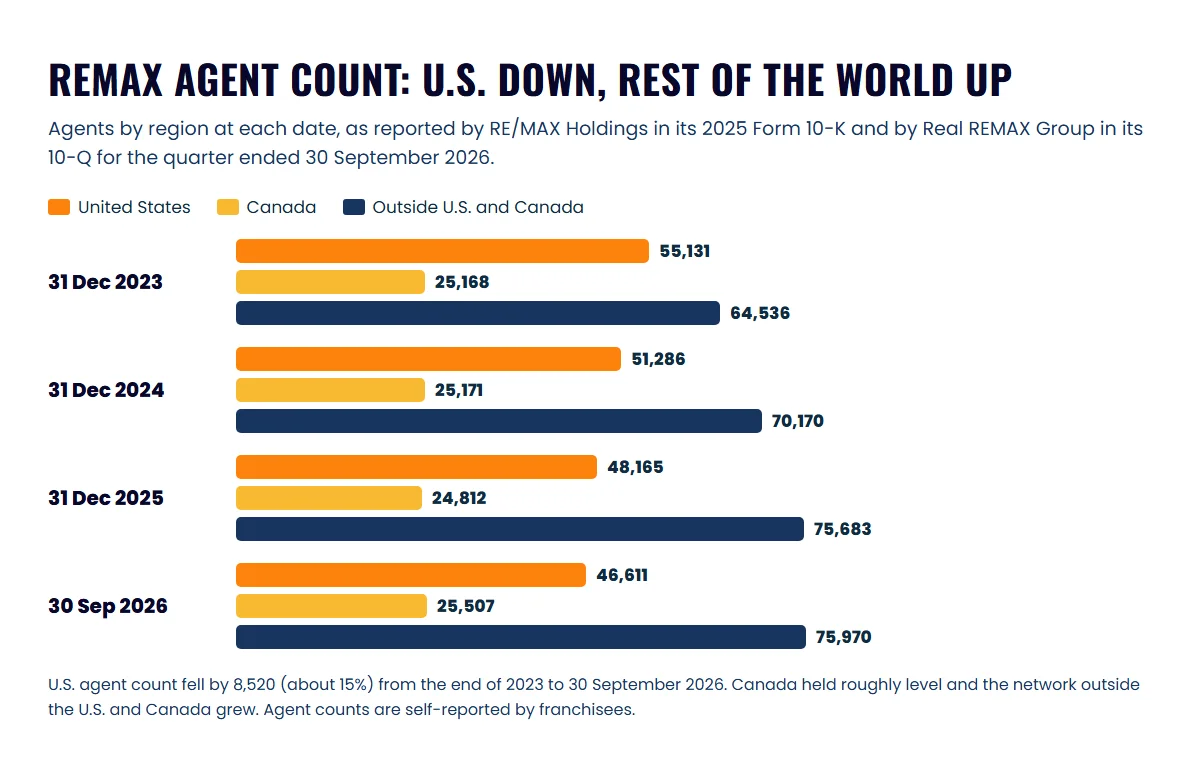
REMAX lost a net 8,520 agents in the United States between the end of 2023 and 30 September 2026, a drop of about 15%. Canada held roughly level, and the network outside North America grew.
The table shows REMAX agent count by region at each date, as reported to the SEC by RE/MAX Holdings and, after the merger, by Real REMAX Group.
| Date | United States | Canada | Outside U.S. and Canada | Total |
|---|---|---|---|---|
| 31 Dec 2023 | 55,131 | 25,168 | 64,536 | 144,835 |
| 31 Dec 2024 | 51,286 | 25,171 | 70,170 | 146,627 |
| 31 Dec 2025 | 48,165 | 24,812 | 75,683 | 148,660 |
| 30 Jun 2026 | 47,170 | 25,798 | 76,299 | 149,267 |
| 30 Sep 2026 | 46,611 | 25,507 | 75,970 | 148,088 |
The U.S. fell 7.0% in 2024 and 6.1% in 2025. In the year to 30 June 2026 it fell another 5.0%, according to the 10-Q for the quarter ended 30 June 2026. Open U.S. offices went from 3,340 at the end of 2023 to 2,911 in June 2026. The Real REMAX Group 10-Q for the third quarter of 2026 shows 46,611 U.S. agents on 30 September, and a global REMAX count of 148,088, down from June.
Two cautions. First, these are net numbers: agents who joined are offset against agents who left, so the gross number of agents who left isn’t published. Second, both companies’ filings say franchisees self-report their agent counts.
Why are agents leaving REMAX, according to the company?
RE/MAX Holdings blames its falling agent count in the United States on “challenging housing and mortgage market conditions” and broader economic uncertainty. Its 10-K also describes competition for agents as intense.
Here are the factors the company itself names in its 2025 annual report:
- The market. The 10-K says these macro factors “contributed to declines in U.S. REMAX agent count.” Fewer sales mean some agents leave the business altogether, not just the brand.
- Competition for productive agents. The filing says new entrants with “alternative business models, technology-enabled platforms, and consolidation strategies” have raised the pressure for talent.
- Cheaper models. The filing names franchisors that offer 100% commissions and low fees, such as HomeSmart and Realty ONE Group.
- Cloud brokerages. eXp Realty, Real, LPT Realty and Fathom Realty, in the company’s words, “have gained significant market share in recent years.”
The company also makes its case for staying. REMAX agents, it says, averaged 11.9 transaction sides on 2024 production in a RealTrends survey of large U.S. brokerages, more than double other agents. That’s the company’s claim, citing a third-party ranking, so weigh it as you would any recruiting pitch.
How does the REMAX commission split work?
The REMAX commission split isn’t one national number. RE/MAX Holdings recommends that franchise offices give agents 95% of each commission, in exchange for fixed fees that cover the office’s overhead.
That recommendation is in the company’s 2025 10-K. The same filing says franchisees have “the freedom to negotiate commission rates and splits.” In practice, two REMAX offices in the same city can offer you different deals.
So when an agent says “I left REMAX because of the fees,” they usually mean the fixed costs at their office. A high split plus a monthly desk fee works well in a strong year. In a slow year, that fee is still due every month whether you close or not. Agents in a soft market feel that more, which fits the company’s own explanation.
Old blog posts that quote one REMAX split for the whole country are guessing. Get the office’s written fee schedule instead.
What changed in REMAX fees in 2025?
REMAX added three optional fee models in 2025 for offices in its U.S. Company-Owned Regions: Aspire, Ascend and Appreciate. The company said they aim to lower fixed costs and improve recruiting and retention.
These terms describe what a franchise office pays REMAX for each agent, per the 10-K. What you pay your office is still up to the office.
- Aspire covers agents new to REMAX in their first year. The office pays REMAX 5% of the agent’s gross commission income, up to $5,000 a year, plus $25 per transaction and $410 annual dues. The 10-K reported about 2,000 agents on Aspire.
- Ascend launched in September 2025, at the same time as Appreciate. It cuts fixed fees by about 45%, caps broker fees at $3,000 per agent a year, and keeps the $25 per-transaction fee and $410 dues.
- Appreciate is for agents aged 70 or older with at least 10 years at REMAX. It replaces monthly fees with a $100 transaction fee and a 5% broker fee, and cuts annual dues to $99.
The company said in its second-quarter 2026 report that early results were “encouraging.” The U.S. decline did slow, from 7.0% in 2024 to 5.0% in the year to June 2026. The filings don’t say how much of that came from the new models. If you’re at a REMAX office now, ask whether it has adopted Ascend before you assume your costs are fixed.
How do REMAX fees compare with a capped model like eXp’s?
A capped model charges a percentage until you hit a yearly limit, while the classic REMAX model charges a small percentage plus fixed fees. Which costs less depends on your volume and on your office’s fees.
eXp is a useful contrast because its terms are public. Its U.S. policies dated 15 September 2025 set an 80/20 split until you pay $16,000, plus an $85 monthly cloud fee and per-deal fees. Our guide to eXp’s split, cap and fees walks through it.
The pattern matters more than the totals. Fixed fees reward volume and punish slow years. A percentage with a cap does the opposite until you cap. Neither model is better for everyone, so run your own last 12 months through both. Then ask each brokerage to confirm its numbers in writing.
What does the Real Brokerage deal mean for REMAX agents?
The Real Brokerage completed its purchase of RE/MAX Holdings, the company behind REMAX, on 24 August 2026. Both Real and RE/MAX Holdings became subsidiaries of a new holding company, Real REMAX Group Inc.
Real REMAX Group’s third-quarter 2026 report describes two businesses: Real, a brokerage, and REMAX, a global franchise network. The REMAX side still earns its money from franchise fees paid by offices. That’s the same model as before, so your split and fees are still set by your office.
The plans for agents come from the joint press release on 27 April 2026, which announced the deal:
- REMAX and Motto Mortgage “will continue to operate under their current brands,” and Real stays a separate brokerage under the Real brand.
- Agents under either brand would get the chance to use reZEN, Real’s technology platform.
- Franchisees were expected to keep “their existing business model and brand identity.”
- Real’s CEO, Tamir Poleg, would lead the combined company, headquartered in Miami with major operations near Denver.
One change is already on record. The third-quarter 10-Q says the company is no longer selling new Motto Mortgage franchises. None of the filings we read announces a change to REMAX franchise fees or agent splits. If you’re deciding whether to stay, ask your broker-owner what the deal changes for your office. For how Real’s own brokerage plan stacks up, see our comparison of Real Brokerage and eXp Realty.
Should you leave REMAX? Questions to ask first
Leave REMAX only if another offer is clearly better on your own numbers, not on a headline split. Price every offer the same way, then talk to your current broker before you sign anything.
- Monthly cost at zero closings: desk, tech and admin fees you owe in a slow month
- Split, cap and post-cap fees: what each deal costs before and after any cap
- Ascend: whether your current office has adopted it and what it would save you
- Pending deals and listings: what moves with you and what stays with the office
- Your contractor agreement: notice period and any fees owed when you leave
- Support you would lose: training, leads and tools, and what each is worth to you
The best brokerage for part-time agents guide has more questions on fixed fees if you close only a few deals a year.
What moves with you when you switch brokerages?
Your personal brand moves with you when you switch brokerages; the brokerage brand stays behind. That’s the part of your business you control, whatever happens to splits or parent companies.
Agents who built their marketing around the balloon logo have more to rebuild than agents known by name. Our guide to your personal brand vs. brokerage brand covers how to split the two. For a broader plan, start with personal branding for real estate agents. Guesting on other agents’ podcasts is one low-effort way to stay known by name, and podcast guest booking for agents handles the outreach for you.
Frequently asked questions
Is REMAX going out of business?
No. The Real Brokerage bought RE/MAX Holdings in August 2026, and RE/MAX Holdings and Real both became subsidiaries of Real REMAX Group, which runs REMAX as a franchise brand. RE/MAX Holdings stock left the New York Stock Exchange when the deal closed, and the parent's shares began trading on Nasdaq as REAX on 25 August 2026.
Do REMAX agents pay a franchise fee?
REMAX charges its fees to the franchise office, not straight to you. The office then sets what you pay it, through your split and any desk or monthly fees. Ask the office for its full fee schedule in writing.
Can I take my listings with me if I leave REMAX?
Usually not automatically. Listing agreements are normally between the seller and the brokerage, so the office decides whether a listing can move. Check your independent contractor agreement and talk to your broker before you give notice.
Is REMAX still growing anywhere?
Outside the U.S., yes. Agent count outside the U.S. and Canada rose 5.3% and Canada rose 3.3% in the year to 30 June 2026, according to RE/MAX Holdings' second-quarter 2026 report. Both dipped slightly in the third quarter.
Sources
- RE/MAX Holdings, Inc. Form 10-K for the year ended December 31, 2025 — U.S. Securities and Exchange Commission (accessed November 10, 2026)
- RE/MAX Holdings, Inc. Form 10-Q for the quarter ended June 30, 2026 — U.S. Securities and Exchange Commission (accessed November 10, 2026)
- Real to Acquire REMAX, joint press release of 27 April 2026 (Exhibit 99.1 to RE/MAX Holdings Form 8-K) — U.S. Securities and Exchange Commission (accessed November 10, 2026)
- RE/MAX Holdings, Inc. Form 8-K dated August 24, 2026 (completion of the mergers) — U.S. Securities and Exchange Commission (accessed November 10, 2026)
- Real REMAX Group Inc. Form 10-Q for the quarter ended September 30, 2026 — U.S. Securities and Exchange Commission (accessed November 10, 2026)
- eXp Realty (USA) Policies and Procedures, version 09.15.2025 (Exhibit 10.14 to the 2025 Form 10-K) — U.S. Securities and Exchange Commission (accessed November 10, 2026)
Done-for-you podcast production
Want a podcast that brings in referrals, not just downloads?
Icons of Real Estate plans, produces and publishes business-growing podcasts for agents. You record. We handle the rest.
Launch Your Podcast
Written by
Co-Founder and Podcast Guru, Icons of Real Estate
Tomás Fonseca co-founded Icons of Real Estate in 2021 and is its Podcast Guru. He has a background in marketing, with stints at companies like Nintendo and Ardor SEO, and is one of the hosts of the Icons of Real Estate Podcast.

How we research, write, fact-check and correct articles: our editorial standards.