On this page
- How do Real Brokerage and eXp Realty compare side by side?
- What is the Real Brokerage commission split and cap?
- What is the eXp Realty commission split and cap?
- Which costs less, Real or eXp? A worked example
- How does revenue share work at Real vs eXp?
- What stock programs do Real and eXp offer agents?
- How big are Real and eXp?
- What should you check before switching from eXp to Real?
- Next step: build a reputation that doesn’t depend on your brokerage
Real Brokerage and eXp Realty are both cloud-based brokerages, and the main difference is the fee model. Real pays U.S. agents 85/15 until a $12,000 cap with no monthly fees. eXp Realty pays 80/20 until a $16,000 cap, plus an $85 monthly fee and per-deal fees.
Both numbers put the cap at the same place: $80,000 of gross commission income. Below the cap, Real’s 15% costs less than eXp’s 20%. Above it, Real’s $285 post-cap fee per sale compares with eXp’s $250 until $5,000, then $75. Every figure here comes from the companies’ own filings or recruiting pages, checked in November 2026, so confirm the current terms with each brokerage before you decide.
How do Real Brokerage and eXp Realty compare side by side?
Real Brokerage and eXp Realty differ most on split, cap and monthly fees, and least on how the cap works. Below are each brokerage’s published U.S. terms, with the date of each source.
| eXp Realty | Real Brokerage | |
|---|---|---|
| Commission split | 80/20 (agent/brokerage) | 85/15 (agent/brokerage) |
| Annual cap | $16,000 of company dollar | Generally $12,000 in the U.S. (C$15,000 in Canada) |
| Gross commission to reach the cap | $80,000 | $80,000 |
| Sign-up and annual fees | $149 start-up fee (includes the first month) | $249 sign-up fee; $900 annual brokerage fee, taken as $300 from each of the first three deals a year |
| Monthly fee | $85 cloud brokerage fee | None |
| Per-deal fees | $25 review fee; $60 risk management fee (capped at $750 a year) | $50 compliance and broker review fee on every deal |
| After the cap | $250 a deal (or 20% if less) until $5,000, then $75 | $285 per sale, $125 per lease; $100 for Elite agents |
| Revenue share | Seven tiers; 17.5% of the pool from directly sponsored agents | Five tiers; up to $4,000 a year per referred agent who caps at Tier 1 |
| Agent stock | Elect 5% of each residential commission as stock, at a discount | Invest 5% of commission (10% after capping) with a 10% stock bonus (15% after capping) |
| Agents (30 Sep 2026) | 87,457 (AGNT, Inc., includes NextHome) | 36,610 |
| Source dates | Policies dated 15 Sep 2025 (unchanged in the August 2026 version); 10-Q for Q3 2026 | Annual information form for 2025; U.S. fee page, fees from 1 Sep 2026; 10-Q for Q3 2026; recruiting page, Nov 2026 |
eXp’s terms come from its U.S. policies and procedures and contractor agreement, both dated 15 September 2025 and attached to its 2025 annual report. Real’s split and cap come from its 2025 annual information form, its fees from the U.S. fee page in Real’s support center, and its revenue share and stock details from the Join Real recruiting page.
What is the Real Brokerage commission split and cap?
The Real Brokerage commission split is 85/15: agents keep 85% of each commission and Real keeps 15% until the agent’s annual cap. In the U.S. the cap is generally $12,000, according to Real’s 2025 annual information form.
Three details in Real’s own documents are worth knowing:
- The cap can differ. The annual information form says the cap is $12,000 “or such other amount as may be agreed with the agent.” Real’s recruiting page also lists $6,000 and $4,000 caps for some business models, “subject to certain requirements” it doesn’t spell out.
- Capping isn’t free. After the cap, agents keep 100% of the commission but pay $285 per sale or $125 per lease. Elite agents pay $100 on deals created on or after 1 September 2026.
- No monthly fee, but other fees. Real charges a $249 sign-up fee, a $900 annual brokerage fee taken as $300 from each of your first three deals a year, and a $50 compliance and broker review fee on every deal.
Older posts, including the earlier version of this one, quote Real fees that have since changed. The figures here come from Real’s U.S. fee page, checked in November 2026. Ask Real for its written fee schedule before you sign.
What is the eXp Realty commission split and cap?
The eXp Realty commission split is 80/20 for U.S. agents: you keep 80% and eXp keeps 20% until that 20% reaches $16,000 in your capping period. Your cap resets on your anniversary date, not on 1 January.
The eXp U.S. contractor agreement sets the split and the $16,000 cap. eXp’s policies add the fees:
- $149 sign-up fee, then an $85 monthly cloud brokerage fee;
- $25 transaction review fee on every deal;
- $60 risk management fee per deal, capped at $750 a year for non-commercial deals;
- after the cap, the lesser of $250 or 20% a deal until $5,000 is paid, then $75 a deal.
eXp also has a minimum company dollar rule for small commissions and a mentor program for newer agents. Our breakdown of how the eXp Realty 80/20 split and $16,000 cap work covers both, plus team splits.
Which costs less, Real or eXp? A worked example
Real costs less than eXp on published numbers at both volumes below, because its split is lower and it has no monthly fee. Its annual fee and post-cap fees narrow the gap.
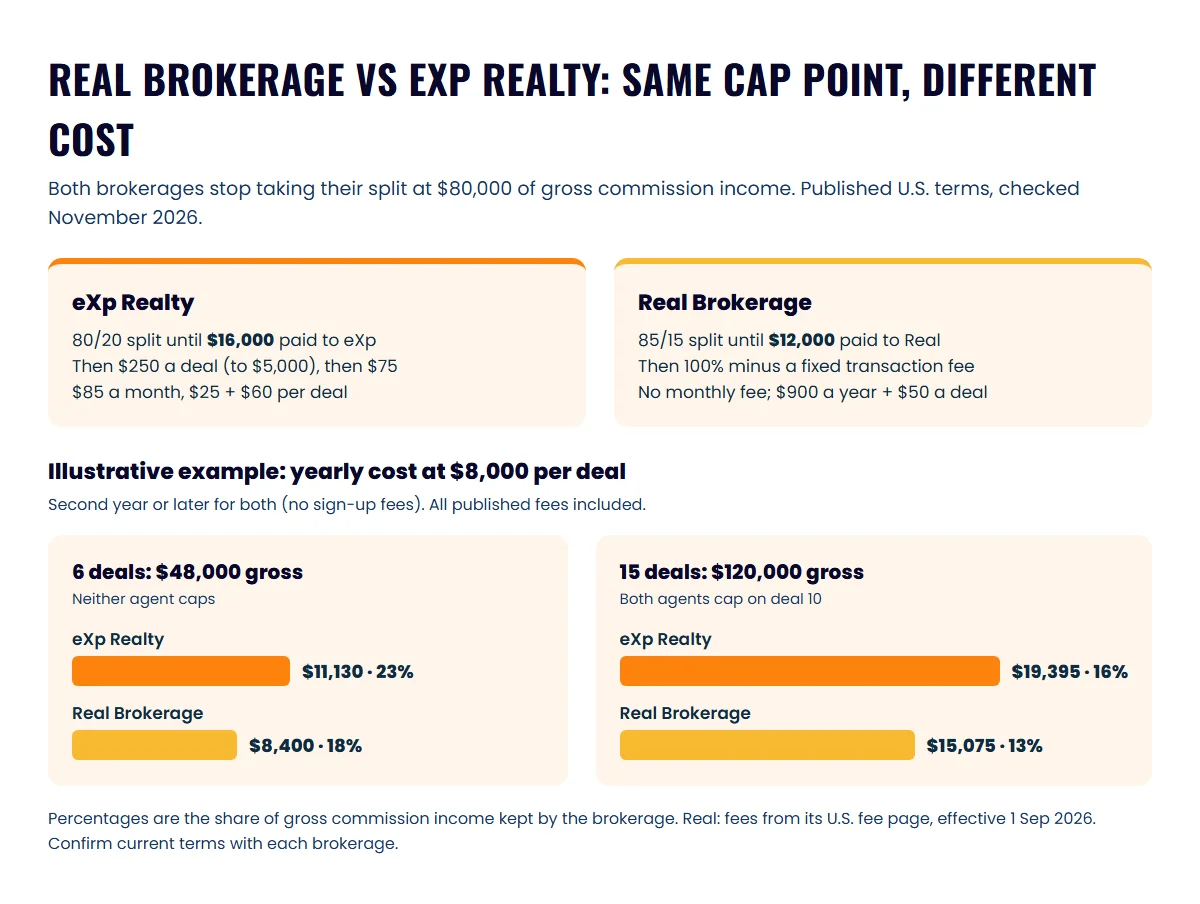
Run the same math with your own deal count and average commission. If you close well past the cap every year, the post-cap fees decide the gap: Real’s $285 a sale against eXp’s $250, which drops to $75 once you’ve paid $5,000.
How does revenue share work at Real vs eXp?
Revenue share at both brokerages pays you a slice of the brokerage’s take from agents you bring in. Each plan is built differently, so compare them on the agents you’d realistically attract, not on the top tier.
eXp Realty. Under eXp’s filed policies, half of the company dollar eXp collects goes into a revenue share pool, paid across seven tiers. You earn 17.5% of the pool from the transactions of agents you directly sponsor (Tier 1), and deeper tiers unlock as you sponsor more productive agents. Agents who have capped generate no company dollar, so their later deals pay no revenue share.
Real Brokerage. Real’s recruiting page lists five tiers with an annual ceiling per referred agent who caps:
| Real tier | Share | Most per $12,000-capping agent a year | Agents listed for the tier |
|---|---|---|---|
| Tier 1 | 5% | $4,000 | 1–4 |
| Tier 2 | 4% | $3,200 | 5–14 |
| Tier 3 | 3% | $2,400 | 15–19 |
| Tier 4 | 2% | $1,600 | 20–24 |
| Tier 5 | 1% | $800 | 25+ |
What stock programs do Real and eXp offer agents?
Both brokerages let agents put part of each commission into company stock, with a discount or bonus shares on top. The terms differ, and both parent companies changed in 2026.
- eXp Realty. According to eXp’s 2025 Form 10-K, the Agent Equity Program lets agents elect to take 5% of the commission on each completed residential deal as company stock, at a discount. No discount rate is stated in the filing. eXp also awards stock to agents who meet ICON Agent production and cultural goals.
- Real Brokerage. Real’s recruiting page says you can invest 5% of your commission (10% after capping) in company stock and receive a 10% bonus (15% after capping). It also mentions stock awards for capping, attracting agents and reaching Elite Agent status, without amounts.
Parent companies matter here, because that’s the stock you’d own. The AGNT, Inc. 10-Q for the third quarter of 2026 says it was formerly eXp World Holdings and runs eXp Realty and NextHome, which it acquired in May 2026. The Real REMAX Group 10-Q for the same quarter says Real completed its acquisition of RE/MAX Holdings on 24 August 2026, with both becoming subsidiaries of Real REMAX Group Inc. If you want the backstory on eXp’s stock awards, our eXp ICON agent guides collect agent interviews on the program.
How big are Real and eXp?
eXp Realty is the larger network: its parent reported 87,457 agents at 30 September 2026, against 36,610 Real Brokerage agents on the same date. Both counts come from each company’s third-quarter 2026 10-Q.
Read the numbers with care. AGNT’s count rose in 2026 mainly because of the NextHome franchise acquisition, according to its 10-Q, so it isn’t only cloud brokerage agents. Real REMAX Group reports Real’s brokerage agents separately from RE/MAX franchise agents, and the 36,610 figure is Real only. Real’s annual information form says Real began operations in Texas in 2014 and now operates in all 50 states and the District of Columbia.
Size alone doesn’t tell you much about your own business. What matters more is who you’d work with day to day: the state broker, the team you join and the people who’d sponsor you.
What should you check before switching from eXp to Real?
Switching from eXp to Real, or the other way, is mostly a timing and paperwork decision. Check these before you sign anything:
- Your cap date. eXp’s cap resets on your anniversary date. If you’re close to capping, leaving mid-cycle may mean starting a new cap at the other brokerage.
- Pending deals. Ask both brokerages in writing how deals under contract on your move date will be paid.
- Revenue share and unvested stock. Ask your current brokerage what happens to both when you leave. Don’t rely on a recruiter’s summary.
- The cap you’d get. At Real, ask whether the $12,000, $6,000 or $4,000 cap applies to you, and what the requirements are.
- Every fee amount. Get Real’s post-cap fees and any annual or joining fee in writing. At eXp, ask about the mentor program if you’ve closed fewer than three deals in the last year.
- State rules. License transfers follow your state real estate commission’s process. Check with your broker and the commission before you move.
Whichever brokerage you pick, your clients will remember your name more than its logo. That’s the case for building your personal brand versus your brokerage brand so it moves with you. If you work part time, our comparison of the best brokerage for part-time agents runs the numbers at lower volume.
Next step: build a reputation that doesn’t depend on your brokerage
Agents switch brokerages, and brokerages merge, as Real and RE/MAX did in 2026. What stays yours is your reputation with past clients and referral partners. A steady plan for a real estate agent personal brand keeps you visible whichever split you’re on. Guest spots on podcasts are one low-effort way to do it, and podcast guest booking for agents shows how that works.
Frequently asked questions
Does Real Brokerage charge a monthly fee?
No. Real's U.S. fee page lists no monthly fees. It does charge a $249 sign-up fee, a $900 annual brokerage fee (paid as $300 from each of your first three deals a year), a $50 compliance and broker review fee on every deal, and $285 per sale after you cap.
Did RE/MAX buy Real Brokerage?
Real and RE/MAX combined under a new holding company, Real REMAX Group Inc., on 24 August 2026. Real's SEC filings describe it as Real completing its acquisition of RE/MAX Holdings, with both becoming subsidiaries of the new company.
Is Real Brokerage's cap lower for some agents?
Real's recruiting page lists caps of $12,000, $6,000 and $4,000 in the U.S. depending on your business model, subject to requirements it doesn't spell out. Ask which cap you'd qualify for and get it in writing.
Do new agents get the standard split at eXp?
Not always. eXp's filed policies put agents with fewer than three purchase or sale transactions in the prior 12 months into its Mentor Program, which has its own addendum and fees. Ask eXp for the addendum in your state.
Sources
- eXp Realty (USA) Independent Contractor Agreement, version 09.15.2025 (Exhibit 10.13 to the 2025 Form 10-K) — U.S. Securities and Exchange Commission (accessed November 10, 2026)
- eXp Realty (USA) Policies and Procedures, version 09.15.2025 (Exhibit 10.14 to the 2025 Form 10-K) — U.S. Securities and Exchange Commission (accessed November 10, 2026)
- eXp World Holdings, Inc. Form 10-K for the year ended December 31, 2025 — U.S. Securities and Exchange Commission (accessed November 10, 2026)
- AGNT, Inc. Form 10-Q for the quarter ended September 30, 2026 — U.S. Securities and Exchange Commission (accessed November 10, 2026)
- The Real Brokerage Inc. Annual Information Form for the year ended December 31, 2025 (Exhibit 99.1 to Form 40-F) — U.S. Securities and Exchange Commission (accessed November 10, 2026)
- Real REMAX Group Inc. Form 10-Q for the quarter ended September 30, 2026 — U.S. Securities and Exchange Commission (accessed November 10, 2026)
- Join Real — The Real Brokerage (accessed November 10, 2026)
- How much does it cost to hang my license with Real (US)? — Real support center (accessed November 10, 2026)
Done-for-you podcast production
Want a podcast that brings in referrals, not just downloads?
Icons of Real Estate plans, produces and publishes business-growing podcasts for agents. You record. We handle the rest.
Launch Your Podcast
Written by
Co-Founder and Podcast Guru, Icons of Real Estate
Tomás Fonseca co-founded Icons of Real Estate in 2021 and is its Podcast Guru. He has a background in marketing, with stints at companies like Nintendo and Ardor SEO, and is one of the hosts of the Icons of Real Estate Podcast.

How we research, write, fact-check and correct articles: our editorial standards.