On this page
- What should you ask a podcast production company before you sign?
- Who owns the show, the RSS feed and the back catalog?
- What exactly is included in each episode?
- How long is the contract, and how do you cancel?
- How many revisions do you get?
- What happens when you or a guest need to reschedule?
- What will they report on each month?
- Do they understand real estate compliance?
- Which contract clauses should you read twice?
- What should you email a podcast producer before the call?
- Next step
Before you sign with a podcast production company, ask six questions: who owns and controls the show and its RSS feed, what each episode includes, how long the contract runs and how to cancel, how many revisions you get, what reschedules cost, and what they report each month. Get every answer in writing, in the contract.
Most “how to choose a podcast agency” posts are written by agencies. This checklist sits on your side of the desk: run through it on discovery calls, then pull up the clause table when the contract lands in your inbox. No shortlist yet? Start with how real estate podcast production works and a look at podcast production companies that work with agents.
What should you ask a podcast production company before you sign?
Ask questions in six areas, and judge each answer against what a good producer would say. Vague answers are a warning sign, even from a friendly salesperson.
| Area | Ask this | A good answer sounds like | Red flag |
|---|---|---|---|
| Ownership | Whose name are the hosting account and Apple Podcasts Connect listing in? | “Yours. We work as users on your accounts, or we transfer them at exit.” | “We own the feed, but you can have the files.” |
| Scope | What do I get per episode, item by item? | A written list: edit, video, clips, article, thumbnails, publishing | “Full service” with no list |
| Term | How long is the term, and does it renew on its own? | A clear start date, end date and renewal rule | Renewal terms you only find in the fine print |
| Revisions | How many revision rounds, and what does an extra change cost? | A number per month and a price per extra change | “Unlimited,” with no definition of a revision |
| Reschedules | What happens if I or a guest cancel a recording? | A set number of free reschedules and a fixed fee after that | Lost episodes with no make-up plan |
| Reporting | What do you send me each month? | Downloads, views, clip performance, plus a place to log leads | Download counts only, or nothing |
Who owns the show, the RSS feed and the back catalog?
You should own the show name, artwork, episodes, RSS feed and audience, and the contract should say so. Ownership on paper is not enough, though. Ask who controls the accounts, because control is what lets you leave, or relaunch a stalled podcast with someone new later.
Ask about the accounts, not just the content
An RSS feed is the web address that Apple Podcasts, Spotify and every other listening app pull your episodes from. It lives on a podcast hosting account. Whoever holds that login can move, pause or delete your show.
Ask these three questions:
- Whose email and payment card is the hosting account under? Yours is best. If the producer uses its own account, ask how and when it transfers to you.
- Who is the owner of the show in Apple Podcasts Connect? Apple’s ownership transfer page explains that Podcasts Connect shows the shows tied to the Apple Account you sign in with. Moving a show between accounts can require claiming it or contacting Apple. Avoid that work by starting in your own account.
- Who owns the YouTube channel, and who are the admins? The same logic applies. You want to be the owner, with the producer added as a manager.
Get the exit plan in writing
Ask the producer to describe, step by step, what happens if you leave. A good one will mention the redirect without being prompted.
Apple’s guide to changing your RSS feed URL says the old feed should return a 301 redirect and the new feed should include the itunes:new-feed-url tag. Both should stay in place for at least four weeks. It also warns that changing episode GUIDs (the unique ID for each episode) can show listeners duplicate episodes. Put a line in your contract that the producer will set up that redirect and keep it live for at least four weeks when you leave.
What exactly is included in each episode?
Get a per-episode list of deliverables in the contract or the attached scope of work. “Done for you” means different things at different companies, and the gaps show up in month two.
Ask about each item by name:
- Audio edit and video edit (and whether video is included at all)
- Number of short clips, and whether they are captioned and vertical
- Thumbnails and episode titles
- Show notes and an episode article for your website
- Publishing to the host, YouTube and your website
- Guest booking and scheduling, or whether that’s on you
- Turnaround from recording to a draft you can review
Hold each quote up against what done-for-you podcast production includes for an agent. If there’s a one-time setup fee too, check it against the usual launch package line items and prices.
How long is the contract, and how do you cancel?
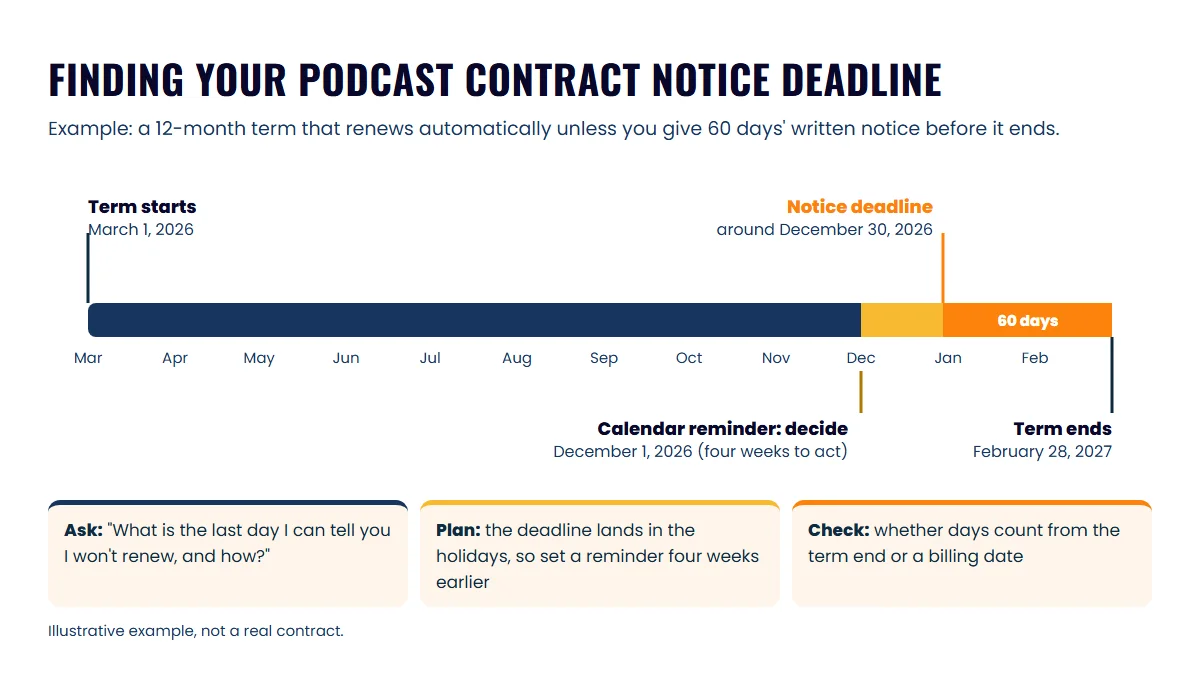
Ask for the initial term, the renewal rule and the notice period, then work out your cancellation deadline before you sign. Many production contracts run for a fixed term and renew automatically unless you give notice by a set date.
The question to ask is: “If I decide not to renew, what is the last day I can tell you, and how?” Get the method too. Some contracts require written notice, so a comment on a call doesn’t count.
Also ask about refunds and billing:
- Are payments refundable if you leave early? Some producers say all payments are final.
- Is billing monthly or on a fixed cycle, such as every four weeks? A four-week cycle means 13 invoices a year, not 12.
- Are there late fees, and how many days do you have to pay?
How many revisions do you get?
Ask for the number of revision rounds included each month and the price of each change beyond that. Then ask what counts as one revision, because that definition decides your real cost. Icons clients send notes and approve each edit by share link in ICONS Review, with comments pinned to the moment they refer to.
Good follow-up questions:
- Is a revision one change, or one batch of notes sent at the same time?
- Do revisions reset each month, or carry over?
- Do clip and thumbnail changes count against the same limit as the episode edit?
- What kind of change is free, such as fixing the producer’s own error?
The best habit on your side is simple: send all your notes on an episode in one message. Producers who count revision rounds will usually treat that as one round.
What happens when you or a guest need to reschedule?
Ask how many reschedules are free each month and what each extra one costs. Agents reschedule a lot. A closing moves, an inspection runs long, and the recording slot is the first thing to go.
Also ask:
- How much notice do they need before a recording to avoid a fee?
- If a booked guest cancels, do they find a replacement, or is that episode lost?
- If you miss a month of recordings, do you still pay for episodes that never get made?
If your calendar runs on closings and inspections, record two episodes in one session. Batching halves the number of slots that can get bumped.
What will they report on each month?
Ask for a sample monthly report before you sign. You want numbers that help you judge the show by business results, not just reach.
A useful report covers:
- Downloads per episode, and views for the full video on YouTube
- Clip views and engagement on each social platform
- Episodes released versus the number promised
- Upcoming guests and recording dates
- A place to log leads, referrals and conversations that came from the show
Producers can’t see your CRM, so lead tracking is partly your job. Still, a producer who asks about your leads is thinking about the right outcome. Use the podcast cost calculator to set what the show needs to produce to be worth the fee.
Do they understand real estate compliance?
Ask how they handle brokerage name disclosure, Fair Housing language and lender or referral-partner episodes. A producer who has never worked with agents may not know these exist.
Questions that reveal real experience:
- “Where does my brokerage name appear in each episode, the show notes and the video?”
- “What do you do if a guest sells an area on its residents instead of its homes?”
- “If a lender wants to sponsor an episode or share costs, what do you suggest?”
A good producer will say they flag issues and send them to you, and that you should run sponsorships and co-marketing past your broker or compliance team, since RESPA can apply. They should not give you legal advice. The pillar’s compliance checks for agent podcasts section lists what to build into each episode.
Which contract clauses should you read twice?
Read the clauses on ownership, term, renewal, cancellation, fees and scope changes twice, and ask for edits before you sign. This table shows what to look for.
| Clause | What to look for | Ask for this if it’s missing |
|---|---|---|
| Ownership | Show, name, artwork, episodes, feed and audience are yours | A sentence naming each one as your property |
| Accounts | Hosting, Apple Podcasts Connect and YouTube in your name | Account transfer within a set number of days of exit |
| Exit | Redirect from the old feed and file handover | 301 redirect kept at least four weeks, plus raw and master files |
| Term and renewal | Start date, end date, auto-renewal rule | The renewal length (for example month to month after year one) |
| Cancellation | Notice period and how notice must be sent | An email address that counts as written notice |
| Refunds | What happens to prepaid fees | A clear statement, even if the answer is no refunds |
| Revisions | Rounds included and price per extra change | A definition of one revision round |
| Reschedules | Free reschedules per month and the fee after | Notice period before a fee applies |
| Scope | Deliverables per episode and turnaround | A scope of work attached to the contract |
| Price changes | Whether rates can rise at renewal | Notice before any price increase |
For reference, here is how one provider publishes these terms. Icons of Real Estate’s production service states that the show, name, artwork, back catalog, audience and RSS feed belong to the client. Its knowledge base lists an initial 12-month term that renews automatically, 60 days’ written notice before the term ends, all payments final, up to 4 revision rounds a month with extra changes at $50 each, and 1 free reschedule a month with extra reschedules at $25 each. Compare every quote you get on the same terms.
What should you email a podcast producer before the call?
Send your questions in writing before the discovery call so the answers come back in writing too. Copy this, fill in the brackets, and send it to every producer on your shortlist.
Need questions for your own guests rather than your producer? The interview question generator drafts a first set for each episode.
Next step
Pick two or three producers, send them the email above on the same day, and compare their written answers side by side in the clause table. The producer with the clearest answers on ownership and cancellation is usually the safest one to sign with, even if they aren’t the cheapest.
Frequently asked questions
Should I sign a 12-month podcast production contract?
A 12-month term is common and can be fine if the price, scope and exit terms are clear. Before signing, write down the date your cancellation notice is due and confirm what happens to your feed if you leave.
Can a production company keep my podcast if I cancel?
It depends on your contract and on whose name the hosting and Apple Podcasts Connect accounts are in. Get ownership of the show, feed and back catalog stated in writing before you pay.
Is it normal to pay for extra revisions?
Yes. Many producers include a set number of revision rounds and charge for changes beyond that. Ask for the limit and the per-change fee up front so there are no surprises.
Sources
- Change the RSS feed URL — Apple Podcasts for Creators (accessed October 6, 2026)
- Transfer ownership of a podcast — Apple Podcasts for Creators (accessed October 6, 2026)
Done-for-you podcast production
Want a podcast that brings in referrals, not just downloads?
Icons of Real Estate plans, produces and publishes business-growing podcasts for agents. You record. We handle the rest.
Launch Your Podcast
Written by
Co-Founder and Podcast Guru, Icons of Real Estate
Tomás Fonseca co-founded Icons of Real Estate in 2021 and is its Podcast Guru. He has a background in marketing, with stints at companies like Nintendo and Ardor SEO, and is one of the hosts of the Icons of Real Estate Podcast.
How we research, write, fact-check and correct articles: our editorial standards.