A podcast download is one request for an episode file that delivers enough audio to play for at least one minute, counted once per listener per day after bots and test requests are removed. The definition comes from the IAB Podcast Measurement Technical Guidelines, the industry’s shared measurement standard. A download proves a file was fetched, not that anyone listened.
Agents ask about downloads for two reasons: the number in the host dashboard doesn’t match Apple’s, and it jumps around from week to week. Both are normal once you know what is being counted. This page explains the counting. How many listeners a real estate podcast needs covers what a good number looks like, so that isn’t repeated here.
What counts as a podcast download?
A podcast download counts when a listener’s app or browser requests an episode file from your host and receives the file header plus enough audio to play for one minute. The IAB Tech Lab guidelines, version 2.3, define a download as “a unique episode request that results in an episode being delivered to the podcast consumer’s device,” including partial downloads that meet that minimum.
The one-minute rule separates real fetches from accidental ones. Your host works out how many bytes one minute of your audio takes from the file’s bitrate, adds the size of the tag data at the front of the file, and ignores any request smaller than that. The guidelines let a host that can’t do this math count only complete file downloads instead, which is one source of differences between hosts.
Three things follow from that definition:
- Streaming is a download. The guidelines are blunt about this: “‘streamed’ podcast files are progressively downloaded via the standard HTTP protocol” and are logged the same way. Pressing play in Apple Podcasts or Spotify creates a request to your host just as saving the episode for later does.
- A download isn’t a listen. A phone set to auto-download new episodes fetches your file whether or not its owner ever plays it. The guidelines ask apps to avoid downloading back-catalog episodes by default and to stop auto-downloads after episodes pile up unplayed, but they can’t make anyone listen.
- A download isn’t a person. One listener who plays the first half on a commute and the rest at home can create two requests. The 24-hour rule below collapses most of those into one.
The counting happens on your host’s server, which is why a host can count every app. Apple Podcasts and Spotify read your feed and request your file like any other app; the hosting guide for real estate agents explains that plumbing.
Why are bots and repeat requests filtered out?
Bots and repeat requests are filtered out because a raw server log records every fetch of your file, including crawlers, link previews, test pings and the same phone asking twice. Without filtering, a brand-new show with no listeners would still show downloads.
The guidelines call the first group “general invalid traffic” and require hosts to remove it. Section 5 of the document lists the filters:
- Volume by address. Any IP address that pulls an unrealistic number of files inside the measurement window is excluded.
- Known bots and data centres. Requests from identified non-human sources, including hosting-provider address ranges, are dropped.
- Bot user agents. Software that announces itself as a bot or crawler doesn’t count, and deliberately faked user agents are discarded.
- Two-byte probes. Apps and link checkers often ask for bytes 0 to 1 of a file to confirm it exists; those requests are removed.
- HEAD requests. A HEAD request asks for the file’s details without the file, so it is excluded; only successful GET requests count.
- Apple Watch duplicates. Specific watchOS user agents are filtered because they duplicate the phone’s request.
Then comes de-duplication. The guidelines represent a listener as “the unique combination of IP address and User Agent.” If that pair requests the same episode again within a 24-hour window, the second request is a duplicate. One phone, one app, one episode, one day: one download.
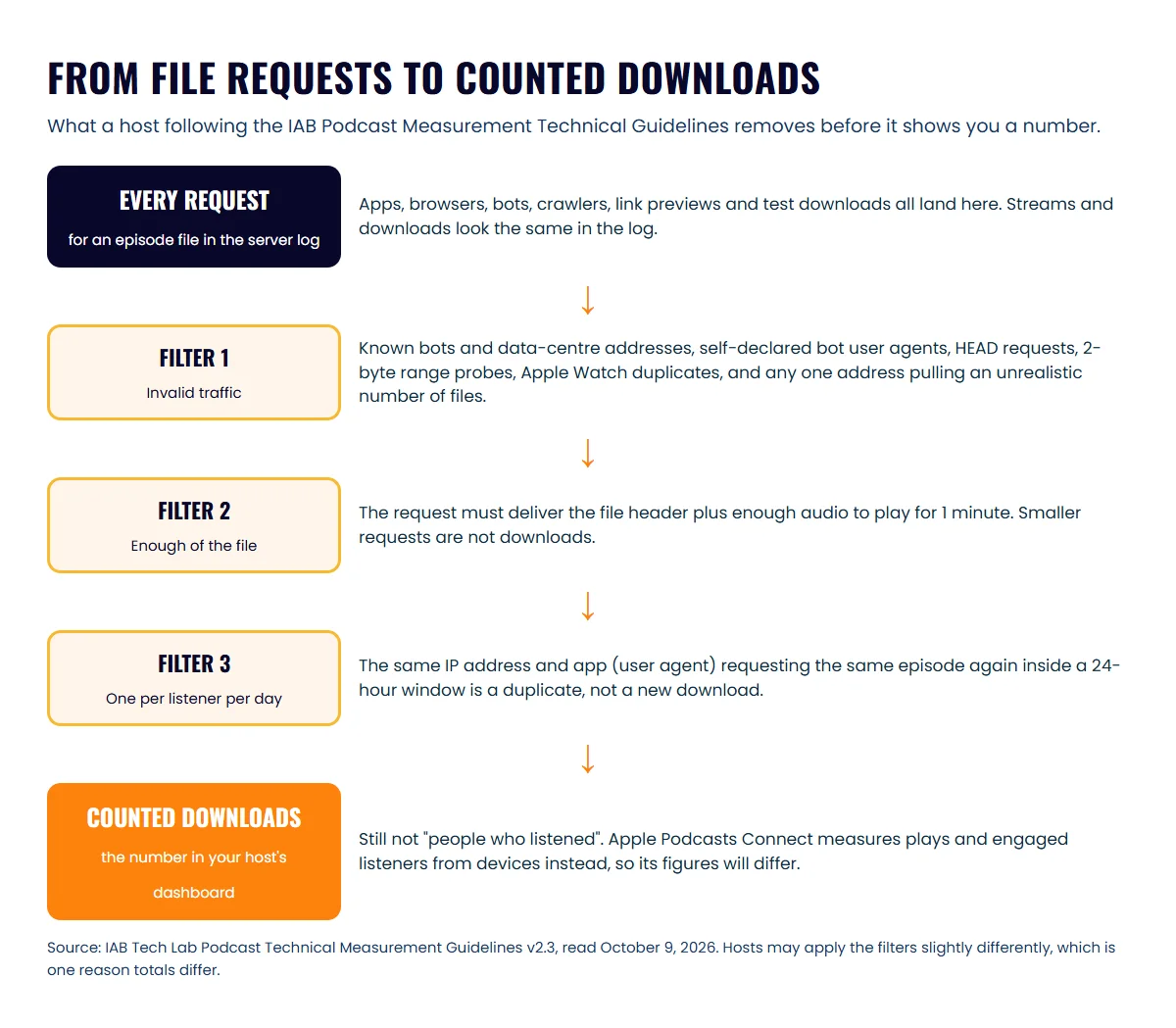
For an agent, the practical effect is that your own test plays mostly vanish. Play the episode three times from your office Wi-Fi to check the intro and you’ll see at most one download from it, and possibly none if each request was shorter than a minute.
Why do download numbers differ between hosts?
Download numbers differ between hosts because the guidelines leave several choices to each host, and each choice moves the total a little. Two compliant hosts counting the same traffic can report different numbers and both be right.
The table below lists the main choices the guidelines allow and which direction each one pushes the count.
| Choice the guidelines allow | Options | Effect on your number |
|---|---|---|
| 24-hour window type | A fixed calendar day that resets at a set UTC time, a rolling window from the first request, or a rolling window that resets with each new request | A late-evening listener who resumes after midnight counts twice under a calendar day and once under a rolling window |
| One-minute threshold | Calculated per episode, per show, or replaced by “complete downloads only” | Complete-only counting drops partial plays and lowers the total |
| Bot and data-center lists | Each host keeps its own, plus a safe-list for busy shared addresses such as offices, re-checked every 90 days | Stricter lists remove more; a brokerage office on one IP address can be over- or under-counted |
| Compliance | IAB Tech Lab runs a compliance program; hosts choose whether to be certified | Certified hosts have had their method checked; others may follow the guidelines without an audit |
Moving hosts therefore changes your numbers even when nothing else changes. When you compare two hosts, compare the same episode over the same 30 days and expect a gap rather than a match.
Certification deserves a sentence because hosts advertise it. The IAB Tech Lab’s podcast measurement compliance program certifies that a company adheres to the guidelines, so “IAB certified” means the company has been through that program. A host that says it “follows” the guidelines is making a weaker claim. Either is fine for an agent’s show; the difference matters more if you plan to sell advertising.
Whichever host you use, look for a published counting method. ICONS Podcast hosting follows the IAB approach without certification: it filters bots, data centres and tiny test requests, counts a download after 1 minute of audio, once per listener per 24 hours, and publishes that method on its own page so you can show it to anyone who asks.
Why does Apple Podcasts show a different number than my host?
Apple Podcasts Connect reports a different number because it measures what happens on the device after the file arrives, while your host measures the file leaving the server. Apple’s listener analytics page says its analytics “focus on providing aggregated listening and viewing completion rates from unique devices for each episode” rather than downloads.
Apple defines its four figures like this:
- Plays: “the total number of times people pressed play on your episode.”
- Listeners: “the total number of people that listened to or watched your show.”
- Engaged listeners: anyone who got through at least 20 minutes of an episode, or 40% of it, per Apple’s definitions.
- Followers: “the total number of people following your show.”
None of those is a download. Apple also points out that download and subscription figures come “from your hosting provider or from the server where your podcast is hosted.” So the fair comparison is host downloads for reach across every app, and Apple engaged listeners for how much people actually heard.
How should an agent use podcast download numbers?
Use download numbers to compare your own episodes with each other, and use replies and appointments to judge the show. Downloads tell you which topics your audience fetched; they can’t tell you who called.
Three habits keep the numbers useful:
- Compare like with like. Judge every episode at the same age, such as downloads in its first 30 days, because older episodes keep collecting plays.
- Watch the shape as well as the total. A spike in the first 48 hours that then flattens means your sphere listened; a slow, steady line means search or sharing is working. Both are good news for a local show.
- Log the outcomes somewhere else. Downloads live in the host; leads live in your CRM. A lead-source setup for podcast leads connects the two.
If a sponsor ever asks for numbers, give them the host’s downloads with the date range and the host’s counting method, and remember that any paid mention on the show has to be disclosed to listeners. The FTC’s endorsement guidance says that when a claim is made audibly, the disclosure “should be made at least audibly.”
Downloads only start once the feed is live in the apps, and getting your podcast on Apple Podcasts and Spotify covers that step.
Next step
Open your host’s stats, pick your three most recent episodes, and write down their downloads at 30 days. That’s your baseline. Then search the host’s help pages for “IAB” and “24 hours” so you know which counting choices it made. If the numbers are fine but you’d rather spend your hours on guests and follow-up, Icons of Real Estate can take editing and publishing off your plate.
Frequently asked questions
Is a stream the same as a download?
Yes, under the IAB guidelines. A podcast app streams by downloading the file progressively over HTTP, and the host's server logs that request the same way as a saved episode, so both count once they pass the one-minute threshold.
Do my own test plays count as downloads?
Mostly no. Playing an episode several times from one office connection and one app counts at most once per 24 hours, and a request shorter than one minute of audio doesn't count at all.
Are YouTube views included in my download count?
No. YouTube stores and serves its own video, so a view never touches your podcast host. Track YouTube in YouTube Studio and treat the two numbers as separate audiences.
What does IAB certified mean for a podcast host?
The host has been through IAB Tech Lab's compliance program, which certifies that a company adheres to the measurement guidelines. A host that says it follows the guidelines without certification hasn't had that check.
Sources
- Podcast Measurement Technical Guidelines — IAB Tech Lab (accessed October 9, 2026)
- Podcast Technical Measurement Guidelines v2.3 — IAB Tech Lab (GitHub) (accessed October 9, 2026)
- Podcast Measurement Compliance — IAB Tech Lab (accessed October 9, 2026)
- Listener analytics — Apple Podcasts for Creators (accessed October 9, 2026)
- FTC's Endorsement Guides: What People Are Asking — Federal Trade Commission (accessed October 9, 2026)
Done-for-you podcast production
Want a podcast that brings in referrals, not just downloads?
Icons of Real Estate plans, produces and publishes business-growing podcasts for agents. You record. We handle the rest.
Launch Your Podcast
Written by
Co-Founder and Podcast Guru, Icons of Real Estate
Tomás Fonseca co-founded Icons of Real Estate in 2021 and is its Podcast Guru. He has a background in marketing, with stints at companies like Nintendo and Ardor SEO, and is one of the hosts of the Icons of Real Estate Podcast.

How we research, write, fact-check and correct articles: our editorial standards.