On this page
- Is a real estate podcast worth it for a solo agent?
- What does a solo agent actually get from a podcast?
- What does a podcast cost a solo agent in money and hours?
- How many deals make a podcast worth it?
- The honest ROI scorecard: is a podcast worth it for you?
- How will you know the podcast is working?
- When should a solo agent skip the podcast for now?
- Next step
A real estate podcast is worth it for a solo agent who lives on referrals, can commit to about a year and will follow up with every guest. It isn’t worth it if you need deals this quarter or won’t use what the conversations give you. For most established solo agents, one or two closings a year covers the cost.
That’s the short version. The rest of this page is the honest check behind it: what you get, what it costs, the break-even math and a seven-question scorecard you can fill in before you spend a dollar. You already know the upside. Here the job is to test whether it fits you.
Is a real estate podcast worth it for a solo agent?
A real estate podcast is worth it for a solo agent when the business runs on relationships, the show lasts a year and every guest gets a follow-up.
Solo agents have one advantage over teams here. You are the brand. Every guest meets the person who will actually take the listing, and every past client who hears an episode hears you, not a team name. A podcast amplifies exactly the thing a referral business sells: trust in one person.
The catch is time and consistency. A solo agent has no one to cover the show during a busy spring. Most podcasts never get far: a 2021 count by Steve Goldstein of Amplifi Media found 44% of shows in Apple Podcasts had three or fewer episodes. A show you abandon at episode four returns almost nothing, so the honest question is whether you’ll keep going, not whether podcasts work.
What does a solo agent actually get from a podcast?
A solo agent gets two things from a podcast: a reason to have a real conversation with people who can refer business, and a steady stream of content made from those conversations. The relationships pay; the content is the byproduct.
That order matters for a referral business. NAR’s 2025 survey of recent buyers and sellers, as summarised by Virginia REALTORS, says 43% of buyers chose an agent someone referred them to, and 18% went back to an agent they’d used before. Two in three sellers (66%) picked an agent through a referral or a past relationship. A podcast feeds both channels at once.
- Guests become referral partners. A lender, an inspector, a builder or an agent in a feeder market spends 30 minutes with you on record. That’s a deeper first meeting than any networking event. The referral partner episode playbook shows who to invite.
- Your sphere hears from you without a sales pitch. An episode email or clip gives past clients a reason to think of you that isn’t “just checking in”.
- The content library compounds. Each episode becomes clips, posts and an article. A year in, anyone who searches your name finds a body of work.
None of this needs a big audience. A solo agent’s return comes mostly from guests and people who already know you, which is why download counts are a poor test of whether the show is working.
What does a podcast cost a solo agent in money and hours?
Podcast costs for a solo agent come as cash, hours or both. DIY is cheap in money and expensive in time, while done-for-you costs more money and takes about an hour a week of your time.
Here’s how three routes compare for one person running the business alone.
| Route | Cash | Your time | Biggest risk |
|---|---|---|---|
| DIY | Low: microphone, hosting and editing software | Several hours per episode for booking, recording, editing and publishing | Falling behind when deals pile up |
| Done-for-you | Setup plus a monthly fee; at ICONS, Launchpad starts at $497 and Ongoing Production at $621/mo | About an hour a week to record | Paying for months before any deal appears |
| Guesting on other shows | Free to low; ICONS Lite on the Hub costs nothing | Prep plus the interview | You build someone else’s show, not your own |
For a solo agent, hours are the real constraint. The weekly time a real estate podcast takes breaks the DIY workload down task by task, and the producer versus DIY time-cost math turns your hourly value into a decision. The ICONS podcast production service is built around the done-for-you route, where recording is close to the only job left on your desk.
How many deals make a podcast worth it?
A podcast is worth it on cash alone once the net commission from podcast-sourced deals covers the year’s cost. For most established solo agents that’s one or two closings a year, but your split and price point decide the real number.
The formula is short: 12-month cost ÷ net commission per deal = closings needed. Use net, after your broker split and fees, not gross.
Get your own 12-month cost from the podcast cost calculator, then test referral scenarios in the podcast ROI calculator. The closings-to-break-even breakdown runs the same math across four price points and three income levels.
The honest ROI scorecard: is a podcast worth it for you?
The honest ROI scorecard is seven yes-or-no questions that predict whether a podcast will pay for a solo agent. Count your yeses: five or more means start, three or four means start smaller, and two or fewer means wait.
Answer for how you actually work, not how you’d like to.
| Question | Why it matters | Your answer |
|---|---|---|
| 1. Do most of your deals come from referrals and past clients? | A podcast multiplies relationships; it’s a weak cold-lead source | |
| 2. Would one or two net commissions cover a year of the show? | Break-even should be a small share of your normal year | |
| 3. Can you protect one hour a week for 12 months? | Shows that stop early return almost nothing | |
| 4. Can you name 20 local people you’d want as guests? | Guests are the main return for a solo agent | |
| 5. Will you follow up with every guest within a week? | No follow-up, no referral partner | |
| 6. Do you have a CRM where you can tag podcast contacts? | Without tracking you’ll never know if it worked | |
| 7. Can your business wait 6 to 12 months for results? | Relationship deals lag the episodes by months |
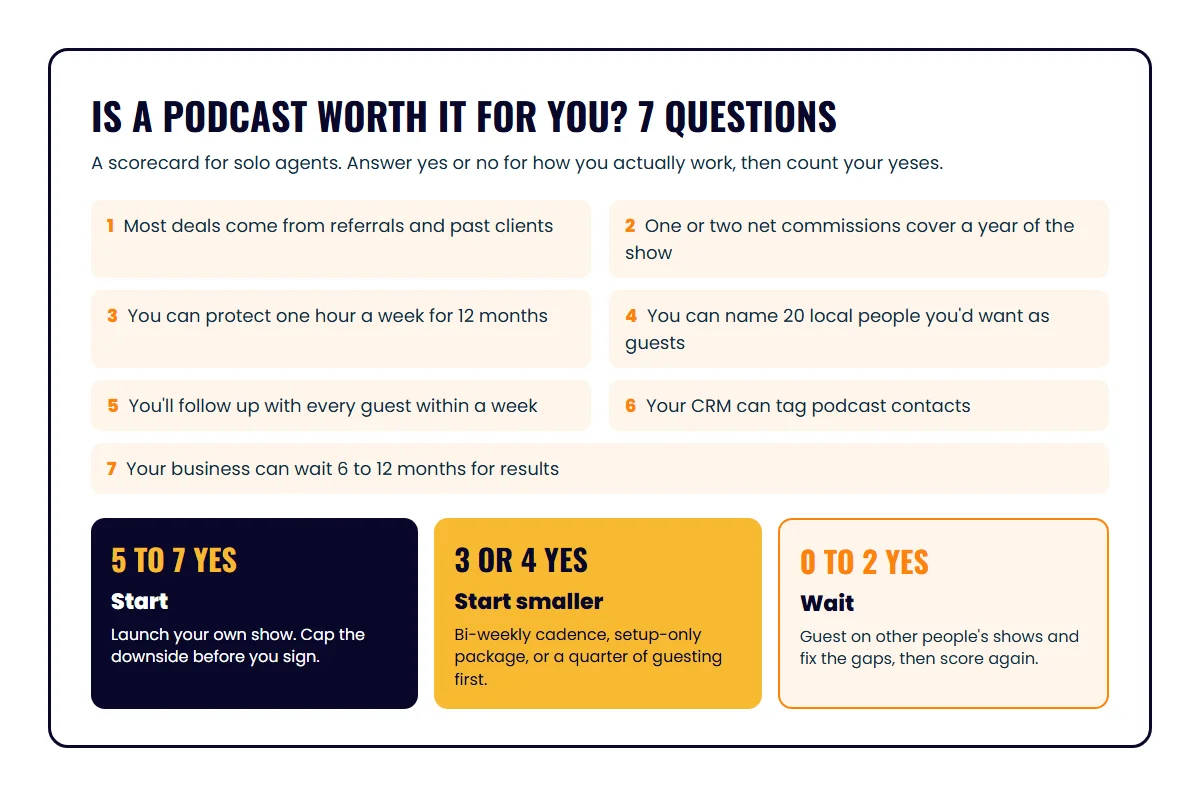
“Start smaller” means a bi-weekly cadence, a setup-only package, or guesting for a quarter before you host. If the scorecard says start, read what to do if the podcast doesn’t pay off before you sign anything, so the downside is capped from day one.
How will you know the podcast is working?
A solo agent’s podcast is working when the people it touches start talking back. Guests take a second call, past clients reply to episode emails and new contacts mention the show, months before closings arrive.
Track three things from the first episode:
- Guest follow-ups. Count how many guests took a coffee, a call or a second conversation after recording. This is your referral pipeline.
- Sphere replies. Count replies to episode emails and comments on clips from people you know. They show you’re staying top of mind.
- Engaged listeners. If you want an audience number, use a better one than downloads. Apple Podcasts reports engaged listeners: people who listened for at least 20 minutes, or to 40% of an episode.
Review the three at month six. If guests aren’t taking follow-ups, change who you invite before you change anything else. At month twelve, count the deals you can trace to the show and put them next to the year’s cost.
When should a solo agent skip the podcast for now?
A solo agent should skip hosting a podcast for now when the business needs deals within 90 days, when one closing wouldn’t cover the cost, or when nobody will follow up with guests. In those cases, guest on other shows first.
Guesting gives you the same kind of conversation at a fraction of the cost and commitment. You meet a host, reach their audience and walk away with a clip, and you can stop any time. The guide to podcast guesting for real estate agents covers how to get booked, and the ICONS Hub guesting plans start with a free profile.
Come back to hosting when the scorecard improves. For proof of what the long game can look like, the real estate podcast success stories show what agents did and what came of it.
Next step
Score yourself on the seven questions, then price your year in the cost calculator. If you have five yeses and the break-even is a small slice of your normal year, a podcast is worth it for you. The full podcast cost and ROI guide covers the tracking you’ll need once you start.
Frequently asked questions
Do I need a big audience for a podcast to be worth it?
No. A solo agent's return comes mostly from guests and from the sphere you already have. A small local audience that knows your name is worth more than a large national one that will never hire you.
Is a podcast worth it for a newer agent?
Usually not as a paid, done-for-you show. Newer agents with thin margins should guest on other people's podcasts first, or run a lean DIY show, until one net commission comfortably covers a year of costs.
How long before I know if my podcast is worth it?
Judge conversations at month six and deals at month twelve. Closings from relationships take months to show up, so an early verdict based on downloads is almost always the wrong one.
Sources
- Key Takeaways from NAR's 2025 Profile of Home Buyers and Sellers — Virginia REALTORS (accessed October 21, 2026)
- Listener analytics — Apple Podcasts for Creators (accessed October 21, 2026)
- Steve Goldstein: Why there really aren't 2 million podcasts — RAIN News (accessed October 21, 2026)
Free podcast tools
Plan your show in minutes
Use our free calculators and generators to price your podcast, estimate ROI and plan your first episodes.
Try The Free Tools
Written by
Co-Founder and Podcast Guru, Icons of Real Estate
Tomás Fonseca co-founded Icons of Real Estate in 2021 and is its Podcast Guru. He has a background in marketing, with stints at companies like Nintendo and Ardor SEO, and is one of the hosts of the Icons of Real Estate Podcast.

How we research, write, fact-check and correct articles: our editorial standards.