On this page
- What happens if a real estate podcast doesn’t pay off?
- How much money can you lose on a podcast?
- How do you set a podcast stop-loss before episode one?
- Which podcast setups put less money at risk?
- How do you fix a podcast that isn’t paying off yet?
- How do you stop or switch without losing what you built?
- Next step
If your real estate podcast doesn’t pay off, you lose the cash and hours you put in, but you keep every guest relationship, the episode library and, if you own it, the feed. You can limit the downside before you start: cap your spend, set checkpoints at months three, six and twelve, and own your feed.
The fear is fair. Most shows never get far. A 2021 analysis by Steve Goldstein of Amplifi Media found that 44% of all podcasts in Apple Podcasts had three or fewer episodes, and only 36% reached ten. The common way to lose money isn’t a podcast that “doesn’t work”. It’s stopping at episode four, after paying for the setup and before any relationship had time to turn into a deal.
What happens if a real estate podcast doesn’t pay off?
A real estate podcast that doesn’t pay off in closings still leaves assets behind. What disappears is money and time. What stays is everything the conversations produced.
The table below splits the two, so you can judge the real loss instead of the feared one.
| What you lose | What you keep |
|---|---|
| Setup cost (artwork, intro, launch work) | The relationship with every guest you interviewed |
| Monthly production or software fees | A library of episodes, clips and articles under your name |
| Your recording and prep hours | The feed, its followers and its directory listings, if you own them |
| The deals you hoped for in year one | Hosting skills: asking questions, listening, keeping a conversation moving |
The relationship column matters more than it looks. Agents live on referrals. NAR’s 2025 survey of recent sellers, as summarised by Virginia REALTORS, says two in three sellers (66%) picked an agent through a referral or a past relationship. Twenty-five guests who now know you, your market and your work don’t vanish when the show stops. That’s why the full cost and ROI model for a real estate podcast counts guests as a return, not just listeners.
How much money can you lose on a podcast?
The money you can lose on a podcast is the larger of two numbers: what you’ll spend before your first real checkpoint, and what your contract or plan commits you to. Work out both before you sign anything.
The first number is simple. Add setup costs to the monthly cost multiplied by the months until you’ll judge the show. The second number lives in the paperwork, and it is often bigger:
- Minimum term. How many months you must pay before you can stop.
- Renewal. Whether the plan renews on its own, and for how long.
- Notice period. How far ahead you must cancel in writing.
- Refunds. Whether unused months come back to you.
- Ownership. Who holds the feed, the artwork and the hosting account if you leave.
Ask every producer for these five in writing. The guide to monthly podcast production retainers shows how each term changes what you really pay.
Plug your own numbers into the podcast cost calculator to see the 12-month total, then compare it with your net commission per deal. If the worst case is more than you’d shrug off, choose a cheaper setup from the table further down.
How do you set a podcast stop-loss before episode one?
A podcast stop-loss is a written rule, set before launch, that says how much you’ll spend and what you must see at each checkpoint to keep going. Writing it first stops you from quitting on a bad week or carrying on out of pride.
Write these down and keep them where you’ll see them:
- Your spending cap. The total cash you’re willing to lose if nothing comes back. Use the larger of your checkpoint spend and your contract commitment.
- Month three: are you shipping? Episodes out on schedule, guests booked four to six weeks ahead, and every guest followed up after recording.
- Month six: are conversations happening? Guests taking follow-up calls, past clients replying to episode emails, and podcast-tagged contacts in your CRM.
- Month twelve: are deals in motion? Closings, pending deals or active referral partners you can trace to the show.
- Your action at each miss. Change one thing and give it a quarter, or stop. Decide which now.
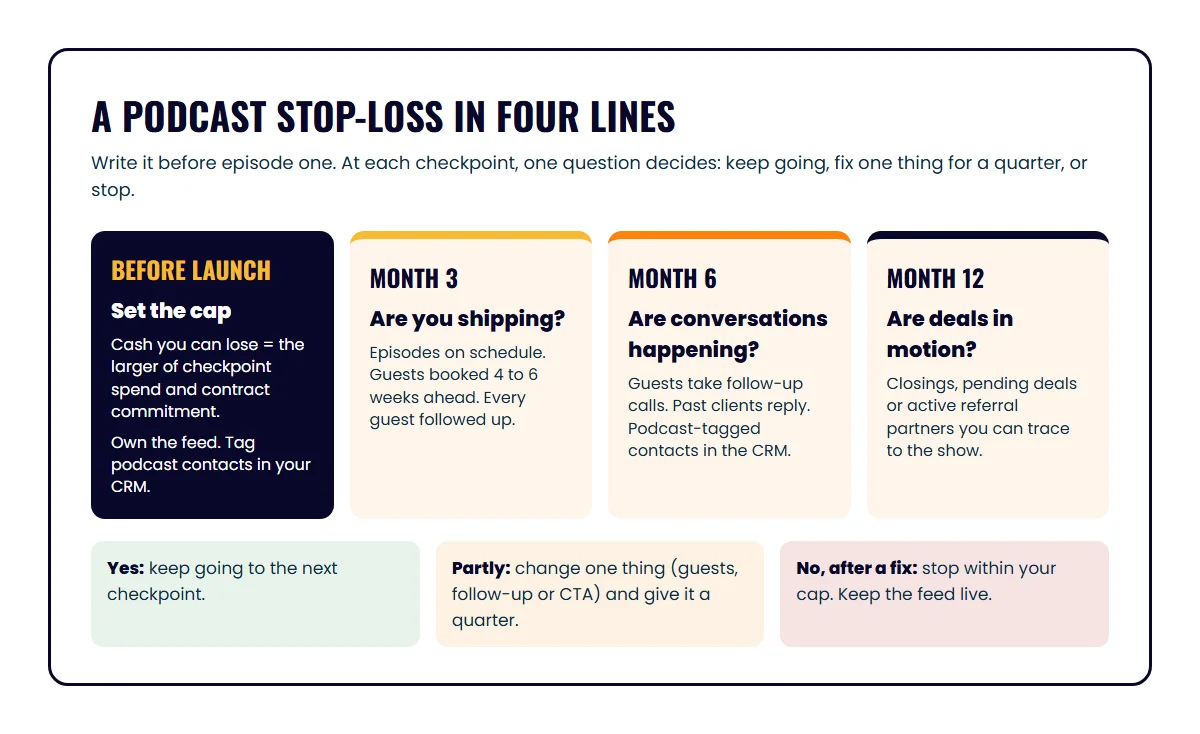
The month-six and month-twelve checks follow the same logic as the month-by-month timeline for when a podcast generates business. Judge conversations first and deals later, because closings from relationships lag the episodes by months. To make the month-six check possible at all, set up podcast lead tracking in your CRM before episode one.
Which podcast setups put less money at risk?
The setups that put less money at risk cut either the monthly cost or the commitment. That means guesting on other people’s shows, recording less often, or paying for setup once and running the show yourself.
This table compares the options by cash at risk and by what you give up.
| Setup | Cash at risk | What you give up |
|---|---|---|
| Guest on other people’s podcasts | Lowest. ICONS Lite on the ICONS Hub is free; Concierge is $87/mo | You don’t own the show or choose the guests |
| DIY podcast | Low cash, high hours | Your time, and consistency when you’re busy closing |
| Setup package, then DIY | One-time cost; the ICONS Launchpad setup package starts at $497 | Ongoing editing, booking and publishing fall to you |
| Done-for-you, bi-weekly | Mid; bi-weekly runs at a reduced rate | Half as many conversations a month |
| Done-for-you, weekly | Highest monthly cost | Nothing on output, but the most money on the line |
Guesting is the cheapest way to test whether conversations bring you business at all. If interviews on other shows produce follow-up calls, hosting your own will likely do more. If they produce nothing, fix your message before you pay for a show.
Cadence is the other lever. Recording every other week halves the number of guests you meet, but it also cuts the cost and the chance you’ll fall behind. For most busy agents, a bi-weekly show they keep up beats a weekly show they abandon. The reasons podcasts fail by episode six come down mostly to schedule.
How do you fix a podcast that isn’t paying off yet?
A podcast that isn’t paying off yet usually has one of three problems: the wrong guests, no follow-up after recording, or no clear next step for listeners. Fix those before you decide the format doesn’t work.
- The guest list. If you interview people who will never refer you or hire you, the relationship output is zero. Swap in local business owners, lenders, past clients and agents in feeder markets.
- The follow-up. A guest who hears nothing after recording forgets you. Send the episode, the clips and a note, then book a coffee within a month.
- The call to action. Every episode should end with one action: reply to an email, book a call or download a guide. One, not three.
Change one of these at a time and give it a quarter. If you’ve already stalled, the steps to relaunch a stalled real estate podcast cover the restart. Our sibling piece, an honest ROI check for solo agents, helps you decide whether the show deserves a second year at all.
How do you stop or switch without losing what you built?
You stop or switch without losing what you built by keeping control of the feed. The feed carries your followers and directory listings, so whoever controls it controls whether your back catalog keeps working after you stop.
Three options, from softest to hardest:
- Take a season break. Publish a short episode saying the show is pausing, keep the feed live and keep sharing old episodes with clients and guests.
- Switch producers or hosts. Apple says the old host should send a 301 redirect and your new feed should carry the
<itunes:new-feed-url>tag, and both should stay live for four weeks or more. Followers move across automatically. Keep episode GUIDs unchanged, or you’ll get duplicates. - Archive the show. In Apple Podcasts Connect, archiving removes the show from Apple Podcasts, and you can restore it to a draft later. Use it only when the content no longer fits your business.
Ownership is the clause to check before any of this. With ICONS podcast production, the client owns the show: its name, artwork, episodes, audience and RSS feed. “We run it, you own it.” Ask any producer you’re considering to put the same in writing.
Next step
Write your stop-loss tonight: one spending cap and three checkpoints. Then price your setup and compare the worst case with one net commission. If you can live with that number, the risk is sized, and the only remaining job is to keep the conversations going long enough to find out.
Frequently asked questions
Can I pause a real estate podcast instead of ending it?
Yes. Announce a season break in a short episode, keep the feed live and keep sharing old episodes. A planned season break reads very differently from a show that just went quiet.
Should I delete my podcast if it didn't work?
Usually not. Old episodes still answer questions for people who search your name, and guests still share them. Archive or delete only if the content is wrong or no longer reflects your business.
Is a podcast a write-off if it never brings a closing?
Not entirely. You keep the relationships with every guest and a library of content. Whether that's worth the cash you spent is your call, which is why you set the cap before you start.
Sources
- Steve Goldstein: Why there really aren't 2 million podcasts — RAIN News (accessed October 21, 2026)
- Change the RSS feed URL — Apple Podcasts for Creators (accessed October 21, 2026)
- Archive or restore a channel, show, or episode — Apple Podcasts for Creators (accessed October 21, 2026)
- Key Takeaways from NAR's 2025 Profile of Home Buyers and Sellers — Virginia REALTORS (accessed October 21, 2026)
Free podcast tools
Plan your show in minutes
Use our free calculators and generators to price your podcast, estimate ROI and plan your first episodes.
Try The Free Tools
Written by
Co-Founder and Podcast Guru, Icons of Real Estate
Tomás Fonseca co-founded Icons of Real Estate in 2021 and is its Podcast Guru. He has a background in marketing, with stints at companies like Nintendo and Ardor SEO, and is one of the hosts of the Icons of Real Estate Podcast.

How we research, write, fact-check and correct articles: our editorial standards.