On this page
- How does ADTV work for real estate agents?
- What does a TV appearance give an agent that a podcast doesn’t?
- What does a podcast give an agent that TV doesn’t?
- ADTV vs podcast: how do they compare side by side?
- What do ADTV and a podcast each ask of your time?
- What should you ask before paying for a TV feature?
- How can you use a TV segment and a podcast together?
- Which one should you choose?
ADTV and a podcast do different jobs for real estate agents. A TV feature like American Dream TV buys borrowed authority and one polished video. Your podcast builds relationships, because every episode is a conversation with someone in your market. For referral-driven agents, a podcast usually builds more business, and an existing TV segment makes a strong trailer for it.
That is our view as a podcast production company, so weigh it with that in mind. The rest of this page describes how TV features work from public sources, where TV wins, where a podcast wins, and what to ask before you pay for either.
How does ADTV work for real estate agents?
ADTV, short for American Dream TV, is a real estate television show that films local agents as hosts of segments about their market. Back in October 2023, a Vail Daily article describes the model in some detail.
According to that report:
- the show sends a professional videographer and delivers a fully edited segment;
- the program is broadcast on ABC, CBS and Fox and streamed on Apple TV, Amazon Fire, Roku and more;
- hosts are usually referred to the show or noticed as top producers;
- there is a licensing fee to be on the show, which lets agents repurpose the content on their own social channels.
ADTV Media calls the show “Emmy-nominated” on its own site. The same page says it reaches “20+ million viewers monthly.” That is the company’s own figure for its national audience, not a count of viewers in any one agent’s market. We found no public rate card, so the fee likely depends on the market and the package.
What does a TV appearance give an agent that a podcast doesn’t?
A TV appearance gives an agent instant credibility that is hard to build any other way. “As seen on” a broadcast show is a line people understand at a glance, and it fits neatly on a listing presentation.
TV has three real strengths:
- Polish without effort. Their crew films and edits the segment. You show up and talk about your market.
- Borrowed authority. Sellers and buyers tend to assume a person on TV was vetted. That impression helps at the kitchen table.
- A finished asset. You get a produced video you can post, email and play in a presentation.
If your problem is that people in your market don’t take you seriously yet, TV addresses that directly. Agents with strong referral businesses often have the opposite problem. Their reputation is fine, and they need more people to think of them first.
What does a podcast give an agent that TV doesn’t?
A podcast gives an agent a repeating reason to have real conversations with people who can send business. Each episode is a recorded interview with a lender, a builder, a top agent in another market or a local business owner. The relationship with that guest is the main return; the episode is a byproduct.
TV is built around you. Your podcast is built around your guests, and that difference drives everything else:
- Who you meet. Television puts you in front of a production crew, while a weekly show puts you across the table from around 50 people a year who matter in your market.
- Where the audience lives. National broadcasts reach people far from your farm. Your guests share their own episodes with their local contacts.
- How long it lasts. Your segment airs once and then lives on your social feeds. Podcast episodes stay searchable, and evergreen podcast episodes outlast social posts by years.
- How much content you get. Each episode can be cut into clips, posts, a newsletter item and an article.
The trade-off is effort over time. Podcasts only work if you keep going, and most shows don’t. Steve Goldstein of Amplifi Media counted shows in Apple’s directory for RAIN News in 2021. In that count, 44% of all podcasts had published no more than three episodes, and just 36% had made it to ten.
ADTV vs podcast: how do they compare side by side?
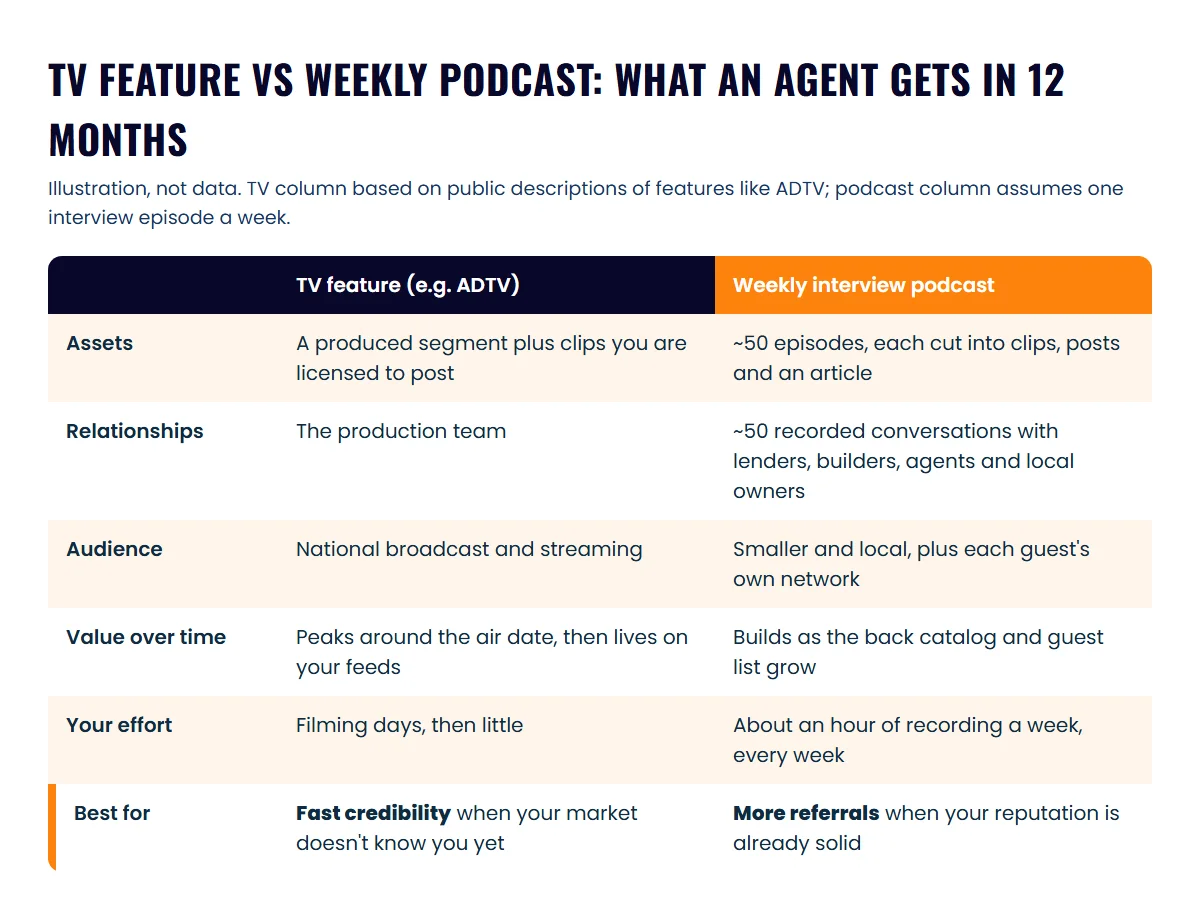
ADTV and a podcast differ most in who you meet and how long the value lasts. The table below compares a TV feature of the kind ADTV offers with a weekly interview podcast an agent hosts.
| TV feature (e.g. ADTV) | Weekly interview podcast | |
|---|---|---|
| Main return | Credibility, “as seen on” | Relationships with guests, plus content |
| Who you spend time with | The production crew | Lenders, builders, agents, local owners |
| Audience | National broadcast and streaming | Smaller, mostly local, guests’ networks |
| Your time | Filming days | About an hour a week of recording |
| Content volume | One produced segment and its clips | A new episode, clips and posts every week |
| How long it works | Strongest around air date | Back catalog keeps getting found |
| Cost visibility | No public rate card found | ICONS and other producers publish starting prices |
| Biggest risk | Paying for reach outside your market | Quitting before the show compounds |
Neither column wins every row. The question is which return your business needs next.
What do ADTV and a podcast each ask of your time?
ADTV and a podcast ask for very different time commitments. A TV feature takes a few concentrated filming days. A weekly podcast takes a small, fixed slot every week for as long as you run it.
That difference decides which one fits a busy agent’s calendar. Filming days are easy to protect once. A weekly recording slot needs protecting 50 times a year, and that is where most agent podcasts stall.
Three habits make the weekly slot survivable:
- Batch your recordings. Two interviews back to back every other week keeps a weekly release schedule with half the calendar blocks.
- Hand off everything after the recording. Editing, publishing and clipping are where hours disappear; a producer or assistant should own them.
- Book guests a month ahead. An empty guest list is the most common reason a show goes quiet.
If you can’t protect an hour a week, a TV feature is the more honest choice for now.
What should you ask before paying for a TV feature?
Before paying for a TV feature, ask for the full cost, the term and your usage rights in writing. These questions apply to ADTV and to any paid media program that features agents; for podcast booking agencies, use the booking agency red-flag checklist. The table lists each question and why it matters.
| Ask | Why it matters |
|---|---|
| What is the total cost, one-time or recurring? | You can’t compare it with a year of podcasting without the full number |
| How many segments do I appear in, and how long is each? | One segment and a season are very different purchases |
| Which channels, which time slots, which markets? | A late-night slot in another state does little for your farm |
| What viewing numbers can you show for my market? | National reach claims don’t tell you who near you watched |
| Which rights do I get to the footage, and for how long? | Reposting, editing and trailer use all depend on the license |
| Can I use the “as seen on” line and logos, and where? | That line is often the most lasting value of the deal |
| Who approves the script and any listing mention? | You stay responsible for what you say on air |
| What does my broker need to approve first? | Brokerage advertising rules apply to TV as they do to print |
Of these, the broker question matters most. The NAR 2026 Code of Ethics requires REALTORS® to show their firm’s name when they advertise real estate services in any medium, and it lists television by name. Clear brokerage identification and any listing mention with your broker before filming.
How can you use a TV segment and a podcast together?
A TV segment and a podcast work best together when the TV piece opens doors and the podcast keeps them open. If you’ve already paid for a segment, don’t let it fade after the air date.
Credibility from TV pays off most in the invitation step. Credibility makes high-profile guests on a real estate podcast more likely to say yes, and each of those guests is a relationship.
Which one should you choose?
Choose TV if your market doesn’t know you yet and you need fast credibility for presentations. Choose a podcast if your business runs on referrals and you want more people to think of you first.
Most established solo agents fall into the second group. Their reputation is solid and their calendar is full. What they lack is a repeatable way to meet the people who send business, and one recorded conversation a week does that. What one 30-minute podcast interview does for a referral network walks through that mechanism step by step.
Run the numbers before you decide. The podcast ROI calculator shows how many closings a show needs to pay for itself, and how long a real estate podcast takes to generate business sets honest expectations for year one. For more channel comparisons, see the real estate content lead generation guide and podcast vs paid ads for realtors, or podcast guesting vs paid ads if you’d rather guest than host.
If you want the show without the production work, ICONS done-for-you podcast production handles guest booking, editing, publishing and clips. Your part is the hour of recording.
Frequently asked questions
Do agents pay to be on ADTV?
A 2023 Vail Daily article on American Dream TV reports a licensing fee to be on the show. We found no public rate card, so ask the producer for the full cost and terms in writing.
Can I put my TV segment on my podcast feed?
Only if your agreement allows it. Usage rights for TV content vary, so check what the contract says about reposting, editing and how long you may use the footage.
Is a podcast cheaper than a TV feature?
It depends on the deal and on how long you run the show. A podcast is an ongoing cost, so compare a full year of each, then ask what each one leaves you with at the end.
Sources
- National TV show features local real estate professionals — Vail Daily (accessed October 21, 2026)
- The American Dream TV Family — ADTV Media (accessed October 21, 2026)
- 2026 Code of Ethics and Standards of Practice — National Association of REALTORS (accessed October 21, 2026)
- Steve Goldstein: Why there really aren't 2 million podcasts — RAIN News (accessed October 21, 2026)
Done-for-you podcast production
Want a podcast that brings in referrals, not just downloads?
Icons of Real Estate plans, produces and publishes business-growing podcasts for agents. You record. We handle the rest.
Launch Your Podcast
Written by
Co-Founder and Podcast Guru, Icons of Real Estate
Tomás Fonseca co-founded Icons of Real Estate in 2021 and is its Podcast Guru. He has a background in marketing, with stints at companies like Nintendo and Ardor SEO, and is one of the hosts of the Icons of Real Estate Podcast.

How we research, write, fact-check and correct articles: our editorial standards.