A real estate podcast doesn’t need thousands of listeners to get clients. In example math, 100 to 300 engaged listeners in your market can produce a few clients a year, plus referrals. Size matters less than two things download charts ignore: how many listeners live where you sell, and how much they trust you after hearing several episodes.
National download benchmarks are real, and the sourced numbers are below. They were built for shows that sell ads. An agent’s show sells nothing to listeners. It earns trust with the few hundred people who might hire you, or send you someone who will.
Starting from zero? Launching a podcast before you have any audience is its own problem. Tactics for raising the number live in the plan for growing a local podcast audience. The question here is how big the number has to be.
How many downloads is good for a podcast?
About 27 downloads in an episode’s first week is the median on Buzzsprout, one of the larger podcast hosts. Its platform stats page, showing September 2026 data, lists how many first-7-day downloads an episode needs to reach each tier of Buzzsprout podcasts:
| Tier of Buzzsprout podcasts | First-7-day downloads per episode (Sept 2026) | What it means for an agent |
|---|---|---|
| Top 50% (median) | 27 | Your sphere alone can get you here |
| Top 25% | 96 | A realistic first-year target for a local show |
| Top 10% | 412 | Strong for a local show; most agents never need more |
| Top 5% | 1,007 | Usually national reach or a big existing following |
| Top 1% | 4,586 | Celebrity and network territory |
That answers the “what percentage of podcasts get 1,000 downloads” question too. On Buzzsprout’s numbers, an episode with about 1,000 first-week downloads sits in the top 5%. Most shows never get there, and a local agent show doesn’t have to.
What about average downloads per episode?
Skip averages. A handful of huge shows drag the average far above what a typical show gets, which is why Buzzsprout reports percentiles. The median of 27 is the honest “typical” figure.
Three caveats before you compare yourself to that table:
- It’s one host. These are Buzzsprout shows only. Other hosts count the same way under industry rules (Buzzsprout says its stats follow IAB Podcast Measurement Technical Guidelines 2.2), but their mix of shows differs.
- It’s the first 7 days. Local episodes often keep getting played for months as people search, get forwarded a link or binge before a listing appointment.
- It counts downloads, not people. One listener can create several downloads, and some downloads are never played. YouTube views aren’t in it at all.
Why don’t download benchmarks fit a local agent show?
Download benchmarks measure reach, and an agent needs relevance. A national show earns money per thousand listeners, so it needs as many as possible from anywhere. You earn money when one person in your market decides to buy or sell and calls you. A listener three states away is worth almost nothing to you, however loyal.
So split every audience into three questions:
- How many are local? Could they hire you, or refer someone who could?
- How many are engaged? Do they hear enough of each episode to know who you are?
- How much do they trust you? Have they heard you several times, ideally talking about places and businesses they know?
A large audience that fails the first question is a vanity number. A small one that passes all three is a pipeline.
How do you work out how many listeners you need?
Work backwards from the number of clients you want each year, using a formula simple enough to do on a napkin:
Listeners needed = clients wanted ÷ (share of local listeners who move in a year × share of those who pick you)
Neither rate has a published benchmark for agent podcasts, so treat them as dials. Set them from your own market and experience, then adjust once you’ve tracked a year.
Here is the same formula run three ways. All three columns are assumptions for illustration, not data.
| Clients a year from listeners | Cautious (3% move, 15% pick you) | Middle (5% move, 30% pick you) | Strong (7% move, 40% pick you) |
|---|---|---|---|
| 1 | 222 local listeners | 67 local listeners | 36 local listeners |
| 2 | 444 | 133 | 71 |
| 4 | 889 | 267 | 143 |
Read the middle column as the planning case. Under its assumed rates, around 130 engaged local listeners can plausibly produce two clients a year on their own. That is roughly the top-25% tier on Buzzsprout’s chart, and it’s within reach of a show built on your sphere and your guests.
Now put a dollar figure on it. Example: you keep $9,000 from a typical closing, so two listener clients a year is $18,000 in gross commission. Set that against the show’s cost with the closings-to-break-even worksheet, or run your own figures through the podcast ROI calculator.
Why the “pick you” rate can be high
The pick-you rate is the dial most agents set too low. A listener who has heard you talk about their town for six months isn’t comparing you with strangers. You’re the agent they already know. The cautious column assumes that familiarity barely matters. The strong column assumes it matters a lot. Your episodes decide which column you live in: local guests and local topics push the rate up, generic tips push it down.
Does a small local podcast still get clients?
Yes, and often more than the listener math alone suggests, because listeners refer. Most people who hear your show won’t move this year. Their coworkers, parents and neighbors will, though. When one of them asks around for an agent at a barbecue, your listeners already have a name.
Referrals are how most agents get hired. The Virginia REALTORS recap of NAR’s 2025 buyer and seller profile reports that 43% of buyers used an agent they found through a referral, and another 18% used an agent they had worked with before. Among sellers, 66% found their agent through a referral or used an agent they’d worked with in the past.
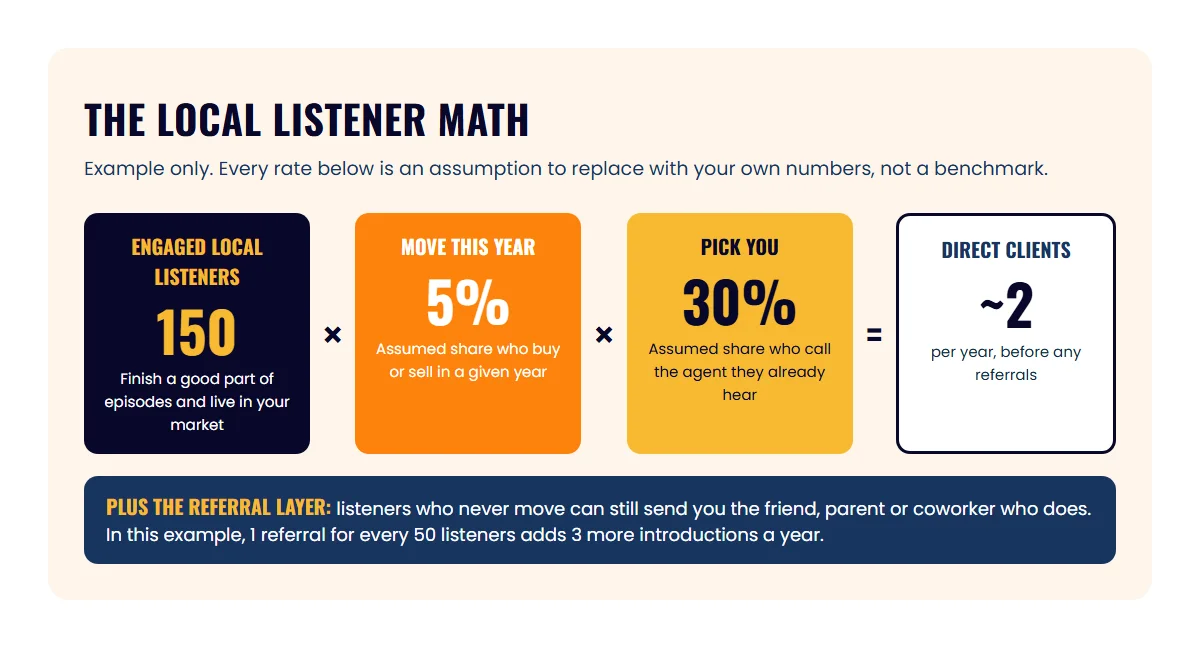
A podcast feeds both of those paths. It keeps past clients hearing from you, and it gives everyone else a reason to name you. In the figure above, one referral for every 50 listeners each year would add three introductions to the two direct clients. That rate is an assumption too, but it shows why a small audience punches above its size.
Listeners are also only one of the ways a show makes money. On an interview show, guests and your sphere usually produce business first, often months before your listener count means anything. For the guest side, see how local business interviews turn into leads.
Local talk should stay on places, homes and businesses rather than who lives where; the Fair Housing checklist for podcast episodes covers the rest.
How do you find your real local listener number?
Use Apple Podcasts analytics, because it gives you both pieces: engaged listeners and cities. Per Apple’s listener analytics help page, engaged listeners are the people who “listened to or watched at least 20 minutes or 40% of an episode,” and top cities shows “the total number of unique devices per city.”
- Open Apple Podcasts Connect and set the time frame to the last 60 days or the last few episodes.
- Note engaged listeners per episode. This is closer to “people who know your voice” than downloads are.
- Open top cities. Add up the devices in the cities and suburbs you actually serve, then divide by the total to get your local share.
- Multiply engaged listeners by your local share. That’s your Apple local engaged number.
- Add the people you can name. Replies, comments and “I heard your episode” mentions tagged in your CRM. Many people in your sphere listen on YouTube or a browser, and Apple never sees them.
Don’t panic at a blank screen early on. Apple shows no data until at least five unique listeners have played your show in the selected time frame. For the named listeners, a “Podcast” source tag in your CRM is all you need.
When is your listener number too small?
Your number is too small when the worksheet says it can’t produce even one client a year in the cautious case, and it isn’t growing. Size alone isn’t the problem. A small number that’s rising and mostly local is a show on track. Use this table to decide what to do.
| What you see | What it means | What to do |
|---|---|---|
| Under 30 engaged listeners, mostly local | Early stage, normal for the first months | Keep publishing; work your sphere and guest shares |
| 30 to 150 engaged, mostly local | A working local audience | Tighten your call to action and follow-up; this can already produce clients |
| 150+ engaged, mostly local | A strong local show | Protect the schedule; put the episodes in front of every listing appointment |
| Big numbers, small local share | Reach without relevance | Add place names to titles, book more local guests, drop generic tips |
| Flat for six months at any size | Promotion or consistency problem | Fix promotion and your publishing schedule before changing the format |
The bands above are rules of thumb from the example math, not industry cut-offs. Shows that stall usually stop before the audience has time to build; the episode-6 drop-off and how agents push past it explains the pattern.
If the number is fine but you don’t have time to keep the show consistent, that’s the part to hand off. Icons of Real Estate can take editing and publishing off your plate, which frees your hours for guests and follow-up. Those two move the number.
Next step
Open Apple Podcasts Connect today and fill in the first five lines of the worksheet. Then pick the column in the reverse table that matches your honest estimates, and write down the local listener count you need for the clients you want. That’s your target, not a download chart.
Frequently asked questions
Is 100 downloads per episode good for a real estate podcast?
Yes, if most of those people live in your market. On Buzzsprout's September 2026 stats, 96 first-week downloads already puts an episode in the top 25% of its shows, and a local audience of that size can be enough for clients.
What percentage of podcasts get 1,000 downloads?
Per episode, very few. Buzzsprout's September 2026 stats put 1,007 downloads in an episode's first 7 days at the top 5% of its podcasts. An agent's show doesn't need to reach that.
Are downloads the same as listeners?
No. A download is a file request from an app or device, and one person can create several, while some downloads are never played. Apple's engaged listeners metric is closer to the people who actually heard you.
Should I buy downloads or paid promotion to look bigger?
No. Bought listeners are almost never in your market and can't hire you. They also blur the analytics you need to judge the show.
Sources
- Buzzsprout Platform Stats — Buzzsprout (accessed October 6, 2026)
- Key Takeaways from NAR's 2025 Profile of Home Buyers and Sellers — Virginia REALTORS (accessed October 6, 2026)
- Listener analytics — Apple Podcasts for Creators (accessed October 6, 2026)
Done-for-you podcast production
Want a podcast that brings in referrals, not just downloads?
Icons of Real Estate plans, produces and publishes business-growing podcasts for agents. You record. We handle the rest.
Launch Your Podcast
Written by
Co-Founder and Podcast Guru, Icons of Real Estate
Tomás Fonseca co-founded Icons of Real Estate in 2021 and is its Podcast Guru. He has a background in marketing, with stints at companies like Nintendo and Ardor SEO, and is one of the hosts of the Icons of Real Estate Podcast.

How we research, write, fact-check and correct articles: our editorial standards.