On this page
- What does “growing” a real estate podcast actually mean?
- Where should a local podcast’s listeners come from?
- How do you get your sphere to listen to your podcast?
- How does the guest-network effect grow a local show?
- Which local partnerships and cross-promotions work?
- Do community events grow a podcast audience?
- How do local people find your podcast on YouTube and Google?
- Do social clips grow a local podcast?
- What should you measure in Apple, Spotify and YouTube analytics?
- Why isn’t my real estate podcast growing?
- What should you skip when growing a local podcast?
- A 90-day growth plan for a local agent podcast
- Next step
To grow a real estate podcast, build the audience from the inside out. Get your sphere listening first, then let every guest share the episode with their own customers, then trade promotion with local partners, and finally make each episode findable on YouTube and your website. Measure local listeners and conversations, not total downloads.
Everything below assumes your show is already live. Still in planning? Get the format, gear and launch sorted with the step-by-step plan to start a real estate podcast, then come back once three episodes are out. Launching with nobody listening yet is a separate problem, covered in starting a podcast with no audience.
What does “growing” a real estate podcast actually mean?
Growing an agent’s podcast means more of the right local people hear you regularly. It does not mean climbing the charts. A national business show needs tens of thousands of downloads to sell ads. You need homeowners, buyers and referral partners in your market to know your voice before they need an agent.
That changes what “good” looks like. For example, a show with 200 regular listeners who mostly live in your farm area can produce more business than one with 5,000 listeners scattered across the country. The first group can hire you. The second group mostly can’t. For where national download benchmarks fit and how small a local audience can be, see how many listeners an agent’s podcast needs.
So when this guide says “grow,” it means three things, in this order:
- Local reach. More listeners and viewers in the places you sell.
- Depth. A bigger share of them finishing episodes and coming back.
- Action. Replies, introductions and calls that trace back to the show.
Download totals sit underneath all three. Watch them, but don’t steer by them.
How long does it take to grow a local show?
Expect three speeds. Your sphere and your guests can bring listeners from week one. Local partnerships take a few months to set up and start paying off. Search traffic from YouTube and your website is the slowest, often six months or more, because it needs a library of episodes before it adds up. Agents who quit at month three usually quit right before the slow channels start working.
Where should a local podcast’s listeners come from?
A local agent show should get listeners from four places, in order of how quickly they pay off: your sphere, your guests’ networks, local partners and community groups, and search. Most generic podcast growth advice starts at ring four (SEO, charts, ads), which is the slowest ring and the least local.
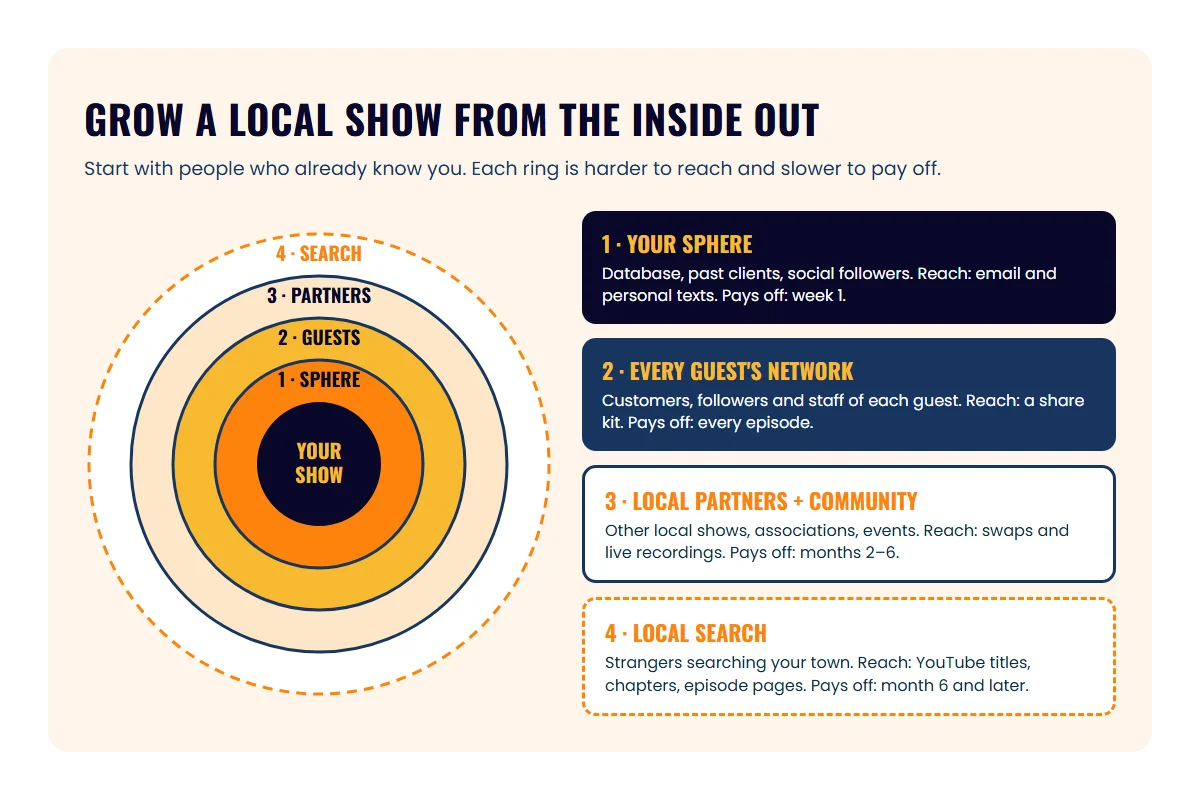
| Ring | Who they are | How you reach them | When it pays off |
|---|---|---|---|
| 1. Sphere | Your database, past clients, friends, social followers | Email, personal texts, social posts | From the first episode |
| 2. Guest networks | Each guest’s customers, followers, staff and family | A share kit and a direct ask | Every episode, if you choose guests well |
| 3. Partners and community | Other local shows, business groups, nonprofits, event audiences | Swaps, live recordings, newsletters | Usually months two to six |
| 4. Search | Strangers searching YouTube and Google about your town | Local titles, chapters, episode pages | Builds over six months and longer |
Each ring feeds the next. Your sphere gives you early listeners, which makes guests more willing to come on. Guests introduce you to partners. Partners and guests link to your episode pages, which helps search. Spend your first 90 days mostly on rings one and two.
How do you get your sphere to listen to your podcast?
Tell them personally, tell them often, and make it about them. Your database already trusts you, so it’s the cheapest audience you’ll ever get. The mistake most agents make is sending one launch email and then going quiet.
Use your email newsletter every episode
Add a short podcast section to every newsletter, or send a short email for each new episode if you don’t have a newsletter yet. Lead with the guest and the local topic, not “new episode out now.” People open emails about their neighborhood, their schools’ new sports complex or the restaurant opening on their street. They rarely open emails about your content.
The reply question matters more than the link. It gives people a reason to write back, which tells you who’s paying attention and hands you future guests. Keep your unsubscribe link and required brokerage details in every email. Email compliance basics and reply tagging are part of the wider content-to-leads system for agents.
Send personal texts to your top 50
Pick the 50 people most likely to refer you: past clients, close friends, people in your farm you know by name. For each episode that matches their interests, send a one-line personal text. “Thought of you. I interviewed the owner of the bakery you love. Five minutes in, she tells the story of the original location.” That’s not a blast. It’s a conversation starter that happens to include your show.
Put the show where your sphere already sees you
- Your email signature: one line with the show name and a link to your podcast page.
- Your social bios on every platform. Use the same podcast page link everywhere.
- Your listing presentation: a slide with two or three relevant episodes. Sellers like hearing that you know the local business owners.
- Your closing gift card: “Our show interviews the people who make [town] great. Here’s where to listen.”
How does the guest-network effect grow a local show?
Every guest you interview has an audience you don’t: customers, followers, staff, family and their own email list. When a guest shares the episode, their people hear you for the first time, already pre-sold by someone they trust. For a local interview show, guest shares are usually the biggest growth channel in the first year.
The effect compounds. Each guest also knows other people worth interviewing, so your guest list and your audience grow together. It’s the main reason an interview format suits most agent shows better than solo episodes.
Choose guests partly for their audience
You should still pick guests for what they can teach your listeners. But when two guests are equally useful, pick the one with the bigger local following. Good questions to ask yourself before you invite someone:
- Do they have a customer email list or an active local social account?
- Do they have a physical location where customers wait, sit or browse?
- Are they connected to a group with its own newsletter: a chamber, a school foundation, a nonprofit board?
- Will they be proud to share this? (People share episodes that make them look good.)
Local business owners, nonprofit leaders, coaches, event organizers and well-known tradespeople tend to score high. If you’re building your first list, booking your first 10 guests walks through who to ask and in what order.
Make sharing effortless with a share kit
Guests don’t share because they don’t know what to post. Fix that by sending everything on release day: the episode link, two short vertical clips, a square graphic, and two suggested captions they can paste. Tag them on every platform. A ready-to-fill guest share kit with captions saves you building one from scratch.
Ask in advance, not after
Tell guests at booking that you’ll send a share kit and that you’d love them to post it. Mention it again at the end of the recording. People keep promises they made out loud. After release, send a thank-you with the kit attached and, a week later, a note with how the episode is doing. Guests who feel the episode did well share it again.
Which local partnerships and cross-promotions work?
The best local partnerships are with people who already talk to your market every week: other local podcasts, business associations, community newsletters and nonprofits. You offer content and exposure; they offer an audience that trusts them. Keep it simple and mutual.
| Partner | What you offer | What you ask for | Watch out for |
|---|---|---|---|
| Another local podcast (non-competing) | A guest spot for the host on your show | A guest spot for you on theirs | Pick shows with a local audience, not just any show |
| Chamber of commerce or business association | Free episodes featuring their members | A mention in their member newsletter | Associations may have rules about promoting member businesses |
| Community newsletter or local blog | An episode summary they can run as content | A link to the episode page | Write a real summary, not an ad |
| Nonprofit or school foundation | An episode about their cause or upcoming event | A share to donors and volunteers | Talk about the event and its impact, not about who lives nearby |
| Other agents in feeder markets | An episode on moving to your area | An episode on moving to theirs | Clear agent-to-agent referral arrangements with your broker |
| Lenders, title, inspectors | An expert episode | A share of the episode they appeared in | RESPA: no paid co-promotion without broker or compliance review |
Guesting on other shows is the fastest cross-promotion of all, because you meet a ready-made audience in one conversation. The podcast guesting guide for agents explains how to find local shows and pitch them.
Do community events grow a podcast audience?
Community events do grow a local podcast audience, and most agents underuse them. A live recording or a recurring local appearance puts you in a room with exactly the people you want listening. It also gives guests and partners a reason to promote you to their crowd, since the event is partly theirs.
Three event formats work well for agents:
- Live recording at a local business. Record an episode at a coffee shop, brewery or bookstore with the owner as guest. The owner promotes it to customers, you invite your sphere, and attendees become listeners who were “there.”
- Panel episode at a community event. Offer to host a short panel at a farmers market, festival or charity event, then publish it as an episode. Organizers love free content.
- Neighborhood Q&A night. A homeowner question night with a local inspector or contractor, recorded and released as an episode.
At every event, put a QR code on a table sign that goes to your podcast page, not to a generic homepage. Ask people to follow the show right there on their phones. A follow made in person is worth more than a click from an ad.
Check with your broker before you run an event with your brokerage name on it, and avoid giving away things of value to referral sources. Keep any raffle or giveaway simple and cleared in advance.
How do local people find your podcast on YouTube and Google?
Local people find a podcast on YouTube and Google by searching a local question and landing on an episode that answers it. Strangers rarely type “real estate podcast” into anything. They type “moving to [town],” “best time to sell in [county]” or “[suburb] new construction.” Your job is to make each episode the answer to a search like that.
Make YouTube your local search engine
YouTube is where locals and people moving in search for “what’s it like to live in” questions, and a filmed episode lets them see and hear you. Upload the full video episode, not a static image of your cover art. Filming setup is covered in running a real estate video podcast, and the cameras and mics are in this podcast equipment list for agents.
For each episode on YouTube:
- Title for the search, not the show. “Opening a Restaurant in Downtown [Town]: What It Takes in 2026” beats “Episode 14 with Maria.” Put the place name early.
- Add chapters. Chapters let viewers jump to the part they care about and spell out your topics. YouTube’s video chapters help page sets three rules: start the list at 00:00, list three or more timestamps from earliest to latest, and keep every chapter 10 seconds or longer. Name chapters after real questions: “02:15 Why parking matters for retail on Main St.”
- Write a real description. Two or three sentences on what the episode covers, the guest’s name and business, the place names you discuss, and a link to the episode page on your site.
- Use a readable thumbnail. Your face, the guest’s face (with permission) and three or four words with the place name.
- Group episodes into playlists by area or topic. “Living in [Town],” “Selling in [County],” “[Town] Business Owners.” Playlists keep local viewers watching the next episode.
- Pin a comment asking a local question: “What business on Main St should we feature next?”
Give every episode its own page on your website
An episode page is a page on your own site with the embedded episode, a summary, chapter-style headings and your call to action. It’s the page you link from emails and QR codes, and the one Google can show to someone searching your town. The show page on your podcast hosting platform and the Apple listing belong to them. The episode page belongs to you.
A strong local episode page includes:
| Element | What to include | Why it helps |
|---|---|---|
| Title | The local question the episode answers, with the place name | Matches what people search |
| Summary | 150 to 300 words in plain language | Gives search engines and readers context |
| Embedded player | Audio player and the YouTube video | Lets visitors listen without leaving |
| Key points | 3 to 6 headings or bullets that match the chapters | Easy to skim; answers sub-questions |
| Guest section | Name, business, link to their site | Guests often link back, which helps your page |
| Transcript or detailed notes | A cleaned-up transcript or long notes | More local terms on the page |
| One call to action | The same ask you use in the episode | Turns visitors into contacts |
| Disclosure | Brokerage name and required details | Broker advertising rules |
Ask every guest to link to their episode page from their own website’s press or “as featured on” section. Those local links are part of the guest-network effect too.
Do social clips grow a local podcast?
Clips grow awareness, but only if they’re local and specific. A 40-second clip of a bakery owner explaining why she picked your downtown will travel further in your town than a generic “three tips for buyers” clip. The guest will also share it, which is half the point.
Keep clips short, caption them, and put the place name in the first line of the caption. Clip length and the cutting workflow are in how agents cut podcast clips. Tag the guest and any business or location mentioned.
Post fewer, better clips. Two strong clips per episode, posted on the platforms where your local audience actually spends time, beat ten clips spread thin. For many agents that’s Instagram and Facebook for homeowners, plus YouTube Shorts because they sit on the same channel as your full episodes. Your personal branding plan should decide which platforms you commit to.
What should you measure in Apple, Spotify and YouTube analytics?
Measure whether your listeners are local, whether they finish episodes and whether they come back. Each platform shows a different slice, and none of them shows the full picture, so check all three once a month and write the numbers down.
Apple Podcasts
Apple’s analytics help page defines the metrics that matter most for a local show:
- Listeners: “The total number of people that listened to or watched your show.”
- Engaged listeners: people “who listened to or watched at least 20 minutes or 40% of an episode.”
- Top cities: “The total number of unique devices per city.”
Two practical notes from the same page: no data appears until “at least five unique listeners” play your show in the selected time frame, and the default view shows “the last 60 days.” For an agent, the most useful view is top cities. If your metro isn’t near the top, your promotion is reaching the wrong people.
Spotify
Spotify for Creators splits analytics into sections. The engagement analytics page covers consumption time, follower counts and each recent episode’s completion rate “in their first 7 days after publishing.” It also notes that these engagement numbers “only show people who engage and listen to or watch your show on Spotify.”
The audience analytics page lists the breakdowns you can see, including locations, which Spotify says come “from Spotify and all platforms.” Use location to confirm local reach and completion rate to spot which topics hold attention.
YouTube
YouTube Studio’s analytics are organized in tabs. Per YouTube’s getting started page, the Reach tab shows how people discover your channel, including “impressions, impressions click-through-rate, views, and unique viewers,” and the Audience tab shows “what percentage of your audience are new, casual, and regular viewers.” The same page warns that some data, such as geography and traffic sources, “may be limited.”
For a local show, check three things on YouTube each month: which episodes get found through search (your titles are working), how many viewers are regulars (your show has a following), and where viewers are when YouTube shows it.
Your local scorecard
Put platform numbers next to the numbers only you can see. This monthly scorecard takes about 20 minutes to fill in:
| Metric | Where to find it | What it tells you |
|---|---|---|
| Share of listeners in your metro | Apple top cities, Spotify locations, YouTube geography | Whether you’re reaching the right market |
| Engaged listeners per episode | Apple Podcasts Connect | Whether people stick around past the intro |
| Completion rate, first 7 days | Spotify for Creators | Which topics hold attention |
| Regular viewers | YouTube Audience tab | Whether you’re building a habit |
| Guests who shared their episode | Your own tracker | Whether your share kit works |
| Replies to episode emails | Your inbox or email platform | Whether your sphere is listening |
| Contacts tagged Podcast | Your CRM | Whether attention turns into conversations |
The bottom three rows matter most. Tying the show to actual closings takes CRM source tags and UTM links, both explained in real estate podcast cost and ROI.
Why isn’t my real estate podcast growing?
Most stalled agent podcasts have one of six problems, and each shows up in a specific way. Find your symptom, then fix the cause instead of posting more.
| Symptom | Likely cause | Fix |
|---|---|---|
| Downloads flat since launch | Only your sphere knows about it; guests aren’t sharing | Send a share kit to every guest and ask at booking |
| Lots of listeners, few in your city | Topics or promotion are too general | Add the place name to every title; pick local guests |
| People start but drop off early | Long intros, slow first five minutes | Open with a strong guest moment; cut the small talk |
| YouTube views near zero | Audio-only uploads or titles with episode numbers | Upload real video; use local, question-style titles and chapters |
| Listeners but no calls or replies | No clear, repeated call to action | Pick one ask and repeat it in every episode, email and page |
| Growth stopped after a few months | Irregular schedule or a long gap | Batch-record ahead and keep the same release day |
The most common cause is the last one. Shows that skip weeks lose the habit they built, and every gap resets some of your progress. If your show has already gone quiet, follow the steps to relaunch a stalled podcast. If time is the reason, the weekly time budget in how real estate podcast production works shows what to hand off.
What should you skip when growing a local podcast?
Skip anything that buys attention from people who can’t hire you. For a local agent show, these usually waste money or time:
- Paid podcast promotion services and download packages. They tend to deliver listeners from anywhere, and you can rarely tell who those listeners are. A local show gains little from them.
- Chasing the charts. Category rankings measure a national audience. Your market is a few zip codes.
- Posting clips on every platform. Two platforms done well beat six done badly.
- Big-name national guests with no local tie. They’re fine occasionally for credibility, but they rarely share, and their audience isn’t in your market.
- Changing the show every month. New names, new formats and new days confuse the people who were starting to listen.
A 90-day growth plan for a local agent podcast
Run this plan once your show has at least three episodes live and you publish every week or every two weeks. It focuses on rings one and two first, then adds partners and search habits. Each block takes a few hours a week on top of recording.
| Days | Focus | Tasks | Done when |
|---|---|---|---|
| 1–7 | Set up | Create an episode page for every live episode; add chapters and local titles on YouTube; add a podcast line to your email signature and social bios; tag “Podcast” as a CRM source | Every episode has a page and a local YouTube title |
| 8–14 | Sphere | Send an episode email to your full database; text your top 50 personally; add a podcast slide to your listing presentation | Email sent; replies logged |
| 15–30 | Guests | Build a share kit template; send kits to every past guest and ask them to share again; book the next four guests, choosing for local reach | Every guest has a kit; four guests booked |
| 31–45 | Partners | Pitch two non-competing local podcasts for a guest swap; offer an episode summary to the chamber or a community newsletter | One swap or feature confirmed |
| 46–60 | Community | Plan one live recording at a guest’s business; print a QR table sign to your podcast page | Event date set and promoted by the host business |
| 61–75 | Search | Group YouTube episodes into area and topic playlists; add transcripts or detailed notes to your three best episode pages; ask guests to link to their episode page | Playlists live; three pages expanded |
| 76–90 | Review | Fill in the local scorecard; compare the first and last month; keep what moved local reach and replies, drop the rest | Scorecard done; next 90 days planned |
If the plan looks like more hours than you have, cut tasks that don’t need your voice. Editing, clips, episode pages and share kits can all be handed off. The Ongoing Production plan from Icons podcast production services covers editing, publishing, social clips and SEO episode articles on your site, so your part is the recording and the relationships.
Next step
Open your podcast analytics today and look at one number: the share of your listeners in your own city. Write it down. Then send one guest a share kit and one personal text to someone in your sphere about an episode they’d like. Need ideas for your next local guest conversation? The interview question generator builds a question list for business owners, partners and community leaders.
Frequently asked questions
How many listeners does a local real estate podcast need?
There is no magic number. If a few hundred people in your market hear you regularly and some of them reply, refer or book a call, the show is working. Check the city data in your analytics to see how many of your listeners are actually local.
How long does it take to grow a real estate podcast?
Your sphere and guest shares can bring listeners from the first week. Local partnerships usually take a few months, and search traffic from YouTube and your website tends to build over six months or more of consistent publishing.
Should I pay for podcast promotion services?
Not for a local show. Paid promotion tends to bring listeners from anywhere, and an agent needs listeners in a specific market. Spend the money on editing and clips so you have more time for guests and partners.
Is YouTube or Apple Podcasts better for growing a local show?
Use both, but YouTube does more for discovery because people search it for local questions. Apple and Spotify are where your regular listeners subscribe once they already know about you.
Can I ask my lender partner to promote the podcast?
Guests sharing an episode they appeared in is normal. Paid co-promotion, sponsorships or shared marketing costs with lenders or title companies can raise RESPA questions, so clear any arrangement with your broker or compliance team first.
Sources
- Analytics — Apple Podcasts for Creators (accessed October 6, 2026)
- Understanding Engagement analytics — Spotify for Creators Support (accessed October 6, 2026)
- Understanding Audience analytics — Spotify for Creators Support (accessed October 6, 2026)
- Get started with YouTube Analytics — YouTube Help (accessed October 6, 2026)
- Video Chapters — YouTube Help (accessed October 6, 2026)
- Housing Discrimination Under the Fair Housing Act — HUD (accessed October 6, 2026)
Done-for-you podcast production
Want a podcast that brings in referrals, not just downloads?
Icons of Real Estate plans, produces and publishes business-growing podcasts for agents. You record. We handle the rest.
Launch Your Podcast
Written by
Co-Founder and Podcast Guru, Icons of Real Estate
Tomás Fonseca co-founded Icons of Real Estate in 2021 and is its Podcast Guru. He has a background in marketing, with stints at companies like Nintendo and Ardor SEO, and is one of the hosts of the Icons of Real Estate Podcast.
How we research, write, fact-check and correct articles: our editorial standards.