On this page
- How to Start a Podcast: Why Real Estate Agents Should Do It
- How Much Do You Need to Start a Podcast?
- Planning Your Podcast Foundation
- Recording Your First Episode
- Quick Action Checklist
- Launching Your Podcast Successfully
- Turn Every Guest Into a Distribution Partner
- Your Episode Goes Live Tomorrow!
- Common Podcast Mistakes to Avoid
- Take the Next Step
- Frequently Asked Questions
Are you still paying Zillow $50-200 per lead only to compete with 50 other agents for the same lukewarm prospect?
If you would rather build an audience that already trusts you before they ever reach out, learning how to start a podcast is a great place to begin.
Podcasting isn’t some future trend. According to Pew Research Center, two-thirds of U.S. adults under 30 and 58% of those aged 30 to 49 have listened to a podcast in the past 12 months. And here’s the kicker: According to Edison Research, 46% of weekly podcast listeners have purchased a product or service after hearing an ad on a podcast
That’s a massive, engaged audience actively seeking expertise and connection.
And for real estate agents specifically, the numbers make it impossible to ignore:
- 86% of marketers report video-based content helps them increase web traffic
- 403% more inquiries for real estate listings with video
- 13x greater ROI for businesses prioritizing content marketing
How to Start a Podcast: Why Real Estate Agents Should Do It
Real estate is fundamentally a relationship business.
If you’re asking, “Why start a podcast?”, consider this question: how do you build quality relationships at scale without losing the personal touch?
- Option 1: Waste time creating content that doesn’t build deep relationships
- Imagine designing graphics past midnight. Or paying $100 for reels no one watches. Posting every day for months – only to have 1 lukewarm lead ghost you after the first call.
- Option 2: Build relationships without creating content
- You’re networking every Tuesday night (goodbye, family dinners). Collect 30 cards. Follow up with 8, and end up with maybe 1 client in 18 months.
The problem:
- Option 1 = scalable but shallow
- Option 2 = deep but doesn’t scale
But podcasting gives you both. Deep conversations that work 24/7 in every neighborhood while you sleep.
When you interview 52 ideal guests per year, one per week, you’re talking with people who would normally be hard to reach, the kind who rarely respond to LinkedIn messages or filter requests through their assistant.
The podcast opens doors to natural conversations with your exact target avatar.
| What Podcasting Delivers | The Real Impact |
|---|---|
| Quality Relationships | Direct access to 52+ ideal prospects, partners, or referral sources annually |
| Establishes Authority | You become the go-to resource by interviewing local experts and discussing market trends |
| Pre-Qualified Leads | Listeners who reach out already trust your expertise (less reliance on cold pitches) |
| Recurring Referrals | Past clients stay engaged and become a compounding referral source |
| Top of Mind | Be the first one people think of when they’re looking for agents in your locality. |
82% of all real estate transactions come from previous clients, referrals, friends, family, and personal contacts.
That’s not a side benefit, that’s where most of your business should come from.

A podcast keeps those past clients engaged and referring while new prospects discover you organically through local real estate search. You’re feeding both pipelines with every episode you record.
In this video, I talk about what a podcast actually does for your real estate business beyond “content creation,” so you can decide if this makes sense for your market.
And if you want a head start, download our free 5-part Podcast Framework Series, covering the referral math behind podcasting, finding and inviting the right guests, hosting the conversation, launching the show, and distributing each episode.
How Much Do You Need to Start a Podcast?
Now you may be thinking: ‘But I don’t have money to buy podcast equipment!’
Here’s something you may not realize.
You probably already own everything you need.
The Bare Minimum Setup:
| What You Need | What You Probably Already Have |
|---|---|
| Recording device | Your smartphone |
| Editing/managing platform | Your laptop or PC |
| Upload capability | Stable internet connection |
| Recording software | Zoom (you’re probably already using this for client calls) |
| Scheduling tool | Calendly (easily automate guest books, and end email back-and-forth) |
| Total cost | $0 to start |
If you’re wondering how to start a podcast for free, use the simple setup you already have and start immediately.
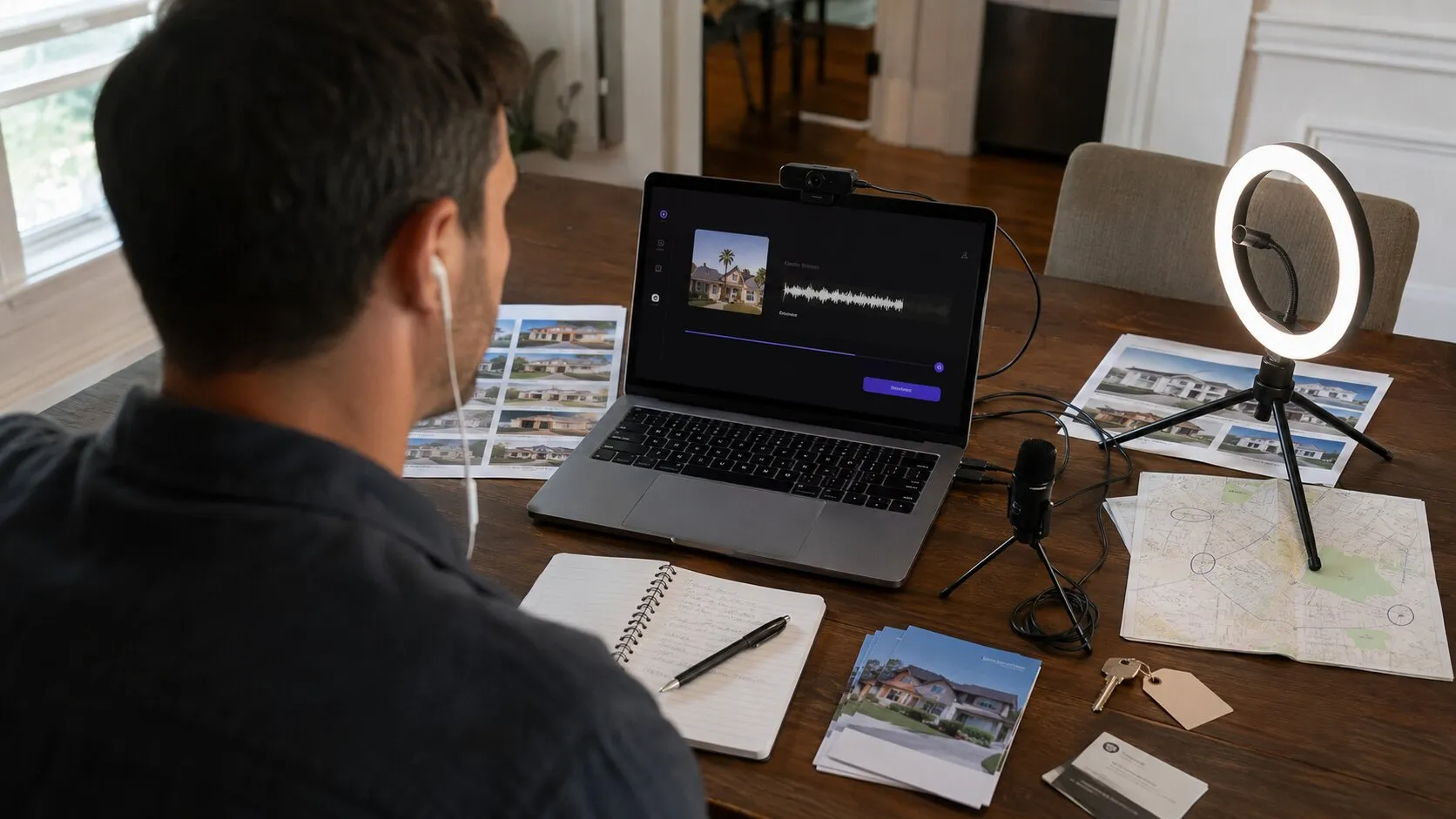
Here’s the basic podcast equipment you need. You might already have it.
Don’t wait for the “perfect” setup. Perfect is the enemy of published.
You can always upgrade your equipment as you gain experience.
If you’d rather have everything set up for you and all you need to do is show up, you can try a fully done-for-you podcast production service.
Planning Your Podcast Foundation
Most agents skip this step. Then they wonder why they quit after 3 episodes.
If you’re learning how to start a podcast for beginners, don’t wing it. Spend a few hours planning now, or spend months flailing later.
About 90% of all new podcasts actually quit after just three episodes. And for the ones that stick around, another 90% usually tap out before episode 20. Ultimately, only a small fraction, around 5% to 6% of all podcasts, ever hit the big 100-episode mark.
And if you’ve stayed consistent till episode 30, you’re already in the top 1% of podcasts that are out there.
Related Video Lesson:
Consistency comes with a plan. Here are the next steps you should take to make sure you can keep up with your podcast.
Define Your Podcast Purpose
Your podcast needs a clear business purpose. “Building my brand” or “providing value” aren’t goals. They’re vague ideas that won’t guide your content decisions.
Focus on specific, measurable business outcomes, not download numbers, social media engagement, or any other vanity metric.
The best podcast purposes tie directly to your revenue model.
Are you:
- Trying to dominate a niche?
- Generate seller leads?
- Build referral partnerships?
- Position yourself for team recruitment?
And once you’ve set up your purpose, you can then move forward to making a SMART goal: Specific, Measurable, Achievable, Relevant, and Time-bound. This framework forces you to define exactly what success looks like and when you’ll achieve it.
Here are some examples:
| Consistency comes with a plan. Here are the next steps you should take to make sure you can keep up with your podcast.
Define Your Podcast Purpose
Your podcast needs a clear business purpose. “Building my brand” or “providing value” aren’t goals. They’re vague ideas that won’t guide your content decisions.
Focus on specific, measurable business outcomes, not download numbers, social media engagement, or any other vanity metric.
The best podcast purposes tie directly to your revenue model.
Are you:
- Trying to dominate a niche?
- Generate seller leads?
- Build referral partnerships?
- Position yourself for team recruitment?
And once you’ve set up your purpose, you can then move forward to making a SMART goal: Specific, Measurable, Achievable, Relevant, and Time-bound. This framework forces you to define exactly what success looks like and when you’ll achieve it.
Here are some examples:
| Bad Goal | Good Goal |
|---|---|
| “Get more clients” | “Generate 5 qualified buyer consultations per month from podcast listeners within 6 months” |
| “Grow my audience” | “Reach 150 downloads per episode and convert 2% of listeners into email subscribers by month 6” |
| “Get more referrals” | “Generate 3 referrals per quarter from past clients who listen to my podcast regularly” |
Define Your Podcast Audience
Before recording a single episode, you need to answer one single important question:
Who are you serving?
Is it:
- First-time homebuyers who are terrified of the process?
- Luxury sellers who expect white-glove service?
- Real estate investors hunting cash flow?
- Your local community looking for neighborhood insights?
Pick one. Your answer shapes episode topics, guest selection, and marketing strategy.
If you’re not sure, here’s a step-by-step for identifying your ideal listener:
1. Define Your Ideal Listener
- Start with demographics (age, location, income),
- Then psychographics (interests, values, lifestyle).
Example: “Sarah, 32, Austin, $150K income, first-time buyer, values sustainability, overwhelmed by mortgages.”
2. Conduct Market Research
Search social media, forums, and real estate communities for recurring questions and pain points.
You could join “First Time Home Buyers [Your City]” Facebook groups. And then note the top 10 questions asked weekly.
3. Analyze Competitors
Listen to similar podcasts. Read reviews. Find the gaps they’re not filling. For example, you might notice certain luxury real estate podcasts cover market trends but skip estate planning. So you could address that in your podcast.
4. Create Listener Personas
Build detailed profiles including motivations, challenges, and content preferences.Example: “Investment Ian: 45, engineer, 3 rentals, wants 10 units in 5 years, needs property management advice, prefers tactical over theory.”
Choose Your Podcast Name
Your podcast name has one job: tell people what they’re clicking on.
So you must make it memorable, searchable, and crystal clear. Keep it to 2-5 words max.
Choose clarity over cleverness. And include real estate keywords like “property,” “homes,” or “investment,” then add your unique angle.
Include your city or community. It’s free local SEO that positions you as the area authority.
Examples from successful podcasts:
- “Real Roots: Hawaii”
- “Oklahoma Real Estate Radio”
- “Jacksonville and Beyond: Life and Real Estate”
Before you commit, make sure the name that you have is available: Do this by searching podcast directories, domain names, and social media for similar-sounding names. Then test your top 3 options with colleagues or past clients. Their immediate reaction will tell you if it works.
Brand Your Podcast
Now that you have a name, it’s time to build the visual identity around it. Branding helps people recognize you across platforms.
Here’s how to set up your branding:
-
Start with professional cover art.
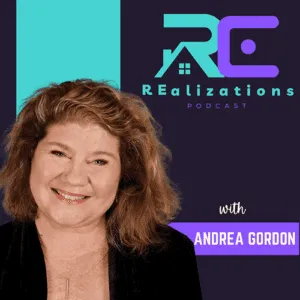
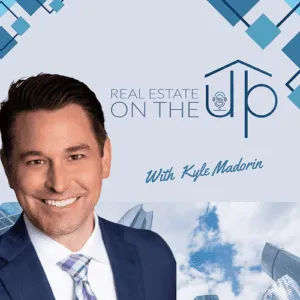
It needs to work at thumbnail size and have a bold design, clear podcast name, and brand-aligned visuals. Include your photo if possible, as people connect with faces in real estate. To make sure it’s compatible with Apple Podcast and Spotify, keep it at 3000 x 3000 pixels.
Here are sample cover arts from our podcast network:
1- Andrea Gordon for the REalizations podcast
| | --- |
2- Kyle Madorin for the Real Estate On The Up podcast
3- Kathy Byrnes for the Real Estate Riches podcast

2. Pick your brand colors and fonts, then use them everywhere:
Use them in your cover art, social media graphics, YouTube thumbnails, website, and email signatures. It helps people remember you faster.
3. Create reusable promotional templates:
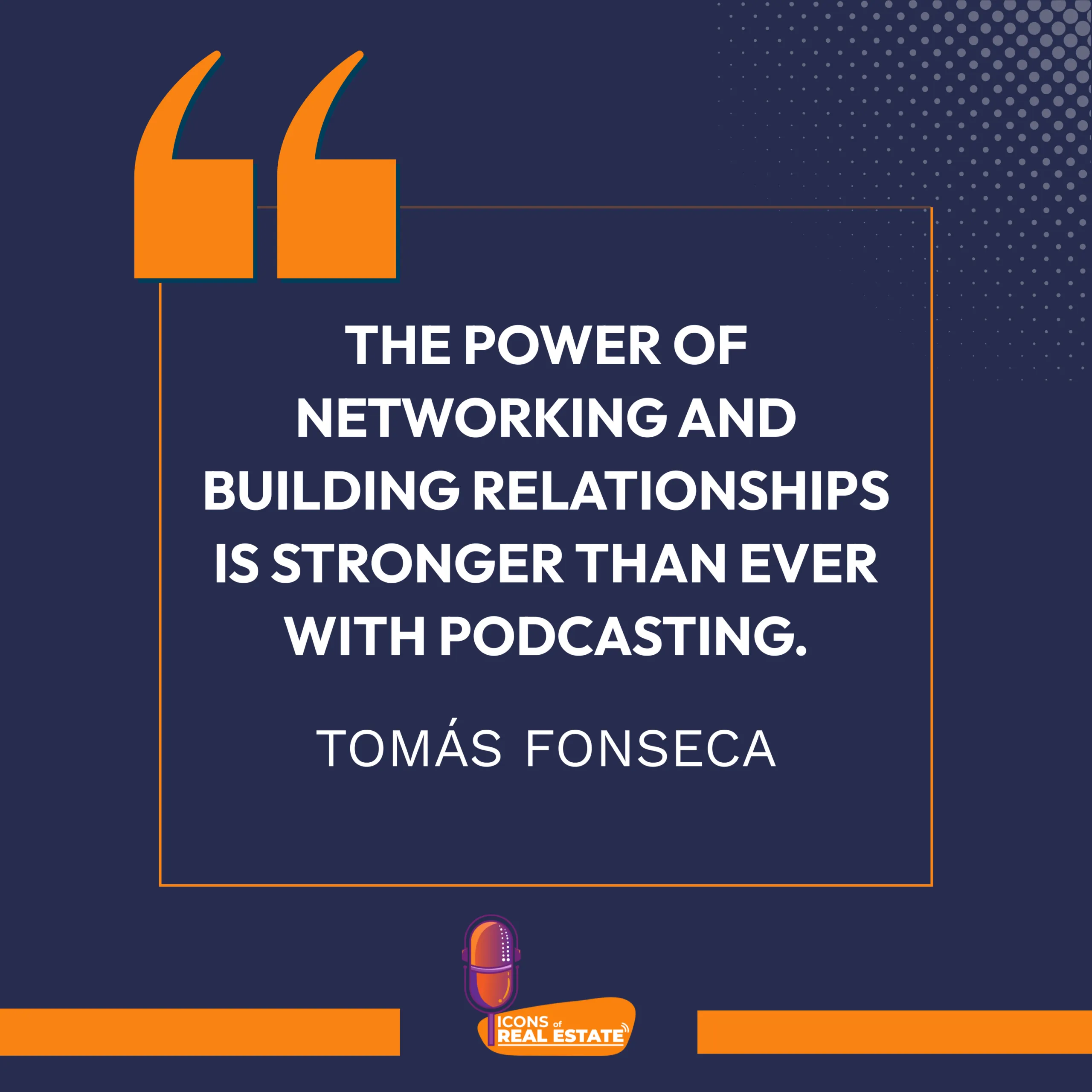
Create quote cards for key moments, episode thumbnails for YouTube, reel frames for Instagram/TikTok. Having these ready saves hours each week.
Quote Card
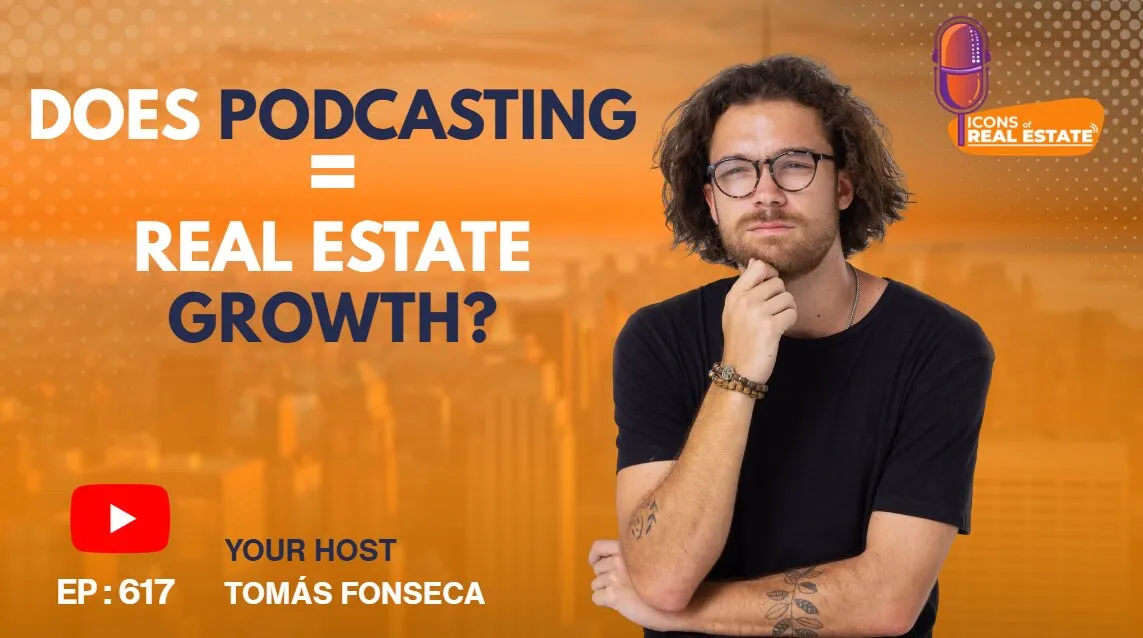
-
Keep your intro and outro under 30 seconds each.
Include a hook, your name, what the podcast delivers, and one clear call-to-action (e.g. visit your website, message you, or download your lead magnet). Add branded music to bookend each episode.
Plan Your Content Strategy
Map out your first 10-12 episodes before you record episode 1.
Why? Because here’s what could happen without a plan:
Episodes 1-3: Easy. You’re excited. Ideas flow. Episode 4: Hmm, what should I talk about? Episode 5: Panic. Total creative block. Episode 6: Never happens.
Don’t be that person.
Examples of topics that resonate with real estate audiences:
- Market Updates – What’s happening in your local market right now
- Neighborhood Deep Dives – Hidden gems, up-and-coming areas, buyer guides
- Tips & How-Tos – First-time buyer mistakes, seller preparation, negotiation tactics
- Investment Breakdowns – Cash flow analysis, market timing, portfolio strategy
- Local Voices – Business owners, community leaders, success stories
- Client Journeys – Real deals, real challenges, real outcomes
You can also create content that fits what most real estate agents would be concerned about during that season in time.
| Season | Content Focus |
|---|---|
| Spring | Selling tips, curb appeal, staging |
| Summer | Relocation, vacation rentals, market activity |
| Fall | Tax strategies, investment planning, year-end reviews |
| Winter | Market predictions, buyer prep, New Year goals |
Need detailed frameworks on content planning? Check out our podcast marketing resources.
Recording Your First Episode
You’ve done the hard thinking.
You know your audience. You’ve mapped out your first 10-12 episodes. You’ve got your microphone and recording software ready.
Next:
- Record your first podcast episode
- Find a guest to interview for your podcast episode.
You should strike a balance between sharing your own expertise on your podcast and inviting other experts to interview.
The former is self-explanatory and easier to get going.
The latter expands the areas of expertise you can cover and provide value for your audience, as well as expands your network.
Step 1: Identify and Book Your First Guests
Once your podcast concept and target audience are locked in, your immediate priority is finding voices that resonate with your listeners.
Not random voices. Not “whoever will say yes.” The right voices.
Create Your Guest Avatar
Remember that target audience you defined during planning? Now flip it.
Your Guest Avatar is a hypothetical profile of the perfect guest who:
- Aligns with your podcast goals
- Serves your audience’s needs
- Brings expertise your listeners actually want
Before you list guests, you need one thing clear:
Who is this person, really?
Define the Avatar (Demographics + Psychographics)
Think of your avatar as two layers. The facts. And the mindset.
First, the facts. This keeps your guest selection focused and relevant.
Demographics answer: Who are they on paper?
| Demographic | Ask yourself |
|---|---|
| Age range | How old are they, roughly? |
| Role & experience | What do they do, and how long have they been doing it? |
| Income & status | Are they established, top-producing, or niche experts? |
| Market & location | Where do they operate, and in what type of market? |
Then, the mindset.This is what makes the conversation interesting.
Psychographics answer: How do they think and why would they say yes?
| Psychographic | Ask yourself |
|---|---|
| Personality & tone | How do they sound on a mic? |
| Interests & lifestyle | What do they care about outside transactions? |
| Motivation | Why would they want to be on your podcast? |
| Pain points | What challenges are they actively dealing with? |
This is what turns “any guest” into the right guest.
Apply the Avatar to Real Guest Examples
Now that the avatar is clear, you can apply it to real roles.
Here’s what that looks like in practice:
Example Guest Avatars:
| Podcast Focus | Guest Avatar |
|---|---|
| First-Time Buyers | Mortgage broker in their mid-30s who specializes in low down-payment loans and explains financing in plain, story-driven language |
| Luxury Market | Mid 20s+ Interior designer with a high-end portfolio who understands affluent buyer psychology and speaks to lifestyle, not just design |
| Investment Properties | 40s Property manager handling 100+ units and $10M+ in assets who openly shares real cash-flow numbers and operational lessons |
| Local Authority | 50s Business owner in the city for 20+ years who can connect neighborhood history to where the market is going next |
Notice the difference.
“Any lender” becomes “A lender who specializes in X and communicates Y.”
That’s your filter.
Build Your Guest Pipeline
Once your avatar is clear, finding guests becomes easy.
Start building your target list across these categories.
| Industry Experts | Community Figures | Success Stories | Collaborative Pros |
|---|---|---|---|
| Mortgage brokers | Local business owners | Past clients | Contractors |
| Home inspectors | City officials | Local investors | Property managers |
| Real estate attorneys | Nonprofit leaders | First-time buyer stories | Off-market agents |
Pro Tip
Keep it simple:
- Create a spreadsheet
- Track name, role, why they’re a fit, contact info
- Update outreach status (contacted, follow-up, accepted.
Clarity upfront saves you time, awkward outreach, and bad interviews later.
Having the right guests in mind is only half the battle. Actually getting them to say yes is where most podcasts stall.
The Podcast Guest Booking Framework helps you narrow your list by checking four signals before you send an invite:
1. Substance — They genuinely know their subject. 2. Articulation — They communicate clearly and naturally. 3. Alignment — Their expertise fits your audience. 4. Commitment — They want to provide real value.
These four checks help you avoid booking guests who look impressive on paper but bring little to the conversation.
Finding your right-fit guest is Part 2 of our 5-part Podcast Framework for real estate agents . Get the full framework to see how ICONS recommends finding, evaluating, inviting, and preparing guests who can become valuable long-term relationships.
→ Get the 5 Frameworks to Grow Your Real Estate Business Here
Step 2: Master the Outreach (Without Being Annoying)
Don’t be that person who sends mass emails like: “Hi! I have a podcast. Want to be on it?”
Successful outreach isn’t all about volume. It’s also about personalization, clarity, and enthusiasm.
Here’s how to get guests who actually want to be on your show.
Do Your Homework First
Before hitting send, research your prospect.
Check their:
- Website
- Recent articles, or
- Interviews.
Find something specific – a project, achievement, or insight – and mention it in your message.
Why this works: They know you’re not copy-pasting to 50 people.
Make It Personal (And Worth Their Time)
Your email should answer three questions:
- Why them? (specific expertise or story)
- Why your podcast? (your mission and audience)
- What’s in it for them? (exposure, credibility, new audience reach)
Skip the fluff. Keep it concise. Make them curious.
Suggest Times (Don’t Ask Open-Ended Questions)
Instead of “When are you available?” say:
| “Would Tuesday at 3 PM or Thursday at 1 PM work for you?” |
|---|
Even better? Use Calendly or Google Calendar to automate scheduling and eliminate the back-and-forth.
Follow Up (Without Being a Pest)
If they don’t respond in a week, send one friendly follow-up. That’s it.
You can also try multi-channel outreach: LinkedIn message, Instagram DM… But space them out. Don’t spam every platform in 24 hours.
The bottom line: Personalize. Be clear. Respect their time. That’s how you book guests without being annoying.
Even better? Use Calendly or Google Calendar to automate scheduling and eliminate the back-and-forth.
Follow Up (Without Being a Pest)
If they don’t respond in a week, send one friendly follow-up. That’s it.
You can also try multi-channel outreach: LinkedIn message, Instagram DM… But space them out. Don’t spam every platform in 24 hours.
Want a guest outreach email you can actually send?
Framework 02: Inviting Guests includes a ready-to-customize outreach template built around a simple idea: a podcast invitation isn’t a sales pitch — it’s a platform offer.
You’ll learn how to:
Personalize the opening so the invite doesn’t feel mass-sent. Show guests why their expertise fits your audience. Make the opportunity valuable to them — through exposure, reusable content, and new relationships. Give specific scheduling options that make saying yes easier.
Ready to make guest outreach easier?
→ Get the Outreach Template + All 5 Frameworks
Step 3: Recording Your Episodes (The Actual Next Step)
Now you’re ready to hit record.
But even here, most agents miss critical opportunities by treating it like an interview instead of a conversation.
24 Hours Before Recording: Your Prep Checklist
For Your Guest (Send Reminder Email):
- Confirm date, time, and time zone
- Resend Zoom/recording platform link
- Include 2-3 sample questions
- Add tech guidelines: quiet space, headphones, stable internet, good lighting
- End with excitement: “Looking forward to discussing [topic], our listeners will love your insights!”
For Yourself (Final Prep):
- Review the guest’s LinkedIn, website, and recent articles
- Tailor questions to their specific expertise
- Create warm-up conversation topics
- Write key talking points in the Sticky Notes app (easy to reference without looking away)
- Test backup recording method (second device or cloud platform)
- Prep water, icebreaker questions, and filler topics
Why this matters: These steps, 24 hours ahead,d prevent no-shows, technical disasters, and awkward silences, letting you focus entirely on the conversation when it’s time to record.
Pre-Recording: The Warm-Up (Don’t Skip This)
That’s it. You’re not recording an audiobook. You’re having a conversation.
Join the call 5-10 minutes early.
Use this time to:
- Do a quick sound check
- Test if Zoom is working just fine
- Chat casually (break the ice)
- Build rapport before the “official” start
- Receive the guest and make them comfortable
People are nervous. Even confident professionals get weird when they know they’re being recorded.
Your job in the warm-up is to remind them: “This is just a conversation. We’re not live. If you mess up, we’ll just re-record that part. Zero pressure.”
Pro move: Record the warm-up chat anyway. Sometimes the best content happens before you “officially” start.
During Recording: Conduct, Don’t Interrogate
Your goal isn’t to grill them. It’s to guide a natural conversation that serves your audience.
Use open-ended questions:
| ❌ Bad Question | ✅ Good Question |
|---|---|
| “Is staging important?” | “Walk me through what happens when a seller refuses to stage. What do you tell them?” |
| “What’s your advice for first-time buyers?” | “What’s the biggest misconception first-time buyers have about financing that trips them up?” |
Follow the thread. If they mention something interesting, go there, even if it’s not on your question list.
The best episodes feel like you’re eavesdropping on a conversation between two people who actually respect each other’s expertise.
Post-Recording: The “TALK” or After-Chat
Most agents end the recording and say goodbye. That’s where they lose.
The real opportunity happens in the 5 minutes after you stop recording for the audience, but before your guest leaves the call.
This is when you turn a podcast guest into a referral partner, team member, or business ally.
How to Set It Up
Before you even hit record, tell your guest:
| Hey, let’s plan to hang out for a few minutes after we wrap, I’d love to get your feedback and just chat. |
|---|
This primes them to stay instead of bolting the second you say “thanks for coming on.”
Pro tip: Keep the recorder running. This post-chat often produces gold, testimonials, behind-the-scenes content, or spontaneous insights you can repurpose later.
What to Say After Recording
Step 1: Celebrate the conversation
This builds rapport and lets them decompress.
Ex.
| That was awesome. I loved what you said about [specific insight]. How did it feel for you? |
|---|
Step 2: Make a specific ask
Don’t dance around it. You’ve just spent 40 minutes building trust. You have their ATTENTION. Use it.
Ex.
| I have an amazing multifamily project here, and I know that you’ve been investing some frequent times in the past few months. Would you like me to show you the project? |
|---|
Step 3: Lock in the follow-up
Ex.
| Let’s book 15 minutes next Tuesday to discuss. I’ll send you a Calendly link. |
|---|
Related Video: The ULTIMATE PODCAST GUIDE to BOOST YOUT BUSINESS
Why This Works:
Your guest just spent 40 minutes with you. Their guard is down. They feel good about the conversation. They’re receptive.
This is your window. Don’t waste it with “let’s stay in touch sometime.”
Be specific. Ask directly. Book the next call.
That’s how podcasts turn into deals.
More about “the talk” here:
Volume Beats Perfection
Here’s what separates successful podcasters from the ones who quit:
Successful podcasters record even when they don’t feel ready.
Your first episode will be rough. Your fifth will be better. Your twentieth will be good.
But you only get to episode twenty by recording episode one.
So stop tweaking your intro music. Stop redesigning your cover art for the third time.
Book three guests this week. Record those episodes. Publish them.
Done beats perfect. Every single time.
Quick Action Checklist
Before you do anything else, complete these steps:
01. Planning Your Podcast Foundation
Most agents skip this step. Then they wonder why they quit after three episodes.
- Define your podcast goal. Referrals, listings, recruiting, investors, or authority.
- Define your target audience. Pick one primary listener and build everything around them.
- Choose your podcast format. Interview, solo, or hybrid.
- Pick a podcast name that’s clear, local, and searchable.
02. Create Your Guest Avatar
Now flip your audience into the right guest.
- Define guest demographics. Role, experience, and market.
- Define guest psychographics. Personality, motivation, and pain points.
- Write 3–4 example guest avatars.
- Identify 10 potential guests that fit the avatar.
03. Set Up Your Tech and Scheduling
Keep it simple. Done beats perfect.
- Choose your recording platform.
- Set up your microphone and quiet space.
- Create your Calendly link.
- Prepare your guest prep email template.
04. Master the Outreach
This is where most podcasts stall.
- Personalize each outreach message.
- Reference something specific about the guest.
- Suggest clear next steps or time slots.
- Track who you’ve contacted and who’s booked.
05. Prepare and Test Your First Episode
Confidence comes from preparation.
- Outline your episode structure.
- Prepare flexible, open-ended questions.
- Do a short test recording.
- Fix audio, framing, or pacing issues.
06. Book and Schedule Your First Recording
Momentum matters more than polish.
- Confirm your first guest.
- Send the calendar invite and prep email.
- Block recording time on your calendar.
- Show up early and hit record.
- Have “The Talk” and nurture your relationship.
Keep the momentum going. Repeat the steps with your second and third guests.
Launching Your Podcast Successfully
How to Start a Podcast on Spotify
If you’re wondering where to start a podcast, Spotify is one platform worth considering. It isn’t just a music platform anymore. It’s also a major podcast platform.
BY THE NUMBERS:
The process is ridiculously simple:
If you use Spotify for Creators (formerly Anchor) → Distribution is automatic. Done.
If you use another host (Buzzsprout, Libsyn, Podbean) → Submit your RSS feed through Spotify for Podcasters.
What’s an RSS feed?
It’s your podcast’s unique web address (ends in .xml or /feed). It’s the link that connects your podcast host to platforms like Spotify and Apple. When you publish a new episode, the RSS feed automatically sends the audio, title, and description to every platform you’re listed on.
How to get your RSS feed:
- Log in to your podcast hosting platform and open your podcast’s settings or dashboard.
- Look for “RSS Feed” or “Distribution” and copy the RSS feed link shown there.
- Paste that link into Spotify for Podcasters
How to Put Your Podcast on Apple
Apple Podcasts hosts over 2.6 million shows, with 31% of global podcast listening. In the US, 1 in 3 podcast listeners chooses Apple Podcast as their go-to platform.
And the process to get your podcast in there is quite simple:
- Go to https://podcasters.apple.com/ and set up your account using any Apple ID with a valid credit card on file.
- Click the + icon to add a new show.
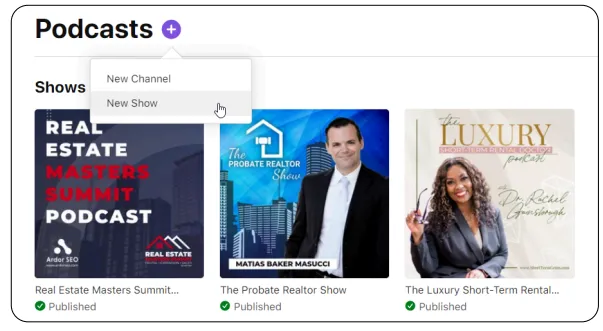
-
Select “Add a show with an RSS feed.”
-
Then, paste your RSS feed from your hosting platform.
-
Submit for review.
| If you want your podcast everywhere your audience listens, not just Apple or Spotify, 👉 Get the Syndication and Distribution Framework. It’s one of five frameworks in our complete Podcast Framework Series. Click here and discover how to to distribute your show across multiple platforms the right way. |
|---|
How to Start a Podcast on YouTube for Beginners
Video podcasting isn’t optional anymore.
For real estate agents, video podcasting gives you advantages audio can’t touch:
- 📊 Show market data visually – Charts, graphs, neighborhood maps
- 🏠 Showcase properties – Walk viewers through listings or staging tips
- 👤 Build face-to-face trust – People buy from people they know and see
Audio builds relationships. Video accelerates them.
If you’re wondering how to start a podcast for free on YouTube, begin with the equipment you already have: record your podcast with a simple webcam setup, then upload it to YouTube as a complementary channel.
Many successful shows now publish both formats, letting audiences choose how they consume content. The audio version serves listeners during commutes and workouts, while video captures viewers at their desks or on their TVs.
Pro Tip: Launch with a minimum of 3 episodes published simultaneously. This gives new listeners enough content to binge, and dramatically increases the likelihood they’ll subscribe.
The Numbers That Matter: According to Buzzsprout, getting 25-30 downloads per episode in the first week puts you in the top 50% of all podcasts. That’s not a typo. Half of all podcasts never hit that mark.
Your Pre-Launch Timeline
Promote your launch 2-4 weeks in advance across your existing channels:
| Week | Action |
|---|---|
| Week 1-2 | Tease episode topics on social media |
| Week 2-3 | Email your database with launch date |
| Week 3-4 | Personally invite past clients to listen |
Request reviews in the first two weeks. Early ratings directly influence platform algorithms, the difference between being discovered and being buried.
Turn Every Guest Into a Distribution Partner
Most agents record an episode, publish it, and hope people find it.
That’s leaving 90% of the value on the table.
The real play? Your guest becomes your marketing team.
Why Guest Promotion Matters
Your guest has an audience you don’t. When they share the episode with their network, you get:
- Borrowed credibility – Their followers already trust them, so they trust you by association
- Instant reach – Tap into their audience without paying for ads
- New demographics – Investors discover residential agents, out-of-state buyers find local experts
- Long-term partnerships – One episode becomes an ongoing referral relationship
| The strategy: Invite guests who have audiences worth reaching, local lenders, top inspectors, title professionals, community leaders. When they share, your reach multiplies organically. |
|---|
How to Get Guests to Actually Share (Without Begging)
Hope is not a strategy. If you want guests to promote the episode, make it super easy for them.
1. Create Share-Ready Materials
Don’t just send a link and pray. Give them professionally designed content they can post immediately:
| Material | Where They Use It | Why It Works |
|---|---|---|
| Short clips (15-60 sec) | Instagram Reels, TikTok, LinkedIn | Bite-sized content performs best |
| Quote cards with their face | Stories, Facebook | Visual + recognition = engagement |
| Audiograms | Twitter/X, LinkedIn | Shows it’s audio, grabs attention |
| Thumbnail images | YouTube, newsletters | Professional = more clicks |
Pro tip: Use consistent branding (your podcast colors/fonts) but make their insight the star. Make them look good, and they’ll want to share it.
2. Write the Caption for Them
Most people don’t share because they don’t know what to say. So say it for them:
“I had a great conversation with [Your Name] on [Podcast Name] about [topic].
We covered [key insight] and why [surprising takeaway].
Worth a listen if you’re interested in [niche/audience].
🎧 Listen to the episode
All they do? Copy. Paste. Post.
Remove friction = increase shares.
3. Send Everything 24-48 Hours Before Launch
Here’s a sample email you can send to your guest.
Your Episode Goes Live Tomorrow!
Hi [Name],
Your episode of [Podcast Name] drops tomorrow at [time]!
Here’s everything you need to share it:
📺 YouTube: [link] 🎧 Spotify: [link] 🍎 Apple Podcasts: [link] 🌐 Website: [link]
I’ve also attached graphics and clips you can post directly. Feel free to share them anytime!
Thanks again for being part of the show.
[Your Name]
This does two things:
- Reminds them to share (without being pushy)
- Gives them everything they need in one place
4. The Mindset Shift
Stop treating guest appearances as one-offs.
Every guest is a distribution partner. When they share the episode, they’re not doing you a favor, they’re promoting themselves to a new audience (yours).
It’s mutually beneficial. Frame it that way.
Your episode reaches 2-5x more people. Your guest feels valued. You build a relationship that compounds over time.
That’s how you turn one guest into exponential reach.
Common Podcast Mistakes to Avoid
| Mistake | Why It Hurts | The Fix |
|---|---|---|
| Inconsistent publishing | Irregular releases train listeners to forget you exist | Pick a schedule (weekly, bi-weekly, monthly) and defend it ruthlessly |
| Overcomplicating production | Perfect episodes stuck in editing help no one | Done beats perfect. Publish and improve as you go. |
| Ignoring audio quality | Background noise and echo scream “amateur” | Record in a quiet space. A $60 USB mic changes everything. |
| Skipping the call-to-action | Listeners enjoy… then leave without taking action | Every episode needs a next step: website, guide, or consultation |
| Going it alone | You waste months solving problems others already solved | Join a network with built-in support and distribution |
Shortcut Worth Knowing: Many agents find success faster by joining an established network. The Icons of Real Estate Podcast Network provides production support, distribution, and a built-in community of real estate podcasters, so you can focus on content, not logistics.
Take the Next Step
The podcast industry is hitting $131 billion by 2030, according to Grand View Research.
Right now, most real estate agents still think podcasting is “too much work” or “not for them.”
That hesitation? Your opportunity.
The window to establish yourself as the podcast authority in your market is still wide open. But it won’t stay that way forever.
What Happens When Real Estate Agents Actually Do This?
These aren’t hypothetical wins. These are real agents who podcasted and won:
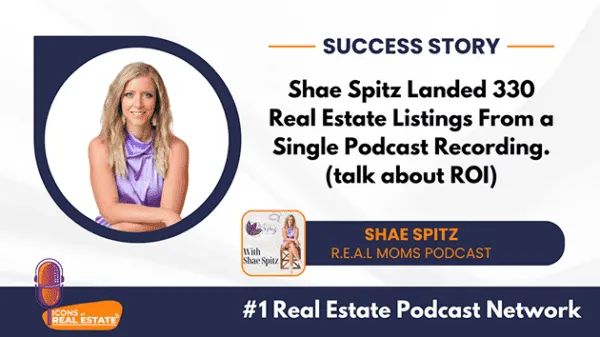
- Shae Spitz (R.E.A.L. Moms Podcast) turned one interview into 330 listings.
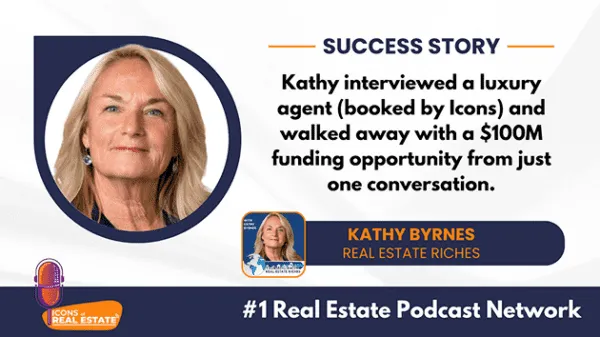
- Kathy Byrnes (Real Estate Riches Podcast) interviewed a luxury agent that led to $100M in funding
- Avery Carl (The Short Term Show) used podcasting and SEO to achieve $1 billion in volume
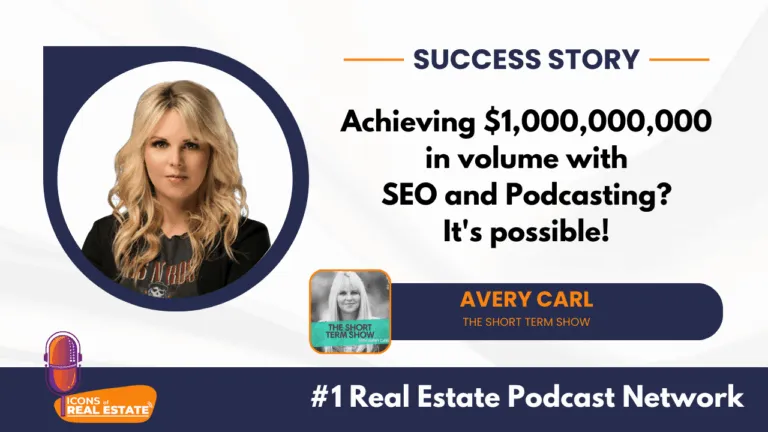
Read those numbers again. These aren’t flukes. This is what happens when you treat podcasting like a relationship-building machine instead of just “content.”
With 70+ top-tier podcasts in our network, countless expert guests, and over 620+ episodes produced, Icons of Real Estate is the #1 Real Estate Podcast Network built to make podcasting a true growth vehicle for agents.
Whether you want to launch your own show or get featured on established podcasts, there’s a clear next step. 👉 Start a podcast with Icons or apply as a guest through the Icons Hub.
Ready to launch? Download our FREE podcast playbook featuring 5 frameworks to grow your real estate business.
Inside, you’ll learn how to:
- Overview: See how one weekly episode can compound into referrals and closings.
- Inviting Guests: Find better guests, land the yes, and build relationships that last.
- Hosting: Turn a 25-minute recording into a connection worth keeping.
- Launching: Avoid the silent launch and build momentum from day one.
- Distribution: Turn one episode into content that keeps working everywhere.
Get the full 5-framework playbook and discover how to turn your podcast into a relationship-building, authority-growing, lead-generating asset for your real estate business.
Frequently Asked Questions
Done-for-you podcast production
Want a podcast that brings in referrals, not just downloads?
Icons of Real Estate plans, produces and publishes business-growing podcasts for agents. You record. We handle the rest.
Launch Your Podcast
Written by
Co-Founder and Podcast Guru, Icons of Real Estate
Tomás Fonseca co-founded Icons of Real Estate in 2021 and is its Podcast Guru. He has a background in marketing, with stints at companies like Nintendo and Ardor SEO, and is one of the hosts of the Icons of Real Estate Podcast.
How we research, write, fact-check and correct articles: our editorial standards.