On this page
- What is a hard skill in real estate?
- Which hard skills do real estate agents need?
- Which soft skills do real estate agents need?
- Which real estate skills should you put on a resume?
- Why do business skills matter so much for agents?
- Which skill brings in repeat and referral business?
- How can you build real estate agent skills faster?
- Is a real estate career worth building these skills for?
The skills needed for real estate agents split into hard skills and soft skills. Hard skills are the teachable tasks of the job: prospecting, pricing, contracts, negotiation, listing marketing, market knowledge, financing basics, technology and pipeline management. Soft skills are the five qualities the Bureau of Labor Statistics (BLS) lists, from interpersonal skills to self-motivation.
Getting licensed means state-approved courses and an exam, per BLS. Neither proves you can find clients, price a house or keep a deal together, and those decide whether you last. Below: what a hard skill is, the nine hard skills with a drill for each, the soft skills BLS names, and what the pay and referral data say about which skills pay off.
What is a hard skill in real estate?
A hard skill in real estate is a task skill you can learn, practice and check, such as pricing a home or filling in a purchase agreement. A soft skill is how you work with people and manage yourself.
The difference matters because you build them differently. You learn a hard skill from forms, data and repetition, and someone can check your work: your price was close to the sale price or it wasn’t. You build a soft skill through feedback on how you handle people, and it’s harder to measure.
This table shows the two side by side.
| Hard skills | Soft skills | |
|---|---|---|
| What they are | Task skills you can learn and check | How you work with people and manage yourself |
| Examples | Pricing, contracts, prospecting, CRM | Communication, dependability, self-motivation |
| How you learn them | Courses, forms, data, repetition | Feedback, role-play, experience |
| How you know you’ve improved | A number moves: price-to-sale gap, replies, closings | Clients come back and refer others |
Most of the job’s daily work needs both. A pricing conversation with a seller is a hard skill (the analysis) delivered with a soft one (telling them a number they didn’t want to hear).
Which hard skills do real estate agents need?
Real estate agents need nine hard skills, and each one comes from a duty the BLS Occupational Outlook Handbook lists for the job. In rough order of how soon a new agent needs them:
- Prospecting and lead follow-up
- Pricing and comparative market analysis (CMA)
- Contracts and disclosures
- Negotiation
- Listing marketing
- Local market knowledge
- Financing basics
- Technology: CRM, MLS and transaction software
- Time and pipeline management
1. Prospecting and lead follow-up
Prospecting is finding people who will hire you, and follow-up is staying in touch until they’re ready. BLS puts it first among the duties: “solicit potential clients to buy, sell, and rent properties.” It shows up every day, in calls, messages and open houses.
Drill: set a daily contact number, log every reply in your CRM, and review the replies each Friday. Our comparison of real estate prospecting methods weighs calls, door knocking and open houses on the time each one takes.
2. Pricing and comparative market analysis
Pricing is comparing properties to set a price the market will pay, which BLS lists as a core duty. A comparative market analysis (CMA) is the written version: recent sales, active listings and adjustments for the differences.
Drill: price three active listings each week before they sell, write down your number, and check it against the sale price. Track the gap. It should shrink over a few months.
3. Contracts and disclosures
Contract skill means knowing your state’s standard forms well enough to fill them in correctly and explain each clause. BLS lists preparing purchase agreements, closing statements and leases, and making sure the terms of purchase contracts are met.
Drill: read every clause of your state’s purchase agreement, then explain it out loud as if to a first-time buyer. For your first deals, review every contract with your broker. The goal is to need the review less each time, not to skip it.
4. Negotiation
Negotiation is presenting offers and working out terms that both sides will sign. BLS lists presenting purchase offers and mediating negotiations between buyer and seller. Inspection repairs and appraisal gaps are where most of it happens.
Drill: role-play offer and repair calls with a mentor, then debrief what you gave up and what you got for it.
5. Listing marketing
Listing marketing is promoting a property through ads, open houses and listing services, in BLS’s words. It covers the listing description, the photo plan, the showing schedule and where the listing gets posted.
Drill: write the listing copy and photo plan for a colleague’s next listing, then compare it with what went live. Check your copy against our list of Fair Housing words that real estate listings should avoid, and ask your broker if a phrase is borderline.
6. Local market knowledge
Market knowledge is knowing what’s selling, for how much and how fast, in the areas you work. BLS lists advising clients on prices and market conditions. Buyers and sellers expect you to answer without looking it up.
Drill: pick one neighborhood, and each week note its new listings, price changes and closed sales. Preview a few homes in person.
7. Financing basics
Financing skill is understanding mortgages well enough to advise clients and spot problems early. BLS lists advising on mortgages. You don’t write loans, but you need to know the common loan types and what a pre-approval does and doesn’t mean.
Drill: ask a local lender to walk you through current loan programs, then explain one back to them.
8. Technology: CRM, MLS and transaction software
Technology skill is using the tools of the job quickly and correctly: your CRM for contacts and follow-up, the MLS for listings and comps, and transaction software for documents and deadlines. BLS lists generating lists of properties, which today means MLS searches.
Drill: build one saved MLS search for each active buyer, and set up CRM reminders so no lead goes a week without contact.
9. Time and pipeline management
Pipeline management is knowing where every client stands and what you have to do next for each one. BLS says agents “must be able to manage their own time for planning and prioritizing their work.”
Drill: keep a weekly pipeline list (leads, active clients, under contract, closed) and block prospecting time on your calendar like an appointment.
How the hard skills map to BLS duties
This table pairs the main BLS duties with the hard skill behind them and one way to practice it.
| BLS duty | Hard skill | One way to practice it |
|---|---|---|
| Solicit potential clients to buy, sell and rent | Prospecting and lead follow-up | Set a daily contact number and track replies in your CRM |
| Compare properties to set a competitive market price | Pricing and comparative market analysis | Price three active listings each week, then check the sale prices |
| Promote properties through ads, open houses and listing services | Listing marketing | Write the listing copy and photo plan for a colleague’s next listing |
| Advise clients on prices, mortgages and market conditions | Market and financing knowledge | Ask a local lender to walk you through current loan programs |
| Present offers and mediate negotiations | Negotiation | Role-play offer calls with a mentor and debrief what you gave up |
| Prepare purchase agreements, closing statements and leases | Contracts and paperwork | Read every clause of your state’s standard forms, then quiz yourself |
Which soft skills do real estate agents need?
Real estate agents need five soft skills, according to the BLS Occupational Outlook Handbook: business skills, interpersonal skills, organizational skills, problem-solving skills and self-motivation. BLS lists them as important qualities for the work.
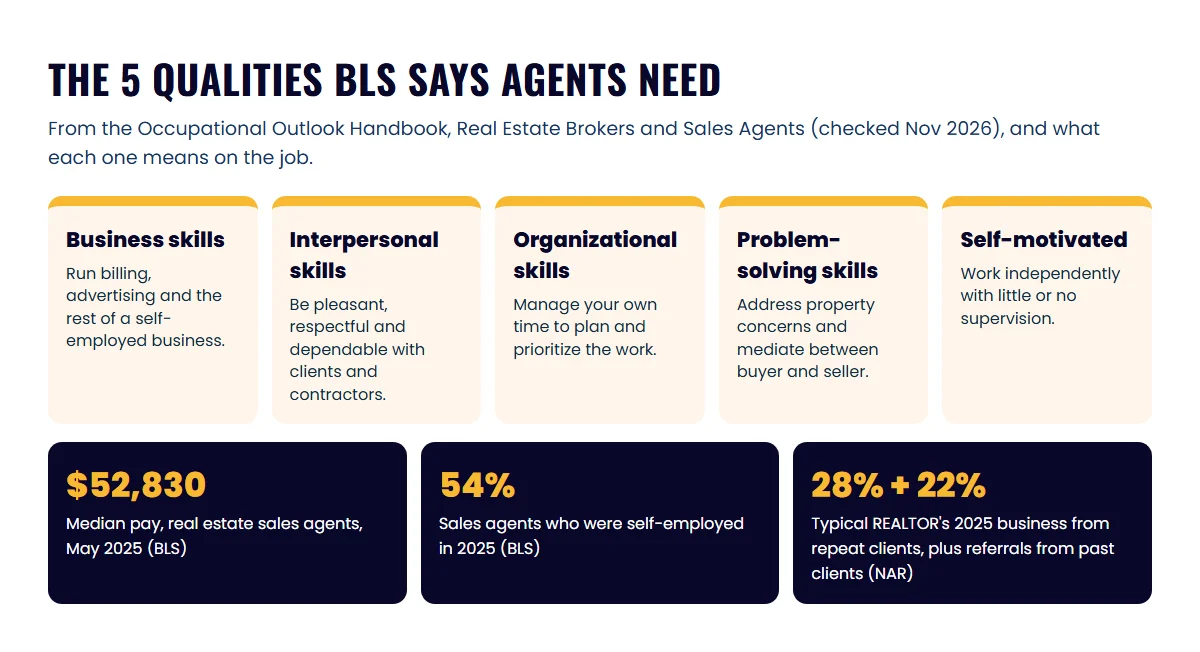
Here’s how BLS describes each one, and where it shows up in your week:
- Business skills. Most agents are self-employed, so BLS says they must manage “every aspect of their business, including billing and advertising.” That’s your budget, your marketing and your taxes.
- Interpersonal skills. Agents spend much of their time with clients and contractors, and “must be pleasant, respectful, and dependable.” Every call, showing and inspection tests this one.
- Organizational skills. Nobody schedules your day for you, so planning and prioritizing your own work falls to you.
- Problem-solving skills. Agents address concerns about a property and “mediate negotiations between a seller and a buyer.” Inspection findings and appraisal gaps land here.
- Self-motivation. Agents “often have little or no supervision,” so they must be able to work independently.
Communication
Communication sits inside BLS’s interpersonal skills, but it earns its own line because every hard skill depends on it. A good CMA is useless if the seller doesn’t understand it. In practice, communication means answering the question first, explaining the next step before the client asks, and replying when you said you would.
Drill: after each client call, write one sentence on what the client now knows that they didn’t before. If you can’t, the call needed a clearer point.
Which real estate skills should you put on a resume?
The skills to put on a real estate resume are the hard skills, written as things you’ve done, plus one or two soft skills backed by an example. The table turns each hard skill into resume wording.
| Hard skill | How to word it on a resume |
|---|---|
| Prospecting | Generated and followed up leads through calls, open houses and a CRM |
| Pricing and CMA | Prepared comparative market analyses for listing appointments |
| Contracts | Prepared purchase agreements and disclosures under broker review |
| Negotiation | Negotiated offers, repairs and closing terms for buyers and sellers |
| Listing marketing | Wrote listing copy and coordinated photos, showings and open houses |
| Technology | Managed contacts in a CRM; used MLS and transaction software |
Use your own numbers where you have them, such as deals closed or listings taken. Leave out any you can’t back up.
Why do business skills matter so much for agents?
Business skills matter so much because most agents run their own business. BLS employment data counts 54% of real estate sales agents and 55% of brokers as self-employed in 2025, so billing, advertising and budgeting fall on the agent.
The pay data shows the range. BLS puts the median annual pay for real estate sales agents at $52,830 and for brokers at $73,220, as of May 2025. Half of sales agents earned more than that and half earned less.
NAR’s numbers point the same way. According to NAR’s 2026 Member Profile release, the median REALTOR earned $59,200 in gross income in 2025. Members with 16 or more years in the business earned a median of $88,500. Median business expenses were $9,530, with vehicle costs the biggest line at $1,580.
Those figures describe NAR members, not every licensee. Still, part of the gap between new and experienced agents is skill, not just time. Experienced agents have a book of past clients, a pricing instinct and a system for their week.
Which skill brings in repeat and referral business?
Relationship skill brings in repeat and referral business, and that business adds up to half of the typical REALTOR’s work. Staying in touch, being dependable and asking for introductions turn one client into several.
NAR’s feature sheet on the 2026 Member Profile says the typical REALTOR earned 28% of their business from repeat clients and customers in 2025. Another 22% came through referrals from past clients and customers.
That’s the BLS interpersonal skill turned into income. A client who found you “pleasant, respectful, and dependable” is the one who sends their sister. Our guide to getting repeat and referral business covers the follow-up system in detail.
Relationships also come from outside your client list. Lenders, inspectors, contractors and local business owners often meet buyers and sellers before you do. Building a local network as an agent is a skill in its own right, and it gets easier with a reason to reach out.
An interview show is one way to practice relationship skills on a schedule. Done-for-you podcast production takes the editing and publishing off your plate, so your only job is the conversation.
How can you build real estate agent skills faster?
You build real estate agent skills faster by practicing one skill at a time on purpose, with a number to track and someone to check your work. Reading about negotiation doesn’t make you a better negotiator; doing it and reviewing it does.
Use this checklist for a 90-day skill plan:
- Pick one hard skill and one soft skill. For example, pricing and follow-up.
- Set a weekly drill for each. Price three listings and make a set number of follow-up calls.
- Track one number per skill. Your price-to-sale gap, or replies per ten calls.
- Get feedback. Ask your broker or a mentor to review one contract, one pricing opinion or one recorded call each week.
- Block the time. Put the drills on your calendar like appointments.
- Review at 30, 60 and 90 days. Keep what moved the number and drop what didn’t.
Formal learning still counts. BLS notes that licenses usually renew every 2 to 4 years, with continuing education required in most states. Use those hours on the skill you’re weakest at, not the easiest course. If you’re still deciding whether to get licensed, our guide on what age you can become a real estate agent covers the basic state requirements.
Is a real estate career worth building these skills for?
A real estate career rewards these skills, but it doesn’t hand out income for showing up. BLS projects employment of agents and brokers to grow 2% from 2025 to 2035, slower than the average for all occupations.
BLS still expects about 40,400 openings each year over that decade, mostly to replace workers who move to other occupations or leave the labor force. In a slow-growth field, building business, pricing and relationship skills early is how you stay in it.
Your reputation is the skill that compounds. Every client you serve well and every partner you get to know adds to it, and building a personal brand as a real estate agent lets more people find out about it.
Frequently asked questions
What are the most important hard skills for a new agent?
Prospecting comes first, because without clients the other skills never get used. Pricing and contracts come next. Your broker can check those two on your first deals, but nobody can find clients for you.
Do you need a college degree to be a real estate agent?
No. BLS says the typical entry-level education is a high school diploma or equivalent, plus a state license. Many agents do have a bachelor's degree, but a degree isn't required.
Do real estate agents keep learning after they're licensed?
Yes. BLS says licenses usually renew every 2 to 4 years, and most states require continuing education to renew. Your state commission sets the hours.
Is real estate a growing field?
Slowly. BLS projects employment of real estate brokers and sales agents to grow 2% from 2025 to 2035, slower than average, with about 40,400 openings a year, mostly to replace workers who leave the occupation.
Sources
- Real Estate Brokers and Sales Agents, Occupational Outlook Handbook — U.S. Bureau of Labor Statistics (accessed November 20, 2026)
- Experienced REALTORS Anchor the Industry as Housing Affordability Remains Top Hurdle: New NAR Report — National Association of REALTORS (accessed November 10, 2026)
- The Feature Sheet: 2026 Member Profile — National Association of REALTORS (accessed November 10, 2026)
Done-for-you podcast production
Want a podcast that brings in referrals, not just downloads?
Icons of Real Estate plans, produces and publishes business-growing podcasts for agents. You record. We handle the rest.
Launch Your Podcast
Written by
Co-Founder and Podcast Guru, Icons of Real Estate
Tomás Fonseca co-founded Icons of Real Estate in 2021 and is its Podcast Guru. He has a background in marketing, with stints at companies like Nintendo and Ardor SEO, and is one of the hosts of the Icons of Real Estate Podcast.

How we research, write, fact-check and correct articles: our editorial standards.