On this page
- How do you calculate real estate commission?
- How did the NAR settlement change commission math?
- Who pays the buyer’s agent now?
- What is the average real estate commission rate?
- What does a commission calculation look like on a real deal?
- Fill-in commission worksheet
- How does commission math fit your marketing budget?
A real estate commission calculator multiplies the sale price by each side’s agreed rate, then takes off your brokerage split and fees. Since August 2024, buyers sign their own written agreement with their agent, so each side has its own rate. Calculate each side on its own. A flat-fee agreement skips the percentage and uses the agreed dollar amount.
Many older calculators ask for one total rate, often 5% or 6%, and split it down the middle. That model doesn’t match how deals are paid now. Below is the formula for each side, what changed in 2024, current averages from primary sources, a worked example and a worksheet you can fill in. The rules come from NAR’s own settlement pages. Check how your state and your broker apply them before you quote a client.
How do you calculate real estate commission?
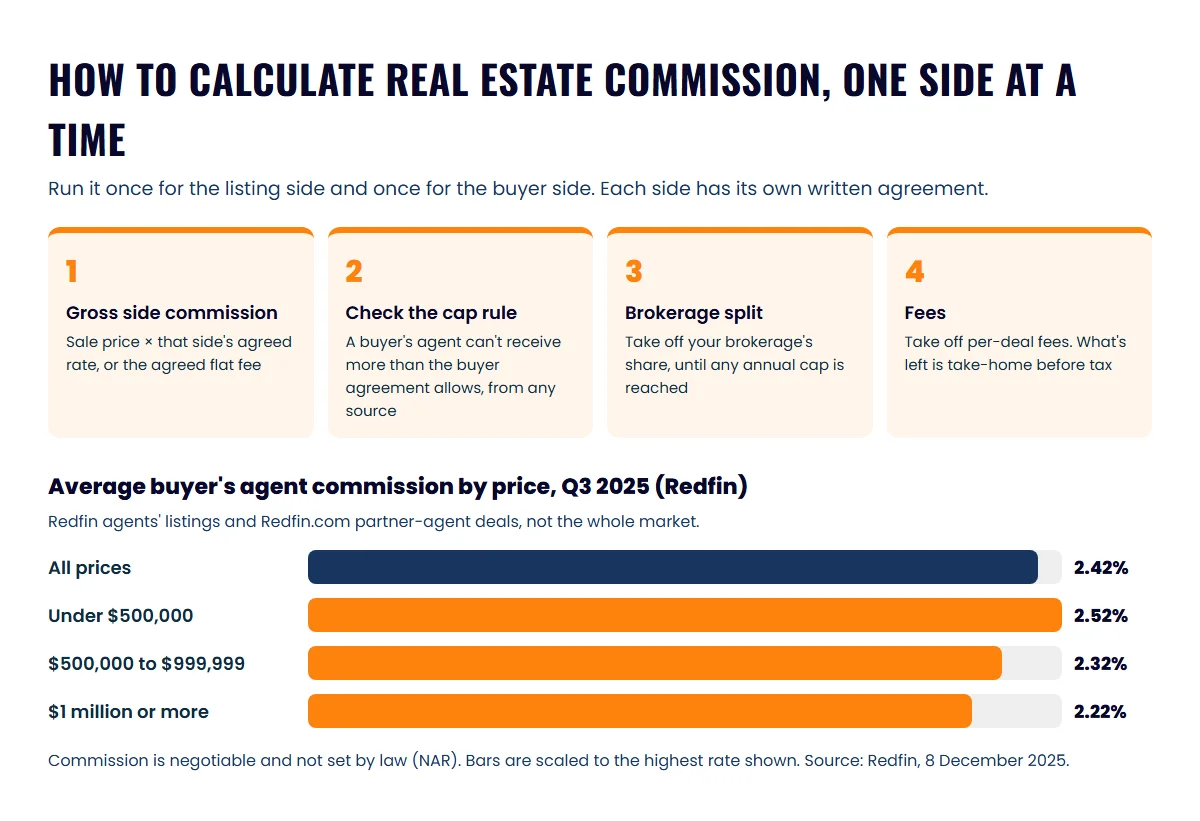
You calculate real estate commission one side at a time: sale price times that side’s rate gives the gross side commission. Then your brokerage takes its split, fees come off, and what’s left is your pre-tax pay.
- Gross side commission = sale price × the rate in that side’s agreement. For a flat fee, use the agreed dollar amount instead.
- Your share = gross side commission × your split. On an 80/20 split, you keep 80%.
- Take-home before tax = your share − per-deal fees (transaction, review or risk management fees).
- Cap check. If your brokerage caps what it collects each year, stop counting its split once you’ve reached the cap.
Every 1% of the price is easy to find: move the decimal two places. On a $400,000 sale, 1% is $4,000, so 2.5% is $10,000. For a side-by-side of one high-priced deal, our breakdown of commission on a million-dollar sale runs the same steps at $1,000,000.
How did the NAR settlement change commission math?
The NAR settlement changed commission math by splitting the two sides apart. Since 17 August 2024, offers to pay buyer’s agents can’t appear on the MLS, and buyers must sign a written agreement before touring a home. That agreement states what the buyer’s agent will be paid.
According to NAR’s settlement explainer, written agreements apply to “both in-person and live virtual home tours.” Talking to an agent at an open house doesn’t need one. NAR’s settlement FAQ lists what the buyer agreement must contain about pay:
- A clear amount or rate, disclosed specifically and conspicuously.
- Objective compensation, for example “$0, X flat fee, X percent, X hourly rate.” It can’t be open-ended. Wording such as “whatever amount the seller is offering” is out, and so is a range such as “between X and Y percent.”
- A cap. The agent can’t receive compensation “from any source that exceeds the amount or rate agreed to” with the buyer.
- A statement that agent fees and commissions are fully negotiable and not set by law.
Listing agreements work differently. NAR’s FAQ says the “objective, not open-ended” rule doesn’t apply to them. They can be structured however the seller and listing broker agree, as long as they follow the law and MLS policy and specify what the seller pays.
Who pays the buyer’s agent now?
The buyer’s agent is paid however the buyer agreement and the deal allow: by the buyer directly, by the seller, or from part of the listing agent’s compensation. NAR’s FAQ lists all three as options buyer brokers can still use.
| Who pays | How it shows up | What to put in your calculation |
|---|---|---|
| Buyer | A fee paid directly at closing | The amount or rate in the buyer agreement |
| Seller | An offer made off the MLS, or a concession to the buyer | The seller’s amount, but never more than the buyer agreement allows |
| Listing side | Part of the listing agent’s compensation | Whatever the listing broker agrees to share, up to the buyer agreement |
| Nobody | A $0 agreement | $0 |
Sellers can still advertise concessions to buyers on the MLS, NAR says, such as help with closing costs. What they can’t post there is an offer to pay the buyer’s broker. NAR’s FAQ also suggests protecting an off-MLS offer in writing, for example in the sales contract.
The cap rule matters most here. If your buyer agreement says 2.5% and the seller agrees to pay 3%, you can only receive 2.5%. If the seller pays less than your agreement, how the gap is handled depends on your agreement’s wording. Read it with your broker before the offer goes in.
What is the average real estate commission rate?
There’s no official average real estate commission rate, because NAR says rates are fully negotiable and not set by law. The best primary figures come from large brokerages that report their own deals, and they barely moved in the year to the third quarter of 2025.
- Redfin. Redfin’s December 2025 report put the average buyer’s agent commission at 2.42% in the third quarter of 2025. That compares with 2.36% a year earlier and 2.43% the quarter before. It’s based on Redfin agents’ listings and deals Redfin.com referred to partner agents, not the whole market.
- Anywhere Real Estate. The owner of Coldwell Banker, Century 21 and other brands reports an “average homesale broker commission rate” to investors. In its third-quarter 2025 results filed with the SEC, that rate was 2.41% for its franchise group and 2.37% for its own brokerages. A year earlier it was 2.41% and 2.36%.
Rates also fall as prices rise. Redfin’s third-quarter 2025 averages were 2.52% under $500,000, 2.32% from $500,000 to $999,999, and 2.22% at $1 million or more.
Agent surveys come out higher, but they measure what agents say they typically charge, not closed deals. In an August 2026 survey of 434 agents, Clever Real Estate reported 2.76% for listing agents and 2.70% for buyer’s agents. A FastExpert survey of 682 agents taken from 14 September to 27 October 2026 reported 3.01% and 2.84%. Use averages as a sense check, never as a quote.
What does a commission calculation look like on a real deal?
A commission calculation on a real deal runs the formula twice, once per side, then once more for each agent’s brokerage split. The example below uses invented numbers so you can follow every step.
The take-home figure is before tax. Self-employed agents also owe self-employment tax and income tax and pay their own business costs. Our million-dollar sale breakdown walks through those deductions.
Fill-in commission worksheet
This commission worksheet works as a calculator for any deal. The middle column holds the formula and the last column is yours to fill in.
| Line | Formula | Your deal |
|---|---|---|
| A. Sale price | From the contract | |
| B. Your side’s rate or flat fee | From your listing or buyer agreement | |
| C. Gross side commission | A × B, or the flat fee | |
| D. Paid by someone else | Seller or listing side amount, if any | |
| E. Paid by your client | C − D, if your agreement says so | |
| F. Brokerage split | C × your brokerage’s percentage, until any cap | |
| G. Per-deal fees | Transaction, review, risk management | |
| H. Take-home before tax | C − F − G |
Brokerage splits and caps vary widely, so put in your own numbers. eXp files its terms with the SEC. Our guide to eXp Realty’s 80/20 split and cap shows how a cap changes line F over a year.
How does commission math fit your marketing budget?
Your average take-home per closing tells you what any marketing is worth. If line H on a typical deal is your number, one extra closing a year from a channel pays for that channel up to that amount.
That’s the logic behind our podcast ROI calculator. You enter your average price, commission rate and broker split, and it shows how many closings a podcast needs to break even. For the costs side, see our real estate podcast cost and ROI guide. If you talk about commissions on your own show, read what agents can say about commissions on a podcast first. Rate talk between competing agents is the risky kind.
Frequently asked questions
Is there a standard real estate commission?
No. NAR says agent compensation is fully negotiable and not set by law. Averages exist, such as Redfin's 2.42% for buyer's agents in the third quarter of 2025, but your rate is whatever each written agreement says.
Does the seller still pay the buyer's agent?
Sometimes. A seller can agree to pay the buyer's agent through an offer made off the MLS or a concession to the buyer, or the buyer can pay directly. Either way, the buyer agreement sets the most the agent can receive.
Can a buyer agreement say 'whatever the seller offers'?
No. NAR's settlement FAQ says buyer agreement compensation must be objectively ascertainable and not open-ended, and gives that exact wording as an example of what isn't allowed. A range such as 'between X and Y percent' isn't allowed either.
Do the same rules apply to listing agreements?
Not the 'objective, not open-ended' rule. NAR's FAQ says listing agreements can be structured however the seller and listing broker agree, as long as they follow the law and MLS policy and specify the amount or rate the seller pays.
Sources
- What the NAR Settlement Means for Home Buyers and Sellers — National Association of REALTORS® (accessed November 10, 2026)
- NAR Settlement FAQ (PDF, updated 29 October 2024) — National Association of REALTORS® (accessed November 10, 2026)
- The Average Buyer's Agent Commission Has Risen Slightly Since New NAR Rules Went Into Effect (8 December 2025) — Redfin (accessed November 10, 2026)
- Anywhere Real Estate Inc. Reports Third Quarter 2025 Financial Results (Exhibit to Form 8-K, 4 November 2025) — U.S. Securities and Exchange Commission (accessed November 10, 2026)
- 6% Real Estate Commission Explained (agent survey, August 2026) — Clever Real Estate (accessed November 10, 2026)
- Real Estate Agent Commissions by State (agent survey, Sept–Oct 2026) — FastExpert (accessed November 10, 2026)
Free podcast tools
Plan your show in minutes
Use our free calculators and generators to price your podcast, estimate ROI and plan your first episodes.
Try The Free Tools
Written by
Co-Founder and Podcast Guru, Icons of Real Estate
Tomás Fonseca co-founded Icons of Real Estate in 2021 and is its Podcast Guru. He has a background in marketing, with stints at companies like Nintendo and Ardor SEO, and is one of the hosts of the Icons of Real Estate Podcast.

How we research, write, fact-check and correct articles: our editorial standards.