On this page
- How much commission is there on a million dollar home?
- Who pays the listing agent and the buyer’s agent after the NAR settlement?
- How much does a realtor actually take home from a million dollar sale?
- What taxes and expenses come out of a realtor’s commission?
- Can you make $1,000,000 a year in real estate?
- Next step: run your own million dollar sale numbers
A realtor’s commission on a million dollar sale is whatever the seller or buyer agreed to in writing, because commission is negotiable and not set by law. Every 1% of a $1,000,000 price is $10,000, so 2.5% to one side is $25,000. The agent keeps less after the brokerage split, fees and tax.
That’s why you won’t find an “average” rate here. NAR’s own settlement FAQ says compensation “remains fully negotiable and is not set by law,” and the rates in the examples below are assumptions to show the math, not market data. Swap in your own numbers.
How much commission is there on a million dollar home?
The commission on a million dollar home is the agreed rate times the price, paid separately to each side that has an agreement. At 1% per side that’s $10,000; at 3% per side it’s $30,000.
The table below shows the gross commission on a $1,000,000 sale at a few illustrative rates. None of these is a standard or typical rate.
| Rate per side (illustrative) | Listing side | Buyer side, if paid at the same rate | Both sides together |
|---|---|---|---|
| 1% | $10,000 | $10,000 | $20,000 |
| 2% | $20,000 | $20,000 | $40,000 |
| 2.5% | $25,000 | $25,000 | $50,000 |
| 3% | $30,000 | $30,000 | $60,000 |
The two sides don’t have to match. Your listing agreement sets what the seller pays the listing broker. On the other side, the buyer agreement sets what the buyer’s broker can earn, and that pay can be a percentage, a flat fee, an hourly rate or even $0. A flat fee doesn’t move with the price, so on a $1,000,000 home it can work out to a much lower percentage than the same fee on a cheaper house.
Who pays the listing agent and the buyer’s agent after the NAR settlement?
The listing agent is paid under the listing agreement with the seller, and the buyer’s agent is paid under a written buyer agreement. Since 17 August 2024 the offer to pay a buyer’s broker can’t appear in the MLS.
Two practice changes from the NAR settlement took effect that day, according to the NAR settlement FAQ:
- No offers of compensation in the MLS. A seller can still agree to pay the buyer’s broker, but the offer has to be communicated off the MLS. Sellers can still list buyer concessions in the MLS, for example toward closing costs.
- Written buyer agreements before touring. MLS participants working with buyers must have a written agreement with the buyer before touring a home, in person or live virtual.
NAR’s consumer guide to written buyer agreements says the pay in that agreement must be clearly defined: $0, a flat fee, a percentage or an hourly rate. It can’t be open-ended or a range. The FAQ adds that the buyer’s broker may not receive more from any source than the amount or rate in the buyer agreement. So on a $1,000,000 sale, the buyer agreement caps what the buyer’s agent can earn, whoever ends up paying it.
These are compliance rules, and state law, your MLS and your brokerage can add requirements on top. Check with your broker before you change how you quote or document commission. If you talk about commissions on your own podcast or video, read what agents can say about commission on a podcast before you record.
How much does a realtor actually take home from a million dollar sale?
A realtor takes home what’s left of their side’s commission after the brokerage split, per-deal fees, business costs and tax. Commission is paid to the brokerage first, then shared with the agent.
The Bureau of Labor Statistics says brokers and agents earn most of their income from commissions, and that commissions “often are divided among the buying agent, selling agent, brokers, and firms” (BLS Occupational Outlook Handbook). Here’s that chain for one side of one sale.
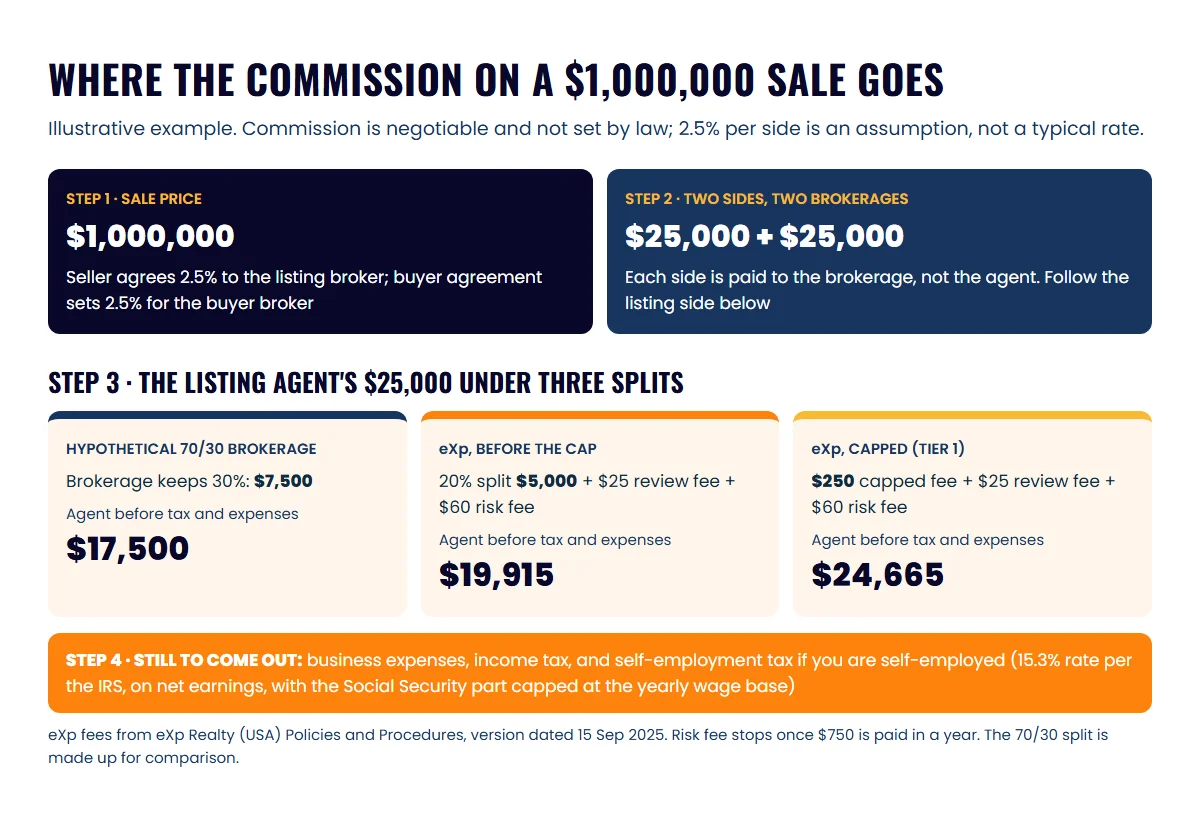
One more wrinkle at eXp: a single $25,000 side pays $5,000 toward the $16,000 annual cap. At that size, you reach the cap on the fourth such side in a capping period. After that, each deal costs $250 (or 20% if less) until capped fees reach $5,000, then $75. Our eXp split, cap and fee breakdown walks through the full year, and the Real Brokerage and eXp Realty comparison sets the two capped models side by side.
What taxes and expenses come out of a realtor’s commission?
Self-employment tax, income tax and business expenses come out of a realtor’s commission after the brokerage is paid. Most agents are self-employed, so planning for that tax is their job.
The BLS occupational handbook says most real estate brokers and sales agents are self-employed. For self-employed people, the IRS sets out these rules on its self-employment tax page:
- Rate: 15.3% in total, made up of 12.4% for Social Security and 2.9% for Medicare
- Base: the tax is figured on net earnings from self-employment, and it applies once those are $400 or more
- Social Security limit: for 2026, only the first $184,500 of combined wages, tips and net earnings is subject to the Social Security part
- Deduction: you can deduct the employer-equivalent portion of self-employment tax when figuring adjusted gross income
- Timing: you may have to pay estimated taxes quarterly
Income tax comes on top and depends on your bracket and state. Business costs come off before any of that: MLS and association dues, licensing, marketing, a car, your phone. We can’t tell you what those add up to for you, and nobody can without your books. Ask your accountant to turn your gross commission into a realistic net number, and use that number when you judge any spend.
Can you make $1,000,000 a year in real estate?
You can earn $1,000,000 a year in gross commission in real estate, but the volume it takes is large. At an illustrative $25,000 per side, you’d need 40 million-dollar sides in a year, before any split, fee or tax.
Here’s the same arithmetic at the other illustrative rates from the first table:
| Commission per $1,000,000 side (illustrative) | Sides needed for $1,000,000 gross commission |
|---|---|
| $20,000 (2%) | 50 |
| $25,000 (2.5%) | 40 |
| $30,000 (3%) | 34 (33.3, rounded up) |
And gross commission isn’t income. Under eXp’s filed fee schedule, an agent who caps still pays per-deal fees, and a self-employed agent then owes self-employment tax and income tax on what’s left. For context, the BLS reports a median annual wage of $52,830 for real estate sales agents and $73,220 for brokers in May 2025. The BLS notes that its pay figures leave out self-employed workers, and most agents are self-employed, so treat those medians as a rough reference only.
Next step: run your own million dollar sale numbers
Take your last three closings, write down the rate, your side’s gross commission, what your brokerage kept, and every fee on the settlement statement. Divide what reached you by the gross. That percentage is your real split, and it’s the number to use when you plan the year.
Then put it to work. Weighing a podcast to build referral relationships? Our guide to how many closings it takes to pay for a podcast uses your net commission per deal, and the real estate podcast cost and ROI guide shows the rest of the math. If you’d rather start as a guest on other agents’ shows, podcast guesting through the ICONS Hub is the lighter first step.
Frequently asked questions
Is there a standard commission on a million dollar home?
No. NAR's settlement FAQ says broker compensation is fully negotiable and not set by law. Any rate you see quoted as standard is someone's estimate, not a rule, so ask each agent what they charge and what's included.
Who pays the buyer's agent on a $1,000,000 sale now?
The buyer, the seller, or both. The buyer agreement sets what the buyer's agent can be paid, and NAR's FAQ confirms a buyer can ask the listing side to pay some or all of it. The offer just can't be posted in the MLS.
Does a 1% commission on a million dollar home mean $10,000?
Yes, 1% of $1,000,000 is $10,000 to that side's brokerage. The agent's share is smaller once the brokerage split and per-deal fees come out, and tax comes after that.
Does the brokerage split change on a bigger sale?
It depends on your contract. At eXp the split is 20% of every commission until you cap, so a large sale simply gets you to the $16,000 cap faster. Other brokerages set their own terms, so read your agreement.
Sources
- NAR Settlement FAQ (PDF, updated 29 October 2024) — National Association of REALTORS® (accessed November 10, 2026)
- Consumer Guide: Written Buyer Agreements — National Association of REALTORS® (accessed November 10, 2026)
- eXp Realty (USA) Policies and Procedures, version 09.15.2025 (Exhibit 10.14 to the 2025 Form 10-K) — U.S. Securities and Exchange Commission (accessed November 10, 2026)
- Self-Employment Tax (Social Security and Medicare Taxes) — Internal Revenue Service (accessed November 10, 2026)
- Real Estate Brokers and Sales Agents, Occupational Outlook Handbook — U.S. Bureau of Labor Statistics (accessed November 10, 2026)
Free podcast tools
Plan your show in minutes
Use our free calculators and generators to price your podcast, estimate ROI and plan your first episodes.
Try The Free Tools
Written by
Co-Founder and Podcast Guru, Icons of Real Estate
Tomás Fonseca co-founded Icons of Real Estate in 2021 and is its Podcast Guru. He has a background in marketing, with stints at companies like Nintendo and Ardor SEO, and is one of the hosts of the Icons of Real Estate Podcast.

How we research, write, fact-check and correct articles: our editorial standards.