

On this page
- Why can a real estate agent only work for one broker?
- Can a real estate agent work for two brokers in Texas, California or Florida?
- What do New York and Georgia say about working for two brokers?
- Can a real estate agent work for two brokers in different states?
- How can you earn from a second brokerage without breaking the rules?
- What goes with you if you change brokers?
A real estate agent generally can’t work for two brokers at the same time. A sales agent works under one sponsoring or employing broker, who supervises them and handles every commission. Texas, Florida and California law each tie a salesperson to one broker. Georgia allows an in-state plus an out-of-state broker, with conditions.
The rule is about sales agents. Licensed brokers and agents with licenses in two states have more room, which causes most of the confusion. Below: the rule in five big states with the citation for each, what changes across state lines, and how to earn from a second firm without breaking your license law. Rules change and vary by state, so confirm yours with your state real estate commission and your broker.
Why can a real estate agent only work for one broker?
A real estate agent works for one broker because state law makes that broker responsible for the agent’s licensed work and the money it earns. The broker holds the client agreements, supervises the agent and pays the agent’s commission.
Two brokers would mean two supervisors and two payers for the same license. Regulators avoid that. Texas puts it plainly in its frequently asked questions: a sales agent must be “associated with, and acting for, the sponsoring broker at all times.”
The money rules point the same way. In Texas and California, for example, a sales agent can’t accept a commission or referral fee from anyone except their own broker. So even if a second firm wanted to pay you, the payment would have to route through the broker who holds your license.
Can a real estate agent work for two brokers in Texas, California or Florida?
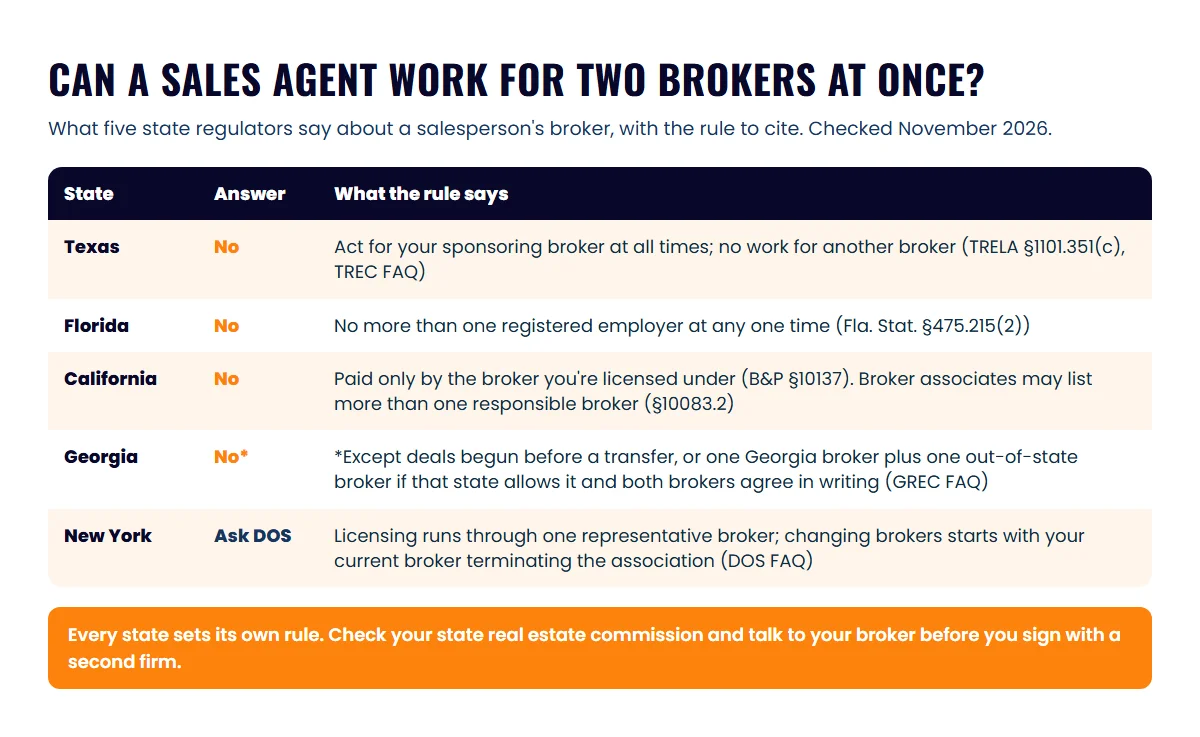
A real estate agent can’t work for two brokers in Texas, California or Florida. Each state’s law ties a salesperson to a single sponsoring or employing broker, and each says so in its statute or official FAQ.
Texas
Texas bars it. TREC’s FAQ cites TRELA §1101.351(c) and draws the conclusion: a sales agent “may not work for a broker who is not the sales agent’s sponsoring broker.” Nor can the agent work “out of another broker’s office.” You can work from a different office location, but your sponsoring broker stays responsible for you.
TREC’s FAQ adds that a sales agent “may not accept compensation for a real estate transaction from anyone other than the broker,” citing TRELA §1101.651(b) and (c).
California
California ties a salesperson’s pay to one broker. The rule is Section 10137 of the Business and Professions Code, printed in the Department of Real Estate’s Real Estate Law book. It says: “No real estate salesperson shall accept compensation for activity requiring a real estate license from any person other than the broker under whom he or she is at the time licensed.”
The same law has a different rule for broker associates, meaning licensed brokers who work under another broker. Under Section 10083.2, the Department lists “each responsible broker with whom the licensee is contractually associated.” That wording assumes a broker associate may work with more than one responsible broker, each of whom reports the affiliation to the Department.
Florida
Florida bars it in so many words. Section 475.215(2) of the Florida Statutes reads: “A sales associate or broker associate shall have no more than one registered employer at any one time.”
Section 475.42(1)(b) backs that up. A sales associate may not operate as a sales associate “for any person not registered as her or his employer.” Unlike California, Florida applies the limit to broker associates too.
What do New York and Georgia say about working for two brokers?
New York and Georgia both build licensing around one broker, but Georgia spells out a cross-border exception. The official New York FAQ doesn’t state a two-broker ban in one sentence, so ask the Department of State if your plan depends on it.
New York
New York’s Department of State answers part of it in its salesperson FAQ. There, “a real estate salesperson works for and is supervised by the representative broker.” Changing brokers starts with your current broker: “Licensing requires the termination of a salesperson or associate broker by the existing representative (principal) broker.” You also need a sponsoring broker to renew. We didn’t find a DOS page that addresses holding two associations at once, so get the answer from DOS in writing before you try.
Georgia
Georgia answers the question directly, in the Georgia Real Estate Commission’s real estate FAQ. Asked whether a licensee can work for more than one broker at the same time, the Commission says: “No, except when transferring to a new broker with respect to transactions begun prior to the transfer.”
The same answer adds: “A licensee may work for a Georgia broker and for a broker from another state, if the other state permits such a practice and if the brokers have agreed to it in writing.” Georgia brokers get more room again. The FAQ says a broker can be the broker for more than one company, citing Rule 520-1-.07(4). A broker can also be an associate broker at another company after giving the required notice.
Can a real estate agent work for two brokers in different states?
A real estate agent licensed in two states usually works for a different broker in each state. Each license is issued by its own state, and each state sets its own broker rules. Georgia, for example, requires an active salesperson to affiliate with a broker licensed by its Commission. Both states’ rules apply, so check both.
Georgia’s FAQ is the clearest official statement we found. It allows one Georgia broker plus one out-of-state broker, but only if the other state permits it and both brokers agree in writing. That last condition matters. Your two brokers need to know about each other and sign off.
To get the second license, start with that state’s commission. Some states, such as Georgia, offer reciprocal licenses to licensees from all states, with a Florida exception. Others, such as Texas, offer no reciprocity at all. Our guides to Georgia real estate license reciprocity and Texas real estate license reciprocity walk through two very different processes.
How can you earn from a second brokerage without breaking the rules?
You can earn from a second brokerage legally through broker-to-broker referrals, a full move to the new firm, or a broker license. Each one keeps the money flowing through a broker who is allowed to pay you.
- Refer, don’t work, the deal. The other firm pays your broker a referral fee, and your broker pays your share under your agreement. That’s how cross-firm and cross-state referrals usually work.
- Ask before you do side work. TREC’s November 2024 article on working across multiple brokerages says that showing another brokerage’s listing for pay is brokerage activity. You need written authorization from your sponsoring broker first, and the pay goes to your sponsoring broker.
- Switch firms cleanly. If the second firm is the better fit, move. Finish or hand off open deals under your old broker, and get the split on pending deals in writing before you give notice.
- Get a broker license. In Georgia and California, licensed brokers have more flexibility than sales agents. Check your state’s experience and education requirements first.
If you’re weighing a move because of fees or splits, compare the full cost on your own numbers. Our best brokerage for part-time agents comparison and the LPT Realty guide show how to read a fee schedule before you sign.
What goes with you if you change brokers?
Your license, your relationships and your reputation go with you when you change brokers. Listings and buyer agreements usually stay with the old broker, because those contracts are in the broker’s name.
TREC’s FAQ makes that point about buyers. A buyer representation agreement “is a private contract between the buyer and the real estate broker, not the sales agent.” So the buyer stays with your old broker unless the broker releases them.
That’s why agents who switch firms without losing momentum are usually the ones people already know by name. Past clients and referral partners follow the person, not the logo. A personal brand as an agent that lives in your own content keeps working through every move. Being interviewed on local podcasts builds it without running a show yourself; ICONS podcast guest booking handles the pitching so you only show up to talk.
Frequently asked questions
Can I keep closing deals with my old broker after I switch?
Often, for deals that started before the move, which Georgia's Commission makes the one exception to its one-broker rule. In Texas, TREC's FAQ says you can be paid through your current sponsoring broker or the broker who sponsored you. Put the split on pending deals in writing before you leave.
Can I be paid directly by another brokerage for a referral?
Not as a sales agent. In Texas and California, compensation must come through the broker you're licensed under. The other brokerage pays your broker, and your broker pays you under your agreement.
Can I do showings or transaction coordination for another brokerage?
In Texas, showing another brokerage's listing for pay is brokerage activity. TREC says you need your sponsoring broker's written authorization first, and the pay goes to your sponsoring broker unless TREC's rules allow otherwise.
Sources
- Frequently Asked Questions — Texas Real Estate Commission (accessed November 10, 2026)
- Working Multiple Brokerages: What Transaction Coordinators and Showing Agents Are Allowed to Do — Texas Real Estate Commission (accessed November 10, 2026)
- Real Estate Law, as amended and in effect January 1, 2026 — California Department of Real Estate (accessed November 10, 2026)
- Florida Statutes § 475.215 Mandatory requirements; registration — The Florida Senate (accessed November 10, 2026)
- Florida Statutes § 475.42 Violations and penalties — The Florida Senate (accessed November 10, 2026)
- Real Estate Salesperson Frequently Asked Questions — New York Department of State (accessed November 10, 2026)
- FAQ: Real Estate — Georgia Real Estate Commission (accessed November 10, 2026)
Done-for-you podcast production
Want a podcast that brings in referrals, not just downloads?
Icons of Real Estate plans, produces and publishes business-growing podcasts for agents. You record. We handle the rest.
Launch Your Podcast
Written by
Co-Founder and Podcast Guru, Icons of Real Estate
Tomás Fonseca co-founded Icons of Real Estate in 2021 and is its Podcast Guru. He has a background in marketing, with stints at companies like Nintendo and Ardor SEO, and is one of the hosts of the Icons of Real Estate Podcast.

How we research, write, fact-check and correct articles: our editorial standards.