On this page
- How Much Does It Cost to Start a Podcast? The Short Answer
- What You Actually Need to Publish Episode One
- The Three Budgets: Starter, Serious, and Done for You
- Line by Line: Where the Money Goes
- What You Can Skip and Nobody Will Notice
- The Cost Nobody Puts in the Spreadsheet: Your Hours
- How a Podcast Compares With What You Already Spend on Leads
- Does a More Expensive Setup Get You More Listeners?
- When It Is Worth Paying Someone Else
- FAQs About Podcast Costs
- Get Help Launching or Fixing Your Podcast
- Final Words
You have the show idea. You can picture the guests. Then the practical question shows up: how much does it cost to start a podcast?
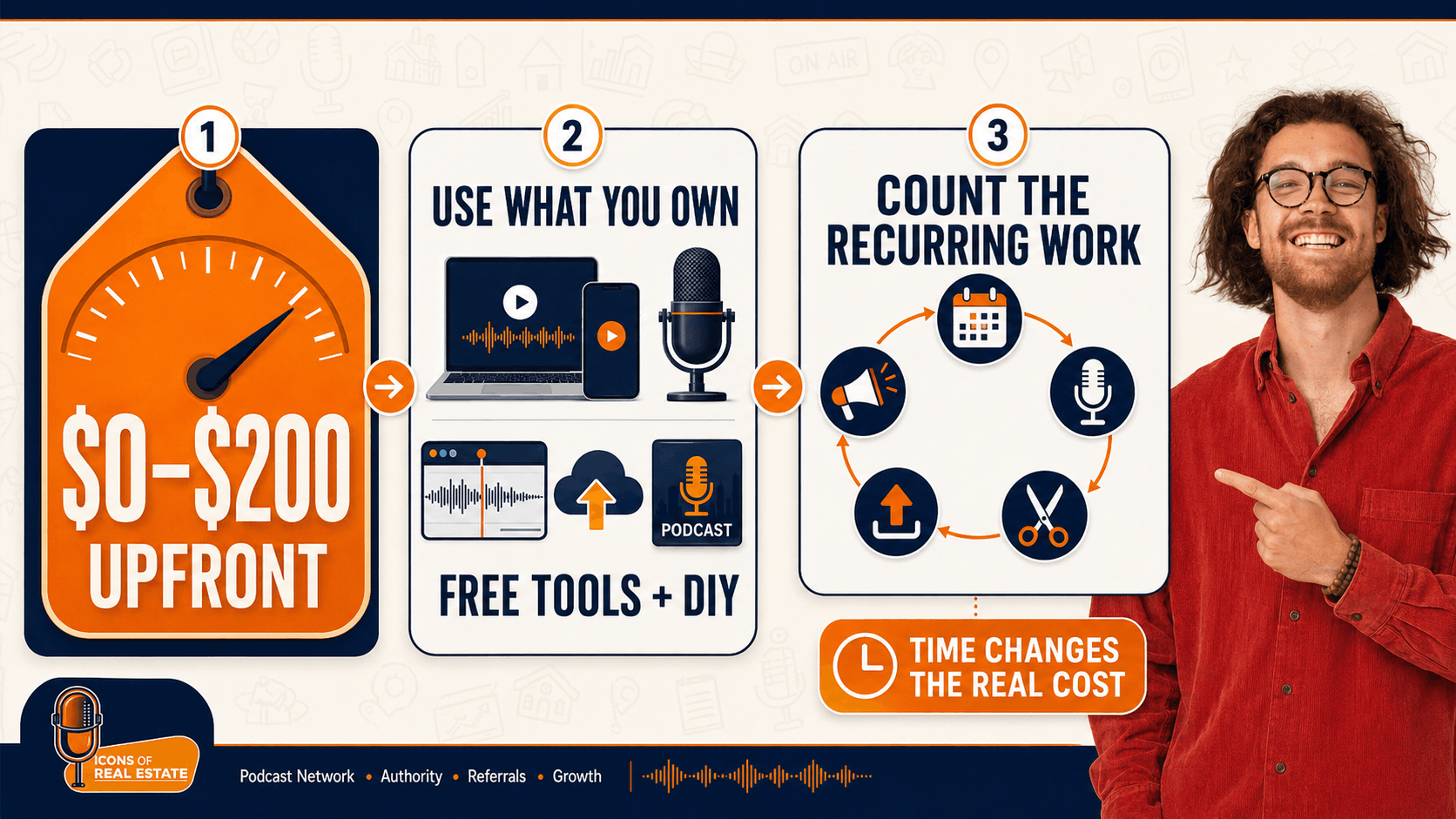
The honest starter answer is $0 to $200 upfront if you already own a phone or computer and use free tools. That number only covers launch. It does not include the hours required to plan, record, edit, publish, promote, and follow up with guests.
Here at ICONS, we look at podcast cost the same way an agent looks at any business investment: cash out, time in, work created, and opportunities supported. This guide will help you:
- Choose between a $0 to $200 launch, a $500 to $1,500 DIY first year, and done-for-you production.
- See every major line item, including what you can defer.
- Calculate the value of your own production time.
- Compare podcasting fairly with your existing lead spend.
If you are still deciding whether a show belongs in your business, start with why real estate agents start podcasts. For the complete strategy, use our real estate podcasting guide for agents and brokers.
How Much Does It Cost to Start a Podcast? The Short Answer
When someone asks, “how much does a podcast cost?” they usually expect a shopping list. So here is the short answer first: $0 to $200 upfront, if you already own a phone or computer and use free tools. That practical launch budget assumes you use:
- Equipment you already own
- Free editing software
- Free podcast hosting
- DIY cover artwork
- A starter microphone
But the shopping list is the small part. The bigger decision is who will do the recurring work: planning, recording, editing, publishing, and promotion. A $90 microphone does not make a show “cheap” if every episode takes half a workday to finish.
That is also why there is no single average cost to start a podcast that fits every show. An audio interview costs far less than a multi-camera video podcast or a weekly show managed by a production team. So use the number that matches your operating model.
What You Actually Need to Publish Episode One
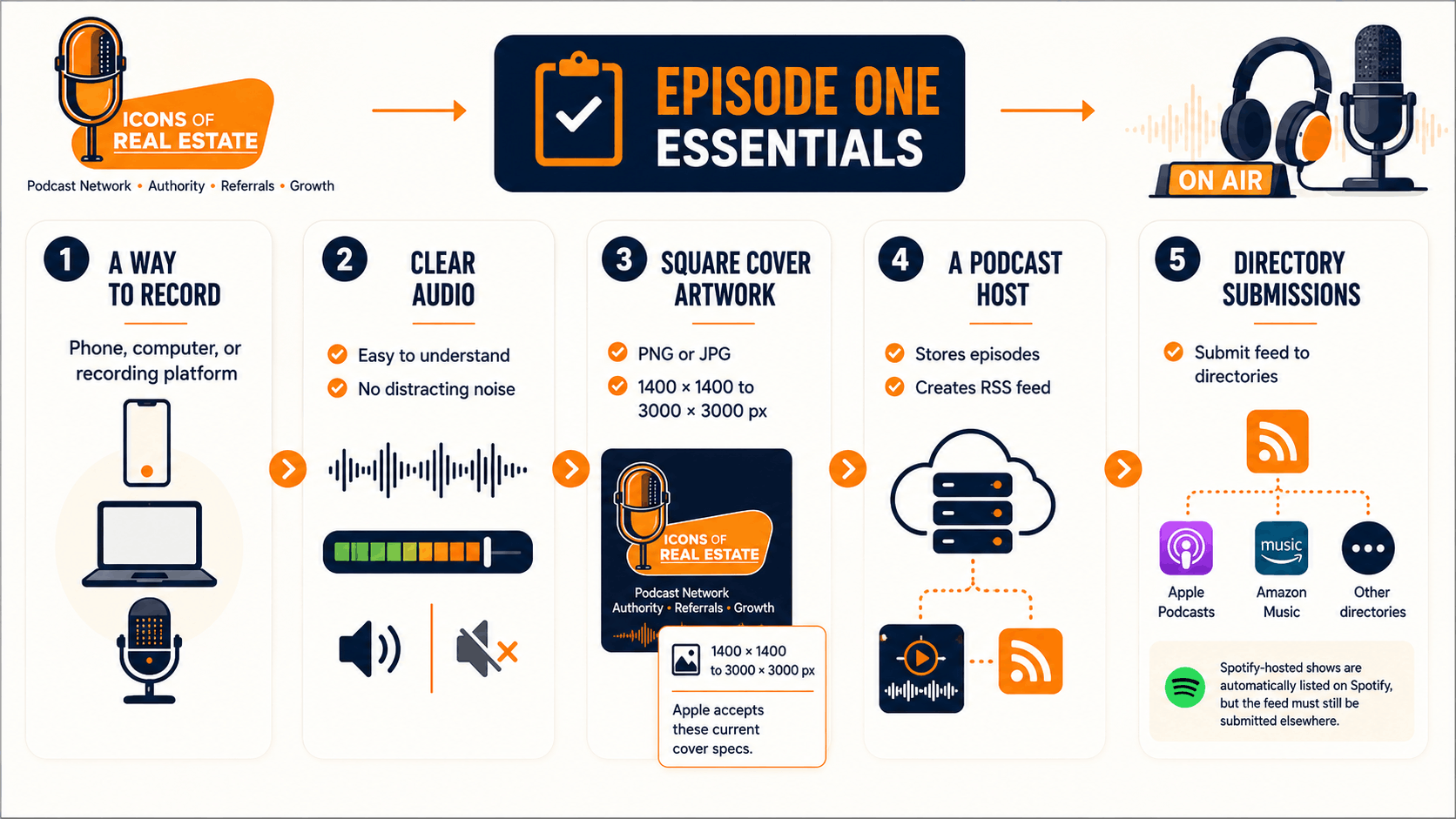
You need five things:
1. A Way to Record
Use a phone, computer, or recording platform.
2. Clear Audio
Your voice should be easy to understand without distracting noise.
3. Square Cover Artwork
Apple accepts PNG or JPG files between 1400 × 1400 and 3000 × 3000 pixels, according to its current cover specifications.
4. A Podcast Host
Your host stores each episode and creates the RSS feed that updates when you publish.
5. Directory Submissions
Apple’s show-submission instructions require an RSS feed for a standard show. Spotify automatically lists shows hosted with Spotify, but you must submit the feed to other directories, such as Apple Podcasts and Amazon Music, yourself. Spotify explains the process in its distribution guidance.
This article helps you price those requirements. When you are ready to put them together, follow the step-by-step podcast launch guide.
The Three Budgets: Starter, Serious, and Done for You
The cost to start a podcast changes mainly with labor. Starter means you handle nearly everything. Serious adds better tools while you remain the producer. Done for you buys back the operational hours.
| Budget | Cash commitment | What it assumes | Best fit |
|---|---|---|---|
| $0-$200 to launch | One-time launch setup | Existing computer/phone, free software and hosting, DIY art, optional entry mic | You want to prove the habit before upgrading |
| $500-$1,500 DIY first year | Equipment plus 12 months of selected tools | Upgraded mic/headphones, paid host or editor, host handles production | You want a smoother workflow and will protect production time |
| From $497 + $621/month | ICONS starting prices | Launchpad plus ongoing production; final scope depends on package | You want to record while a team handles the operation |
Prices checked September 1, 2026. US dollars. Taxes, shipping, add-ons, and plan changes can affect totals.
Starter: $0 to $200 to Launch
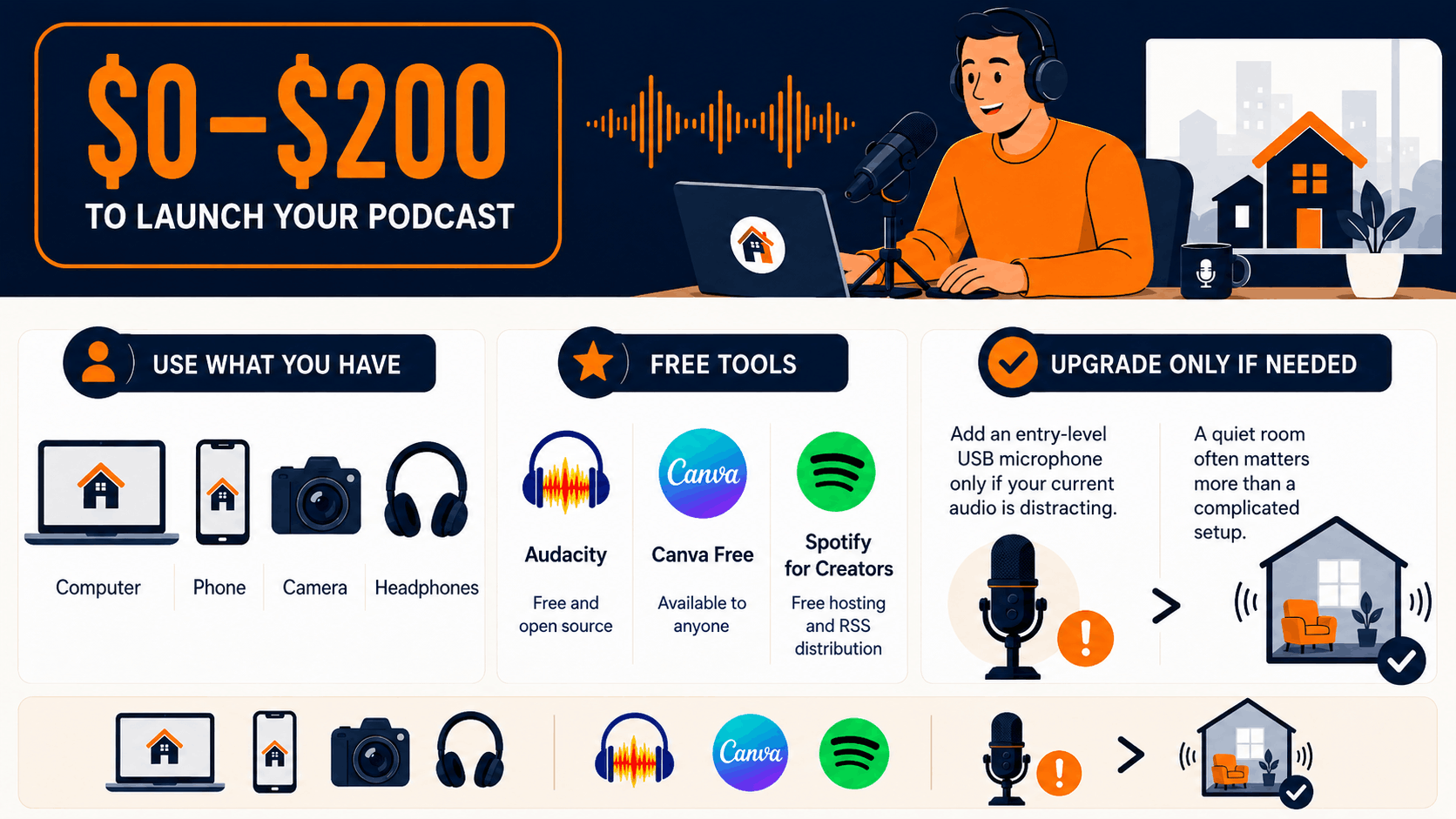
Use the computer, phone, camera, and headphones you already own. Audacity is free and open source, Canva Free is available to anyone, and Spotify for Creators offers free hosting and RSS distribution.
Add an entry-level USB microphone only if your current audio is distracting. ICONS’ podcast equipment guide lists budget options and explains why a quiet room often matters more than a complicated setup.
Serious: $500 to $1,500 for the First Year
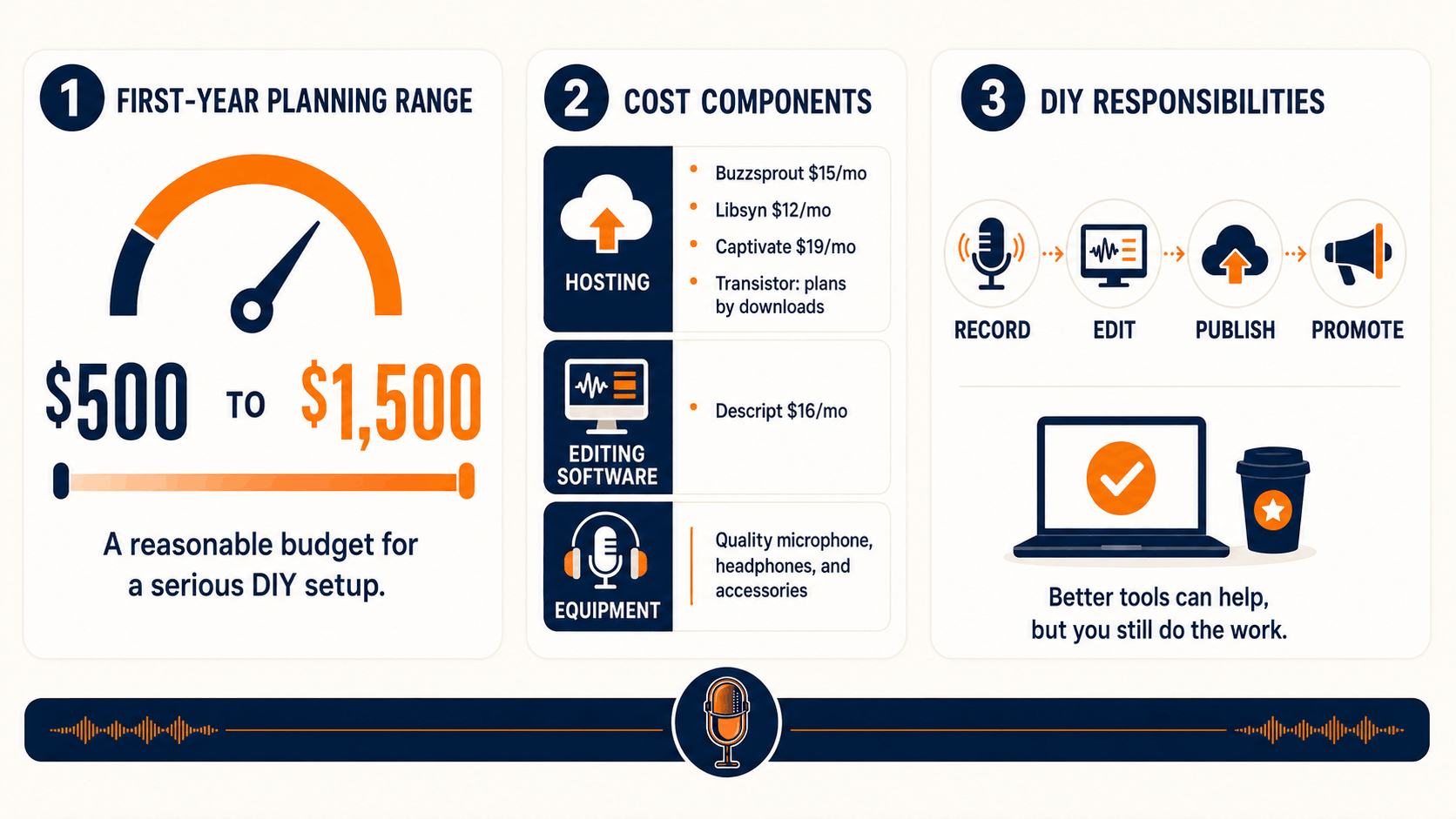
This is still a DIY setup. Better tools can simplify production, but you remain responsible for recording, editing, publishing, and promotion.
Prices checked September 1, 2026:
- Buzzsprout starts at $15 per month when billed annually and limits plans by upload hours.
- Libsyn Basic costs $12 per month and includes a monthly upload allowance.
- Captivate starts at $19 per month and structures plans around downloads.
- Descript’s paid plans start at $16 per month.
- Transistor structures its plans around monthly downloads and private subscribers.
Once you combine hosting, editing software, and equipment, a $500 to $1,500 first-year budget is reasonable.
Done for You: What Full Production Costs and Buys Back
Full podcast production should take more off your plate than editing alone. Before choosing a service, check exactly which responsibilities it will handle, such as:
- Guest booking
- Artwork
- Editing
- Publishing
- Promotional content,
- SEO articles
This helps you compare the price against the hours and responsibilities you will actually recover.
Michael McDonald’s experience shows what that difference can look like in practice. He had already launched The Virtual Millionaire, but he found it difficult to manage the production work and maintain a consistent schedule. After ICONS began handling the editing, posting, descriptions, and social media promotion, his podcast returned to a reliable Thursday publishing schedule. Instead of managing the technical work himself, Michael could focus on hosting valuable conversations.
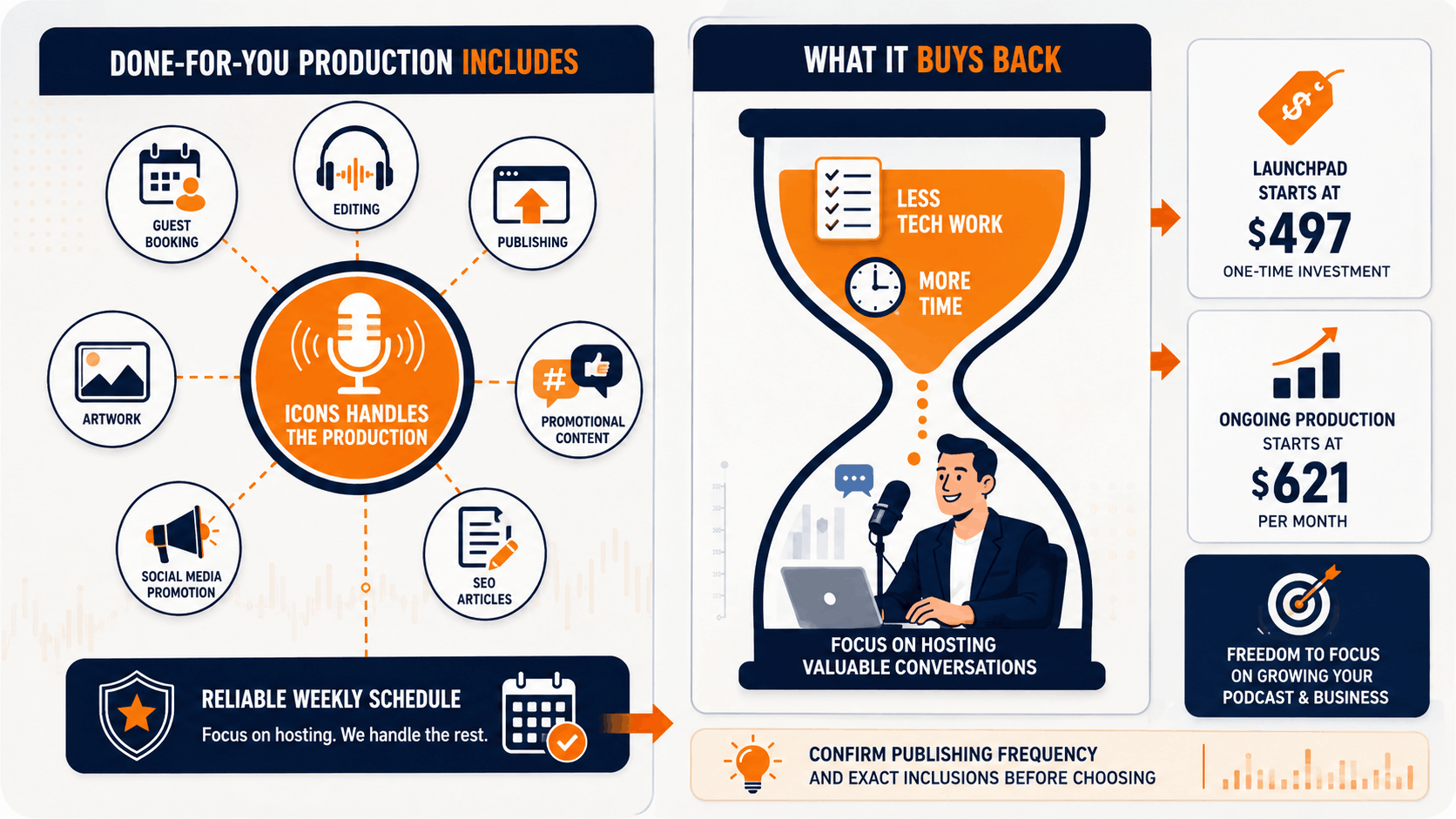
For agents facing the same production bottleneck, ICONS’ done-for-you podcast production service currently offers a Launchpad starting at $497 as a one-time investment, with ongoing production starting at $621 per month. These prices were checked September 1, 2026. Depending on the package, support may include guest coordination, editing, publishing, content curation, promotional materials, social media promotion, and SEO articles. Confirm the publishing frequency and exact inclusions before deciding which package fits your workload.
Line by Line: Where the Money Goes
If you are still asking how much money does it cost to start a podcast, split the answer into one-time, recurring, and optional expenses. Otherwise, a microphone price gets mixed with twelve months of software and the total becomes meaningless.
| Item | Minimum viable choice | Upgraded choice | Billing period |
|---|---|---|---|
| Microphone/headphones | $0 with owned equipment; budget USB mic if needed | Starter microphone: approximately $70–$100; use existing closed-back headphones | One time |
| Recording/editing | Audacity: $0 | Descript from $16 per person per month when billed annually | Monthly or annual |
| Hosting | Spotify for Creators: $0 | • | |
| Buzzsprout: $15/month billed annually |
•
•
$19 monthly or $17/month paid yearly;
•
| Monthly or annual | | Cover art | Canva Free: $0 | Custom designer or production package | One time | | Music | No music: $0 | Properly licensed track or custom music | One time or license term | | Editing | DIY: $0 cash | Freelancer, employee, or production service | Per episode or monthly |
Prices checked September 1, 2026. Confirm the selected plan and billing cadence before publication or purchase.
Microphone and Headphones
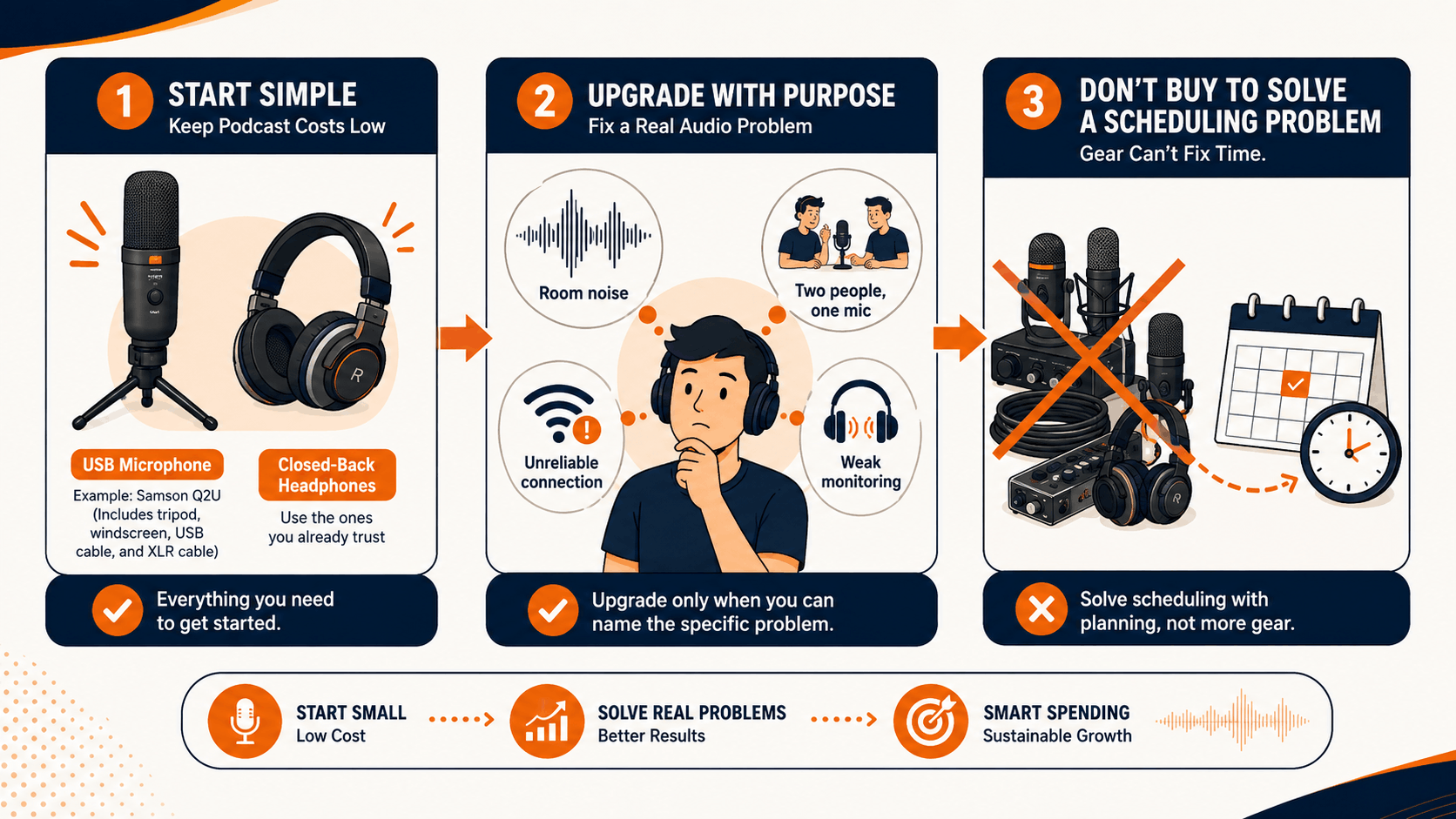
Podcast equipment cost can stay low. Start with one USB microphone and any closed-back headphones you already trust. A microphone such as Samson’s Q2U includes a tripod, windscreen, USB cable, and XLR cable, which can prevent accessory creep.
Upgrade only when you can name the audio problem: room noise, an unreliable connection, two people sharing one microphone, or weak monitoring. Do not buy more equipment to solve a scheduling problem.
Recording and Editing Software
Free software like Audacity and GarageBand lowers podcast editing cost in cash, but it does not remove the learning curve. Paid text-based editing can be worthwhile when it saves enough time to justify the subscription. Test the free tier on two complete episodes before committing.
Podcast Hosting
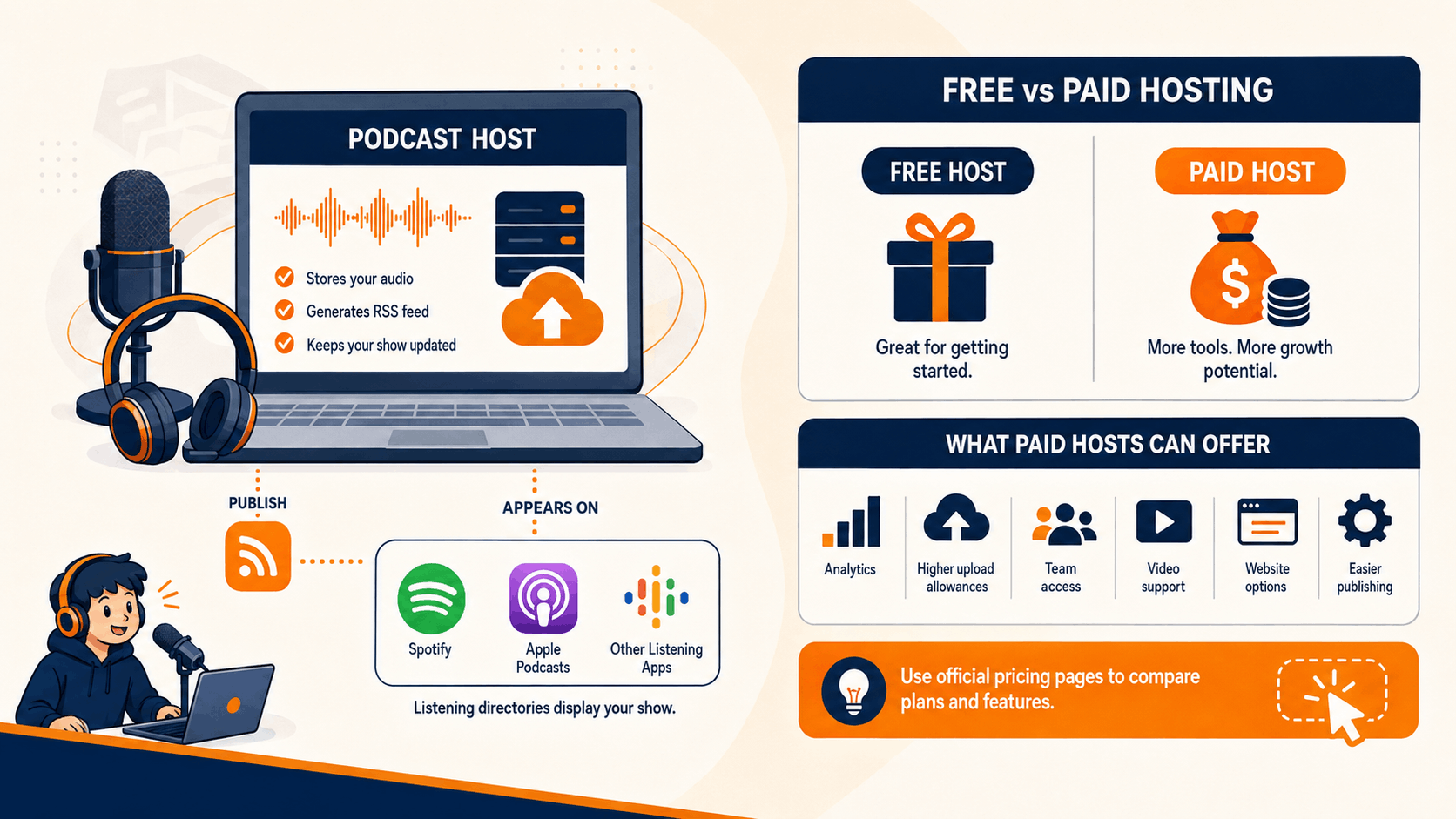
Podcast hosting cost pays for the place where your audio lives and the RSS feed that carries it. Hosting is different from a listening directory. Spotify, Apple Podcasts, and other apps display the show; your host stores and updates it.
A free host can be enough for a new show. A paid host may earn its place through analytics, upload allowances, team access, video support, websites, or a simpler publishing workflow. Use the official pricing pages for Buzzsprout, Libsyn, Captivate, and Transistor when comparing current plans.
Cover Art and Branding
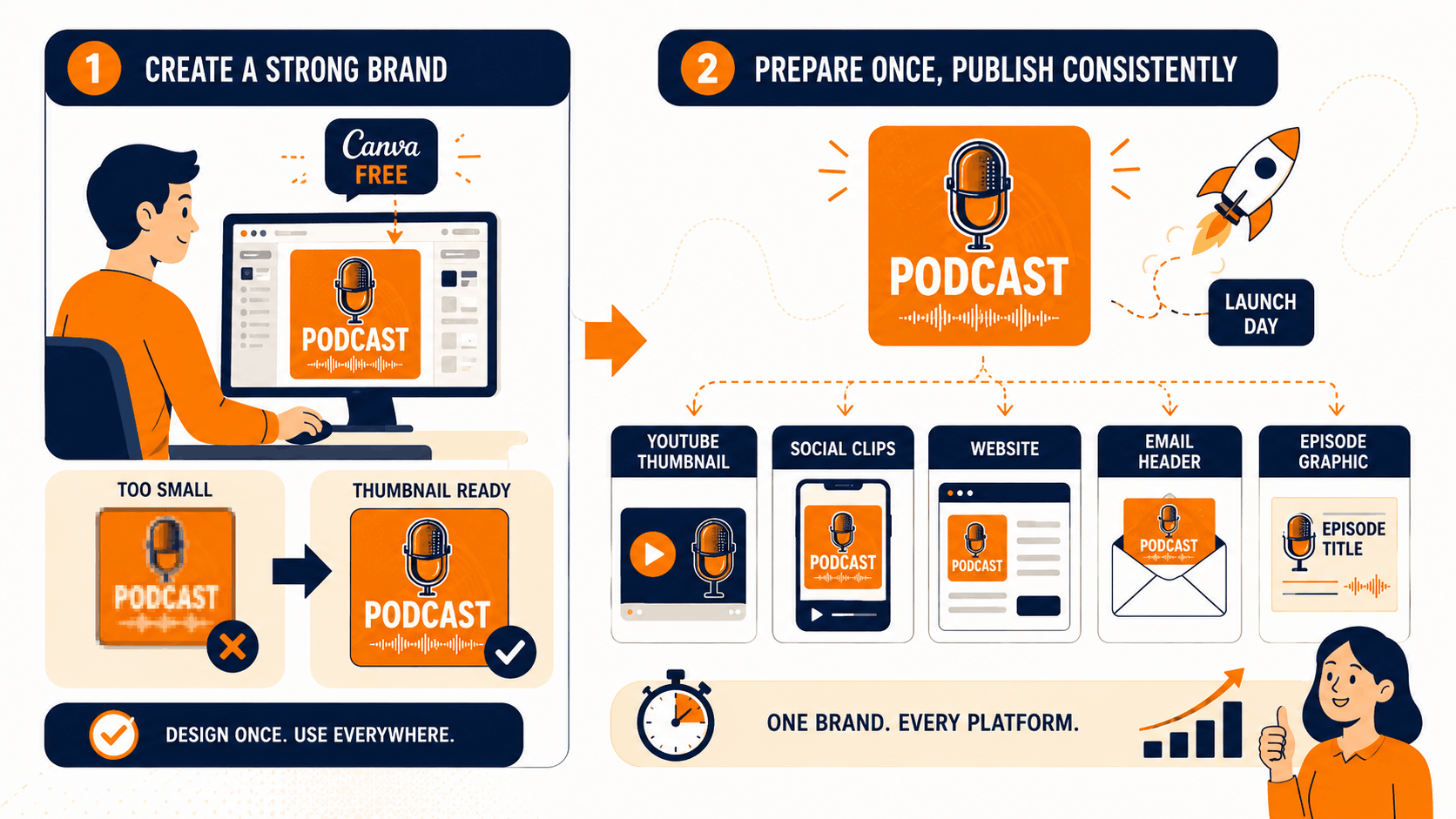
Canva Free provides a $0 option for DIY cover art, but the finished design must still work at thumbnail size and meet platform specifications. Pay for custom branding when you need a consistent system across the show cover, YouTube thumbnails, social clips, website, and email.
ICONS’ Framework 04: Launching treats asset preparation as its own phase. The practical lesson is to finish the repeatable assets before launch day, so every episode does not create a new design project.
Music and Licensing
Music is optional. Silence costs nothing and avoids a rights problem. If you use music, verify that the license covers podcast distribution and commercial use. Spotify’s copyright guidance for creators explains why owning a streaming subscription does not give you permission to place a song in your show.
Editing, If You Are Not Doing It
There is no honest universal editing rate. Price changes with runtime, camera count, cleanup, captions, revisions, clips, show notes, and turnaround. Send the same sample episode and scope to every provider, then compare the effective cost per finished episode.
What You Can Skip and Nobody Will Notice
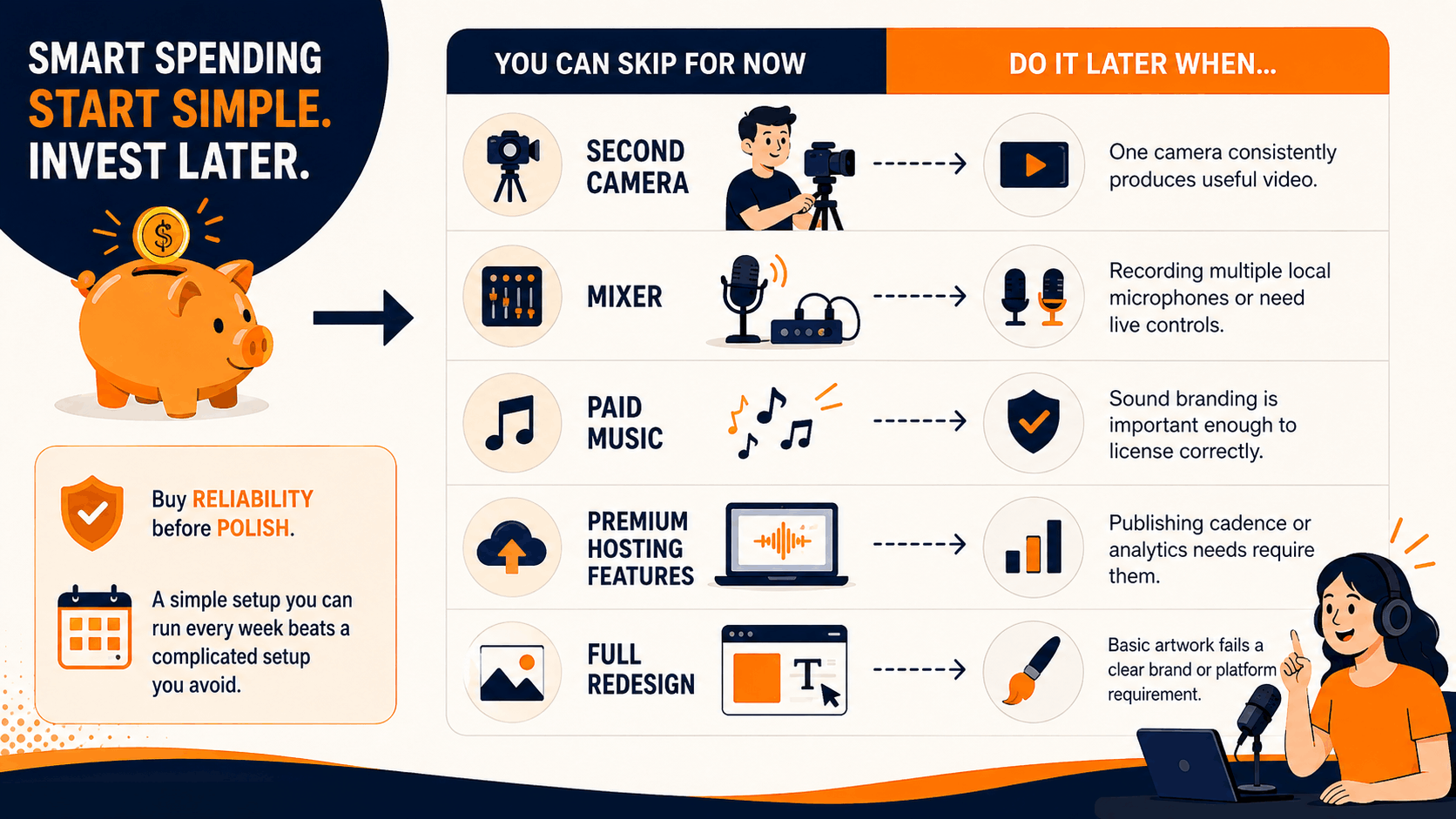
Most new shows do not need a mixer, multiple cameras, studio furniture, custom music, paid acoustic treatment, or an expensive launch campaign. Defer them until they solve a measured problem.
- Skip the second camera until one camera consistently produces useful video.
- Skip the mixer unless you are recording multiple local microphones or need live controls.
- Skip paid music unless sound branding is important enough to license correctly.
- Skip premium hosting features until your publishing cadence or analytics needs require them.
- Skip a full redesign until your basic artwork fails a clear brand or platform requirement.
Buy reliability before polish. A simple setup you can operate every week beats a complicated setup you avoid.
The Cost Nobody Puts in the Spreadsheet: Your Hours
The recurring workload is the part that changes the business decision. Track your first three episodes with a timer. Your own median is more useful than a generic internet average because video, cleanup, guest coordination, and clips can multiply the work.
How Long One Episode Really Takes, Start to Publish
Using the planning assumptions below, one episode can take about 3 hours 15 minutes to 8 hours 15 minutes or more from planning through promotion.
| Task | Planning assumption | Track this |
|---|---|---|
| Planning and research | 30-60 minutes | Topic, guest research, questions |
| Guest coordination | 15-45 minutes | Invites, reminders, rescheduling |
| Recording | 30-60 minutes | Warm-up, interview, wrap-up |
| Editing | 60-180+ minutes | Audio, video, revisions, export |
| Show notes and upload | 30-60 minutes | Title, description, metadata, checks |
| Promotion | 30-90 minutes | Clips, posts, email, guest assets |
These ranges are planning assumptions, not research benchmarks. ICONS’ Framework 03: Hosting recommends getting ready in 30 minutes, while Framework 05 says the established weekly publishing routine can take about 30 minutes. Those two tasks still sit beside recording, editing, promotion, and relationship follow-up.
Why Production Work Causes Podfade
Underestimated production work can cause podfade by making a consistent schedule difficult to sustain. There is no universal episode at which this happens, and a limited series may stop intentionally, so an inactive feed is not automatically a failed show.
Build a workflow you can repeat during a busy listing week. If the plan only works when your calendar is quiet, it is not your real plan.
What Your Hour Is Worth at Your Average Commission
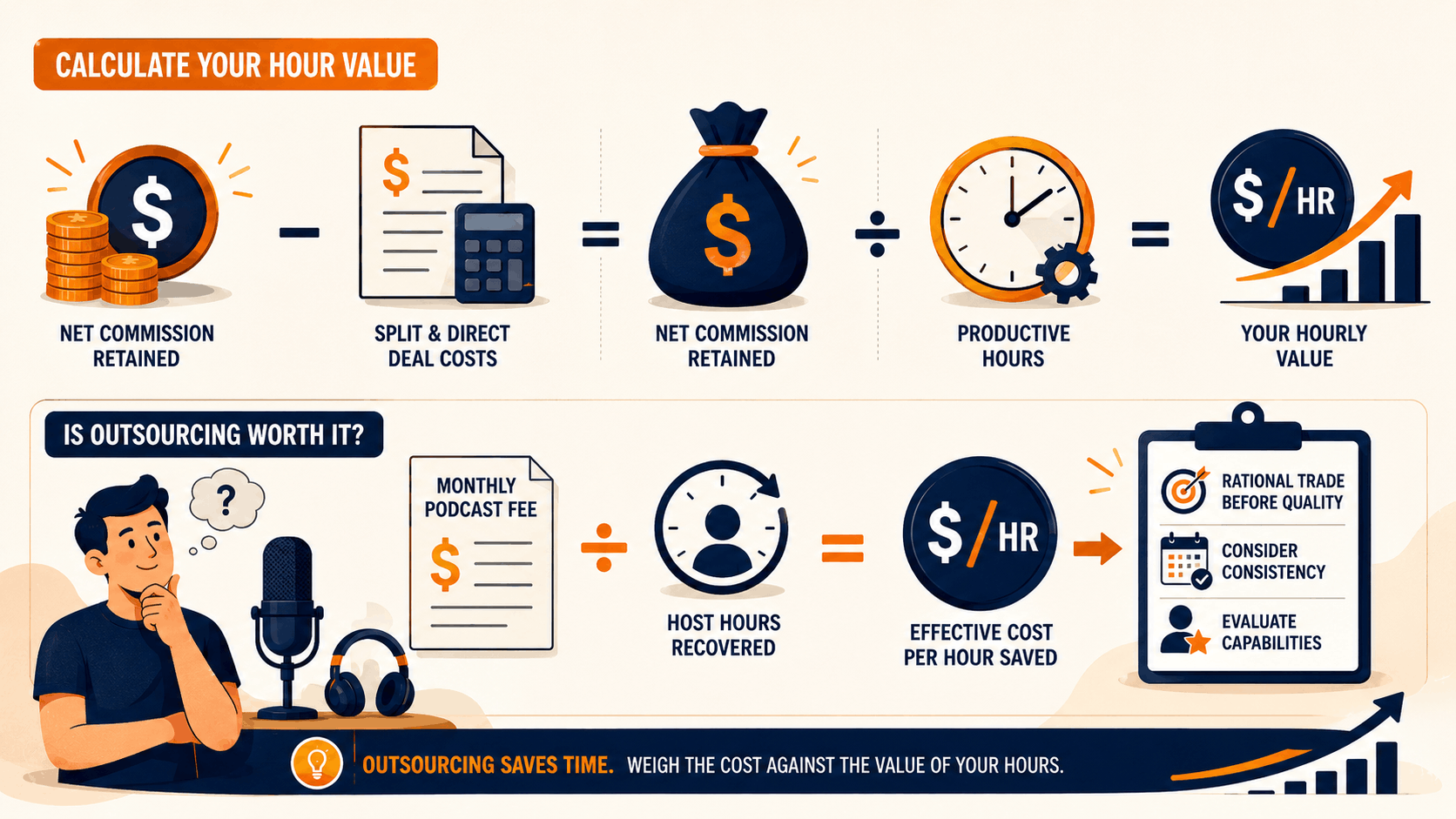
Use net commission retained after the split and direct deal costs, not gross commission income. Divide that number by the hours you spent winning and closing the transaction.
Worked example: $6,000 retained after the split and direct deal costs, divided by 40 productive hours, equals $150 per productive hour; four weekly production hours then represent $600 in opportunity cost. Replace every figure with your own records.
The formula is simple: monthly podcast fee divided by host hours recovered equals the effective cost per hour saved. That does not prove outsourcing will create revenue. It tells you whether the trade is rational before considering quality, consistency, and capabilities.
How a Podcast Compares With What You Already Spend on Leads
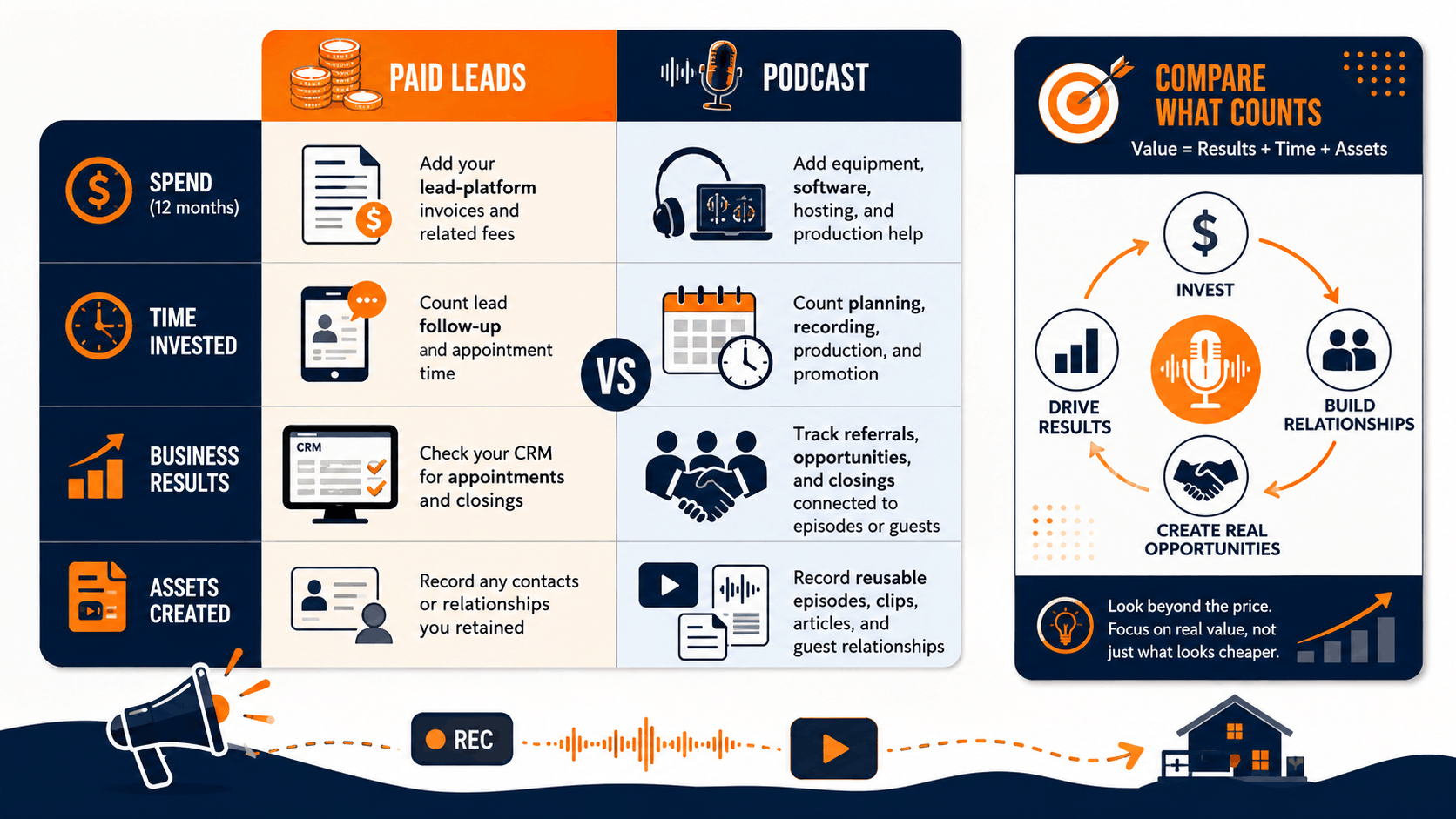
To compare podcasting with paid leads fairly, calculate what each channel costs you over the same period. A twelve-month comparison is usually more useful than placing a one-time microphone purchase beside one monthly lead bill.
For each channel, record:
- Total cash spent: Include equipment, software, services, advertising fees, and other direct expenses.
- Total time required: Count the hours spent recording and producing episodes or contacting and following up with paid leads.
- Business results: Record appointments, referrals, partnerships, and closings that can be traced back to the channel.
- Assets created: Note whether the investment produced reusable content or valuable professional relationships.
| Question | Paid leads | Podcast |
|---|---|---|
| How much did you spend in 12 months? | Add your lead-platform invoices and related fees | Add equipment, software, hosting, and production help |
| How much of your time did it require? | Count lead follow-up and appointment time | Count planning, recording, production, and promotion |
| What business results came from it? | Check your CRM for appointments and closings | Track referrals, opportunities, and closings connected to episodes or guests |
| What remains after the spending stops? | Record any contacts or relationships you retained | Record reusable episodes, clips, articles, and guest relationships |
This comparison tells you which channel produces more value for the time and money invested, not simply which one looks cheaper on paper.
It also captures something a standard lead report can miss: business opportunities created through guest relationships. Do not assign those relationships an imaginary dollar value. Record the real referrals, partnerships, and deals that come from them.
Shae Spitz’s experience shows why. Before The R.E.A.L. Moms Podcast had even launched, she interviewed a local real estate agent and stayed connected after the recording. That relationship later opened a 70-acre development opportunity with the potential for 330 new homes. After eight months of negotiations, Shae closed on 75 acres.
Shae’s experience is an ICONS case study, not a typical or guaranteed result. But it shows why downloads and direct inquiries do not tell the whole story. Track every verified referral, partnership, and deal in your CRM so you can compare your podcast’s business impact with the results from your paid lead sources.
Does a More Expensive Setup Get You More Listeners?
No. A more expensive microphone, camera, or studio does not automatically grow your audience. Better equipment can improve sound, video, and reliability, but it cannot make people discover your show.
Upgrade only when your current setup creates a clear problem. Before buying anything, ask:
- Is the audio difficult to understand?
- Are technical problems interrupting recordings?
- Have listeners or guests mentioned the quality?
- Will this purchase fix that specific problem?
If your recordings are already clear and reliable, put your time, energy, and money into distribution instead. The goal is to bring your podcast to potential listeners rather than waiting for them to find it.
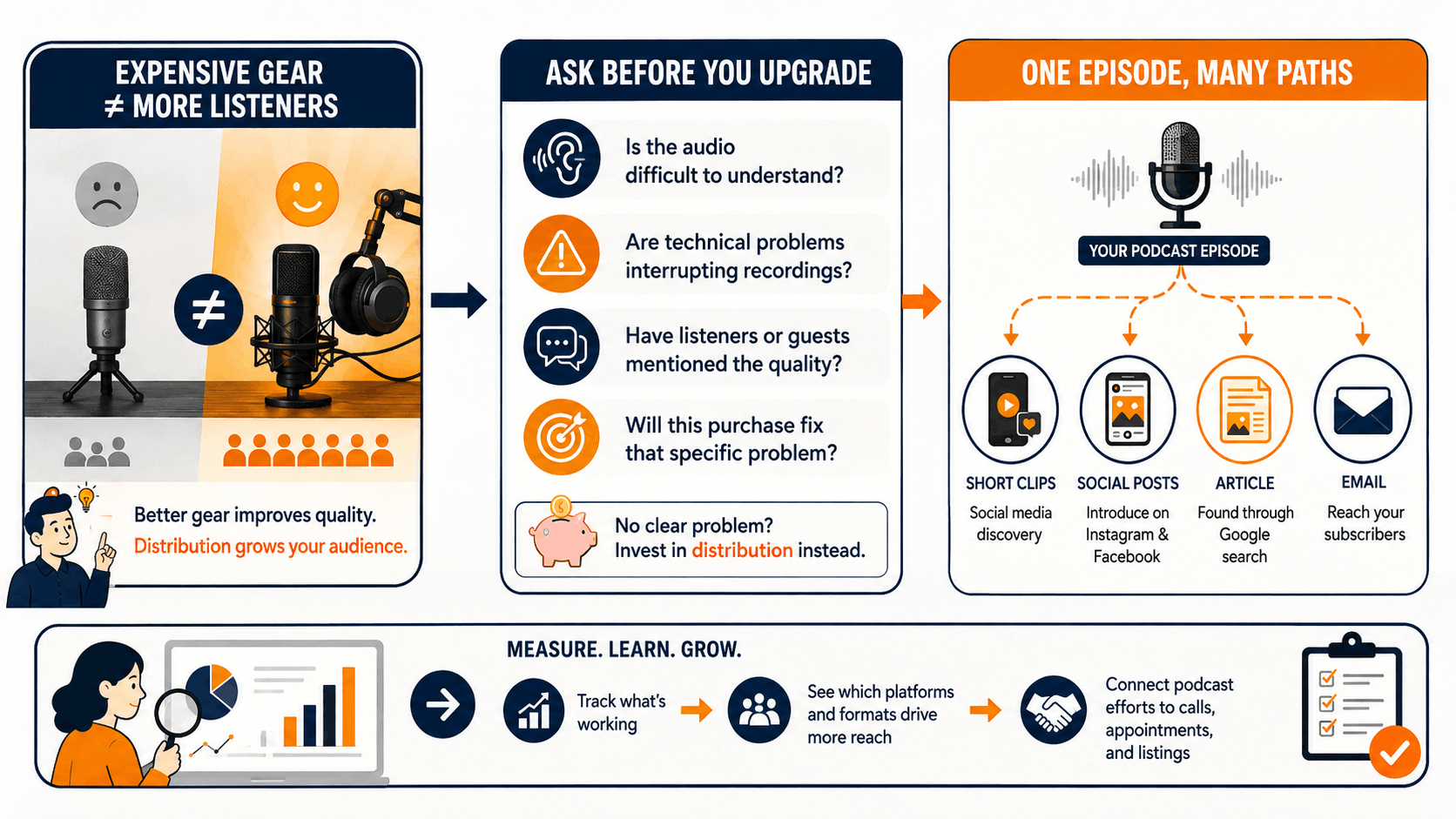
Framework 05: Distribution (one of our 5-part podcasting framework) shows how one episode can become short clips, social posts, an article, and an email. Instagram and Facebook clips can introduce the episode to social media users. An article can help people searching for the topic find it through Google. Each format creates another path to your podcast.
Use this podcast promotion guide for real estate agents to choose where and how to distribute that content. Once your promotion is running, use our guide to measuring podcast success to see which platforms and content formats are expanding your reach, and track the referrals, calls, appointments, or listings connected to your podcast.
When It Is Worth Paying Someone Else
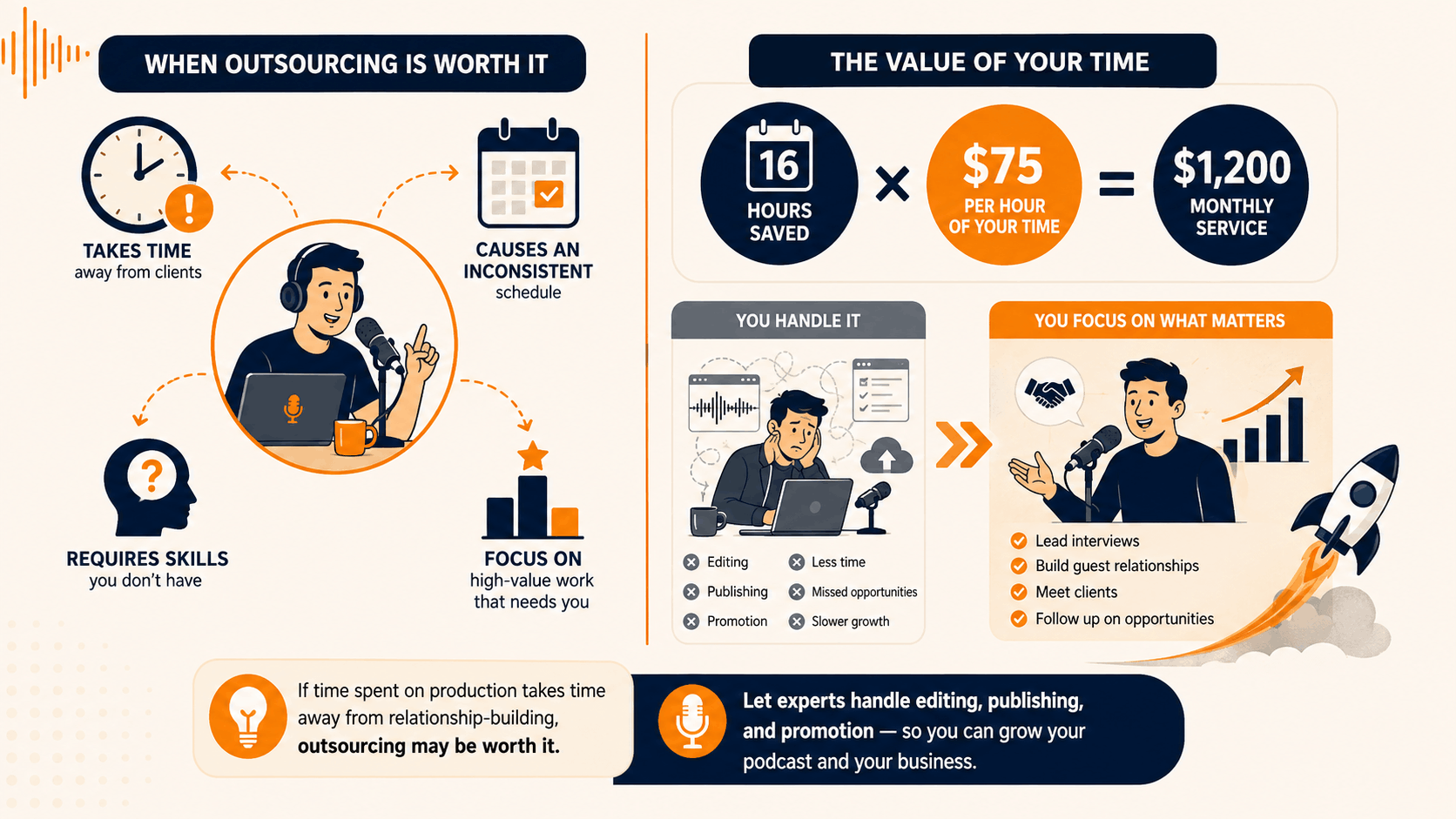
Outsourcing may be worth it when production takes time away from clients, causes an inconsistent publishing schedule, or requires skills you do not have.
For example, a $1,200 monthly service that saves 16 hours costs $75 for each hour you get back. If an hour spent on clients or referrals is worth more than $75 to your business, the service may justify its cost. Just confirm which tasks are included first.
That is how Shaune Corbett divided the work. He spent a couple of hours each week interviewing guests while ICONS handled production and posting. The team also helped connect with sponsors, pitch packages, and close agreements, helping Real Estate Success DFW secure four sponsorships.
Outsourcing lets you focus on the higher-value work that needs you: leading interviews, building guest relationships, meeting clients, and following up on opportunities. Editing, publishing, and promotion still matter, but you do not have to handle them yourself. If those tasks are taking time away from relationship-building, consider full-service podcast production for real estate agents.
FAQs About Podcast Costs
How much does a podcast cost?
A basic launch can cost $0 to $200 upfront under the assumptions in this guide. A serious DIY first year can fall between $500 and $1,500. Outsourced production should be priced by cadence and scope.
Is it free to publish on Spotify and Apple Podcasts?
As checked September 1, 2026, Spotify for Creators provides free hosting and RSS distribution. Apple also confirms that free episodes distributed through an RSS feed remain free on Apple Podcasts. You still need a valid RSS feed and compliant artwork, while optional podcast subscriptions have separate terms.
What does it cost to start a podcast with video?
Video can remain inexpensive if you use an existing phone or webcam, natural light, and free editing. Costs rise with cameras, lighting, local recording, storage, multi-camera editing, thumbnails, and clips. Price the complete workflow, not the camera alone.
How much would it cost to start a podcast with professional help?
It depends on what “professional help” replaces. Ask whether the quote includes strategy, branding, guest booking, editing, publishing, syndication, social assets, SEO articles, and reporting. As checked September 1, 2026, ICONS lists its Launchpad from $497 and ongoing production from $621 per month.
Can I start for free and upgrade later?
Yes. Use equipment you already own, Audacity’s free editing software, Canva Free, and Spotify for Creators’ free hosting. Upgrade only when a repeated problem tells you what to buy or delegate.
Get Help Launching or Fixing Your Podcast
Choose the path that removes the constraint you actually have, whether that is strategy, authority, production, proof, or guest appearances.
Need a step-by-step strategy?
Use the five ICONS Podcast Frameworks to work through foundation, guest invitations, hosting, launching, and distribution.
Want to build authority through guest appearances?
Apply to appear as a guest on the ICONS real estate podcast network and share useful expertise with relevant real estate audiences.
Want someone to operate the entire show?
Review ICONS’ done-for-you podcast production service for current pricing and package inclusions.
Want proof beyond downloads and views?
Explore documented ICONS podcast success stories involving referrals, sponsorships, connections, and business opportunities. These are case studies, not guaranteed outcomes.
Want to be booked on relevant shows?
The Podcast Guesting service supports podcast matching, tailored pitches, booking coordination, interview preparation, and reporting.
Final Words
The useful answer to how much does it cost to start a podcast is not one oversized range. It is your launch cash, your yearly tools, and the value of the hours required every week. Start with the simplest setup that lets you publish consistently, track three episodes, then upgrade or outsource the bottleneck you can prove.
Want a real estate podcast without managing guest outreach, editing, publishing, and promotion yourself? Explore ICONS’ done-for-you podcast production service and compare the current packages with your DIY workload.
Done-for-you podcast production
Want a podcast that brings in referrals, not just downloads?
Icons of Real Estate plans, produces and publishes business-growing podcasts for agents. You record. We handle the rest.
Launch Your Podcast
Written by
Co-Founder and Podcast Guru, Icons of Real Estate
Tomás Fonseca co-founded Icons of Real Estate in 2021 and is its Podcast Guru. He has a background in marketing, with stints at companies like Nintendo and Ardor SEO, and is one of the hosts of the Icons of Real Estate Podcast.
How we research, write, fact-check and correct articles: our editorial standards.