
On this page
- How do LPT Realty and eXp Realty compare?
- What do LPT Realty and eXp Realty charge agents?
- Which costs less at your volume, LPT or eXp?
- How do revenue share and stock compare at LPT and eXp?
- What do LPT and eXp say about technology and support?
- Which brokerage fits which agent?
- Next step: your brand moves with you
LPT Realty vs eXp Realty comes down to size and disclosure. Both are cloud brokerages. eXp is about four times bigger, its parent trades on Nasdaq, and it files its U.S. fees with the SEC. LPT shares plan terms in a consultation. So eXp suits agents who want published terms and stock. With LPT, get a written quote first.
Everything here comes from the two companies’ own pages and filings, or the trade press, checked on 10 November 2026. For LPT’s history, IPO filing and full question list, see our guide to LPT Realty. This page is the head-to-head.
How do LPT Realty and eXp Realty compare?
LPT Realty and eXp Realty both run online instead of from local offices, but they differ on size, ownership and how much they publish. The table sets out what each company says about itself.
| LPT Realty | eXp Realty | |
|---|---|---|
| Started | 2016 as Listing Power Tools software; a brokerage since 2022 | Parent incorporated in 2008 |
| Agents | 21,055 (RISMedia, July 2026) | 87,457 at 30 Sep 2026, including NextHome |
| Footprint | All 50 states, D.C. and Canada | North America, plus 27 countries in its international segment |
| Ownership | Private; parent filed a confidential draft for an IPO | Public; parent AGNT, Inc. trades on Nasdaq as AGNT |
| Split, cap and fees | Not published; “shared in consultation” | Published in SEC filings |
| Revenue share | Not described on LPT’s site | Seven tiers, paid from a pool of company dollar |
| Agent stock | Not described on LPT’s site | Opt-in equity program plus stock awards |
LPT’s facts come from its Why LPT page and RISMedia’s July 2026 report. eXp’s agent count and parent come from the AGNT, Inc. 10-Q for the third quarter of 2026. Its founding date, international reach and stock programs come from the 2025 Form 10-K.
What do LPT Realty and eXp Realty charge agents?
eXp Realty publishes what it charges: an 80/20 split until you pay $16,000 a year, plus monthly and per-deal fees. LPT Realty doesn’t publish its charges, and says its Independent Contractor Agreement overrides anything on its website.
eXp Realty’s published fees
eXp’s U.S. policies dated 15 September 2025 set out the fees, and the August 2026 version leaves them unchanged:
- Split and cap: 80/20 until eXp’s 20% adds up to $16,000 in your capping year
- Monthly fee: $85, plus a $149 sign-up fee in your first month
- Every deal: a $25 review fee and a $60 risk management fee, capped at $750 a year
- After the cap: $250 a deal (or 20% if less) until you’ve paid $5,000, then $75 a deal
The full mechanics, including team splits and the anniversary-date reset, are in our explainer on the eXp commission split and cap.
LPT Realty’s fees: not published
LPT’s Brokerage for Life page offers “multiple primary compensation structures”. It says “current structure details are shared in consultation.” Its individual agent page promises “economic structures that fit your production, not a forced plan.” Both add: “Independent Contractor Agreement supersedes all information provided here.”
The only LPT numbers we can trace to LPT are staff replies in the public comment thread of its help desk article on fees. The article itself needs a login. The replies are dated:
- August 2023: on deals with gross commission over $2,500, a $500 broker fee plus a $195 transaction fee; under $2,500, a 20% fee
- August and September 2023: a $500 annual fee taken from the first closed deal of the year
- February 2024: an agent on the “Business builder” plan pays the $500 plus $195 “along with a .3% risk fee”
- August 2024: “All of the fees were outlined in the ICA that you have signed.”
- April and November 2025: deals under $2,500 count as low-GCI, where the standard fees don’t apply and a low-GCI fee does
Treat those as old answers to individual agents, not a current fee schedule. They don’t say whether the $500 broker fee has a cap or whether other plans exist alongside it. We’ve left out the plan numbers on recruiter sites, because none links to an LPT document we could check.
Which costs less at your volume, LPT or eXp?
Which costs less depends on your deal count, because eXp’s cost flattens out after the cap. LPT’s side can’t be priced from public information, so the comparison needs LPT’s written schedule.
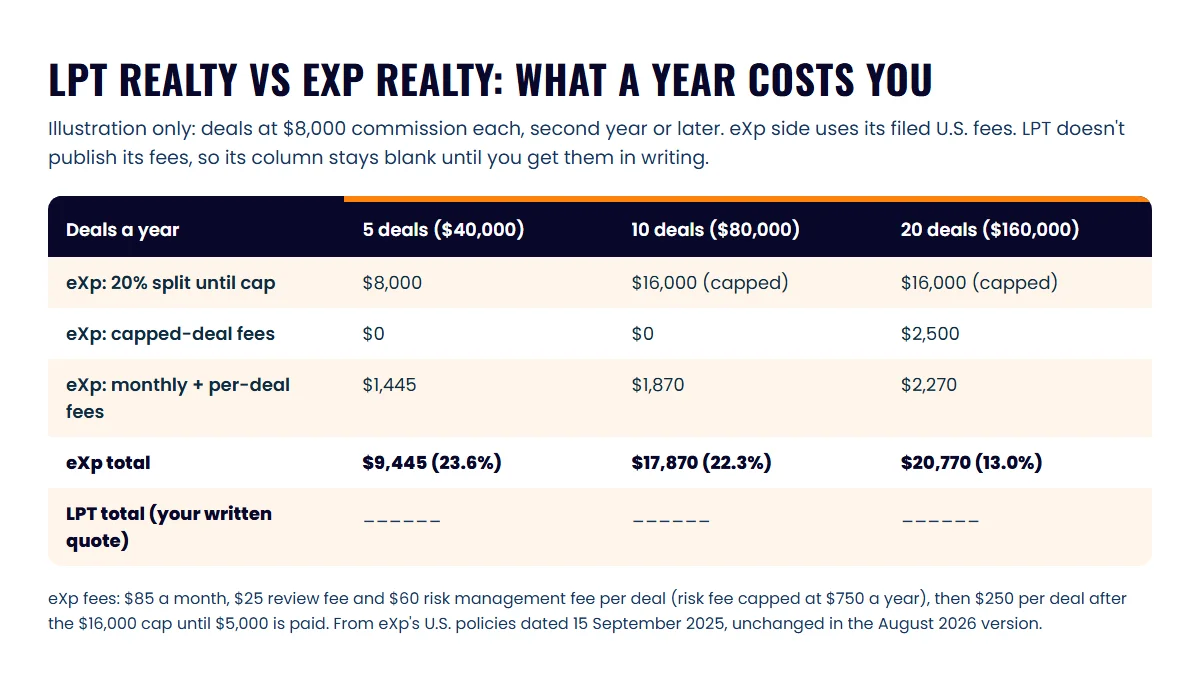
The pattern matters more than the totals. eXp costs about a fifth of gross until you cap, then gets much cheaper per deal. A per-deal fee plan, like the one described in LPT’s 2023 staff replies, costs the same per deal at any volume unless it has a cap. Ask LPT for its numbers on paper and run them at the same three volumes. If you sell part time, our part-time agent brokerage comparison shows how fixed fees hit at low volume.
How do revenue share and stock compare at LPT and eXp?
Revenue share and stock are where eXp and LPT differ most on paper. eXp publishes both programs. LPT’s public pages don’t describe either, and its parent company isn’t publicly traded yet.
eXp’s revenue share pays you from the company dollar of agents you sponsor, across seven tiers. It vests after 36 months in good standing, per its U.S. policies. Agents at eXp can also opt in to an equity program and earn stock awards for a first deal, for capping and for ICON status. Our guide to eXp Realty stock explains the AGNT ticker change and how those awards vest.
LPT is at an earlier stage. On 30 July 2026, its parent, LPT Holdings, Inc., announced a confidential draft S-1 registration statement for an IPO, according to RISMedia. RISMedia also reports that the company reserved the Nasdaq ticker LPTA in August 2025. When we searched EDGAR full text search on 10 November 2026, we found no public S-1 from LPT. A public S-1, once filed, should set out its agent plans in far more detail than its website does.
What do LPT and eXp say about technology and support?
Both brokerages offer technology and central support in place of local offices. LPT stresses a platform it built and owns. eXp stresses low costs from its cloud model and a choice of CRM systems.
LPT says it started as a marketing technology company. Its Why LPT page describes “a technology foundation the company owns end to end,” with automation across marketing, operations, support, matching and routing. Its individual agent page lists “broker support, compliance, and transaction operations included” and a national referral network.
eXp’s 2025 Form 10-K says its cloud-based model “reduces costs to the Company’s agents and brokers.” It also says the company lets agents choose among three customer relationship management platforms. Neither company publishes data you could use to compare the tools, so ask for a demo login before you decide.
Which brokerage fits which agent?
LPT Realty or eXp Realty fits you depending on how much you sell, whether you want stock and revenue share, and how much you value published terms. Use these questions to sort it out:
- Do you want to check every fee before you talk to anyone? eXp’s terms are on SEC.gov. LPT’s need a consultation and a copy of its agreement.
- Do you close enough to cap? At $8,000 a deal, eXp’s cap arrives at 10 deals, and each deal after that costs much less. Below that, compare LPT’s per-deal fees carefully.
- Do you want to recruit? eXp has a published seven-tier revenue share. LPT’s site doesn’t describe one, so ask before you count on it.
- Do you want company stock? eXp’s parent is public and pays agents in stock awards. LPT’s parent isn’t public yet.
- Do you value a smaller company? LPT had about a quarter of eXp’s agent count in 2026. Some agents prefer that, and some prefer scale.
Moving from one to the other also has exit costs. eXp’s policies let you move a pending deal only with the client’s written consent and eXp’s written approval. An uncapped agent’s new brokerage pays eXp a 20% referral fee on it, and unvested stock and revenue share are lost. Our article on why agents leave eXp walks through those costs. For a third option, our Real Brokerage vs eXp Realty comparison runs the same math.
Next step: your brand moves with you
Whichever brokerage you choose, your clients and referral partners follow you, not the logo on your sign. License transfers go through your state real estate commission, so check the process with your broker before you switch.
The agents who move without losing business are the ones people already know by name. A steady personal brand as an agent is what travels with you. Guest spots on other people’s podcasts are one low-effort way to build it, and our podcast guest booking service explains how that works.
Frequently asked questions
Is LPT Realty cheaper than eXp Realty?
Nobody can say from public information, because LPT doesn't publish its splits, caps or fees. Get LPT's full fee schedule in writing and run it against eXp's published fees at your own deal count and commission size.
Does LPT Realty offer stock to agents like eXp?
LPT's public pages we read in November 2026 don't describe an agent stock program. Its parent isn't public yet; it announced a confidential draft IPO filing in July 2026. Ask LPT in writing whether any equity program exists.
Can I move my pending deals from eXp to LPT?
Only on eXp's terms. eXp's policies require good standing, your new brokerage's acceptance, the client's written consent and eXp's written approval, and an uncapped agent's new brokerage pays eXp a 20% referral fee.
Are LPT Realty and eXp Realty in Canada?
Both are. LPT says it operates in all 50 states, Washington, D.C. and Canada. eXp's parent reports a North American segment plus brokerage operations in 27 countries through its international segment.
Sources
- Why LPT — LPT Realty (accessed November 10, 2026)
- Brokerage for Life — LPT Realty (accessed November 10, 2026)
- Grow as an Individual Agent — LPT Realty (accessed November 10, 2026)
- LPTRealty.com fees article and staff replies — LPT Realty Help Desk (accessed November 10, 2026)
- LPT Realty Parent Takes Official Step to Go Public — RISMedia, 30 July 2026 (accessed November 10, 2026)
- eXp Realty (USA) Policies and Procedures, version 09.15.2025 (Exhibit 10.14 to the 2025 Form 10-K) — U.S. Securities and Exchange Commission (accessed November 10, 2026)
- AGNT, Inc. (eXp Realty) USA Policies and Procedures, version August 2026 (Exhibit 10.14 to the Form 10-Q for the quarter ended June 30, 2026) — U.S. Securities and Exchange Commission (accessed November 10, 2026)
- eXp World Holdings, Inc. Form 10-K for the year ended December 31, 2025 — U.S. Securities and Exchange Commission (accessed November 10, 2026)
- AGNT, Inc. Form 10-Q for the quarter ended September 30, 2026 — U.S. Securities and Exchange Commission (accessed November 10, 2026)
- EDGAR Full Text Search — U.S. Securities and Exchange Commission (accessed November 10, 2026)
Done-for-you podcast production
Want a podcast that brings in referrals, not just downloads?
Icons of Real Estate plans, produces and publishes business-growing podcasts for agents. You record. We handle the rest.
Launch Your Podcast
Written by
Co-Founder and Podcast Guru, Icons of Real Estate
Tomás Fonseca co-founded Icons of Real Estate in 2021 and is its Podcast Guru. He has a background in marketing, with stints at companies like Nintendo and Ardor SEO, and is one of the hosts of the Icons of Real Estate Podcast.

How we research, write, fact-check and correct articles: our editorial standards.