Yes, you can make money from a real estate podcast, but usually not through advertising at the audience size of a local show. The stronger podcast monetization strategies connect episodes to listings, referral partners, repeat clients, and warmer sales conversations. A hundred relevant listeners can matter more than thousands of strangers.
Here at ICONS, we build podcasts around business relationships and useful content. That changes what you count as a return.
In this article, you’ll discover:
- What sponsorship requires and what CPM ads pay
- Which real estate outcomes to count
- How to compare one closing with annual ad inventory
- How to track an episode-to-client path
But if you are still deciding what the show should accomplish, start with the reasons agents use podcasts to grow.
The Short Answer: Not From Ads (And Here's Why That Shapes Your Podcast Monetization Strategies)
For most local shows, ads are a weak primary goal. If you ask how do podcasts make money or how to monetize a podcast, separate direct media income from attributable business opportunities.
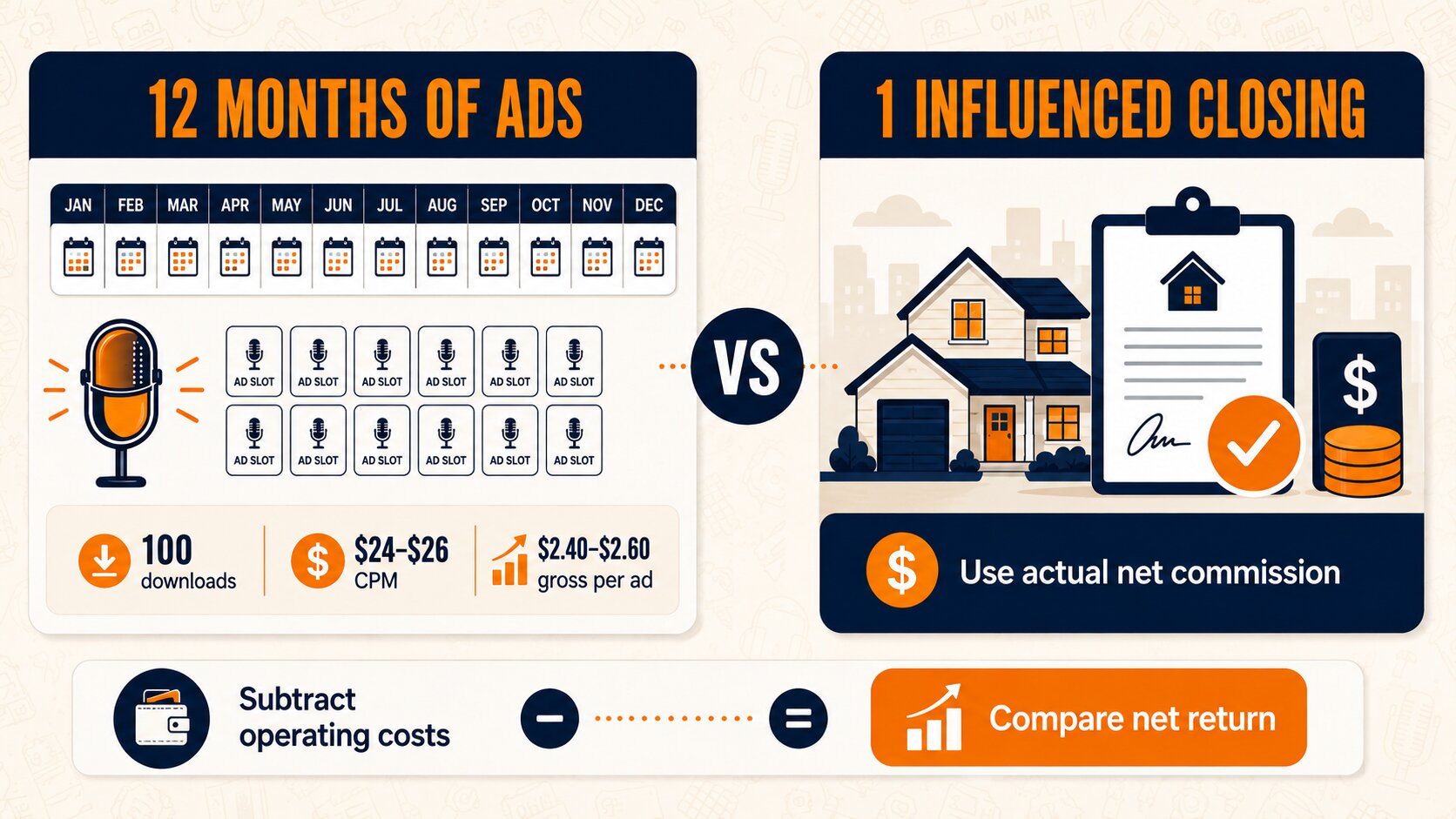
The reason is simple. Advertisers commonly price podcast inventory by CPM, or cost per 1,000 qualifying downloads or impressions. Libsyn's live rate guide, as of September 4, 2026, lists average baked-in host-read rates of $18 to $22 CPM for 30 seconds and $24 to $26 CPM for 60 seconds. At 100 qualifying downloads, one 60-second placement has a gross value of only $2.40 to $2.60 under that guide.
Listings, referrals, and repeat clients sit on different economics. One relevant person can remember you at the right moment.
A CPM calculation can't see any of that: who you invite, what you publish, how people find each episode. The broader real estate podcasting strategy for agents covers the parts it misses.
What Podcast Sponsorship Actually Requires
Podcast sponsorship has no universal listener threshold. Marketplaces impose eligibility rules; local sponsors may value audience fit and geography.
How Many Downloads Do You Need Before Anyone Pays You?
The answer depends on the program. Buzzsprout's current eligibility documentation, as of September 4, 2026, requires 1,000 downloads within a rolling 30-day period, five published episodes, qualifying episode length, and a paid hosting plan. Reaching those requirements unlocks the program; earnings then depend on available ad opportunities and accepted placements.
Spotify's Partner Program rules require at least 1,000 Spotify audience members and 2,000 consumption hours in the previous 30 days, plus three published episodes, Spotify hosting, and an eligible legal address. Use the requirements published by your own host when calculating how many listeners to make money podcasting.
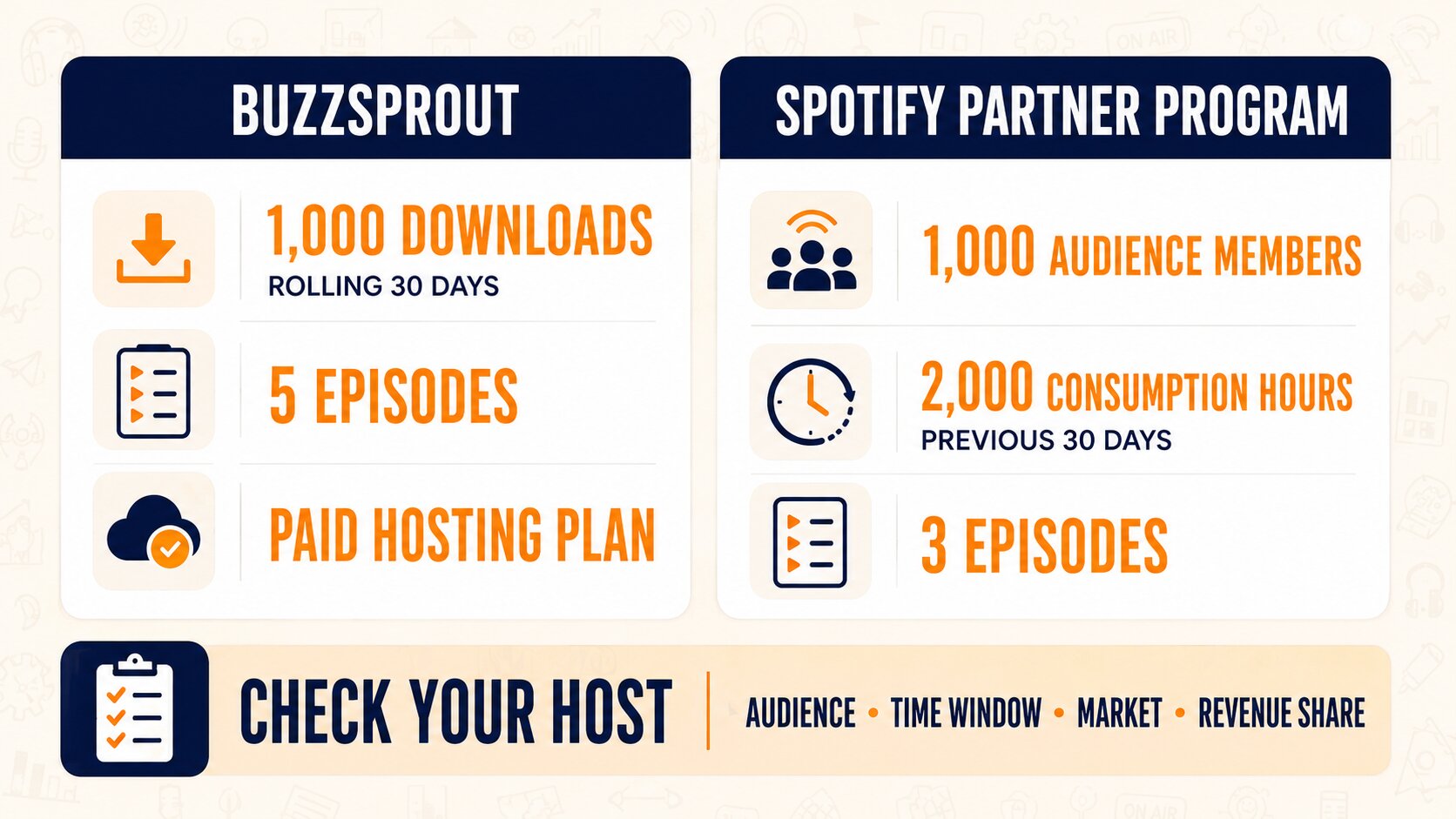
Check your host's monetization page and record its audience measure, time window, market, and revenue share. If you are considering podcast monetization platforms or YouTube podcast monetization, verify each program’s current requirements before projecting revenue.
What Do Podcast Ads Pay Per Thousand Listeners?
Podcast ads commonly pay $18 to $22 CPM for a 30-second host-read and $24 to $26 CPM for a 60-second host-read, according to Libsyn's checked podcast advertising rate guide. CPM means the price per 1,000 podcast downloads or impressions, before accounting for unsold inventory or any platform share.
Using Libsyn's checked $24 to $26 CPM guide for 60-second host-read ads, the illustrative gross value looks like this:
Qualifying downloads | Gross value at $24 CPM | Gross value at $26 CPM |
100 | $2.40 | $2.60 |
1,000 | $24.00 | $26.00 |
5,000 | $120.00 | $130.00 |
10,000 | $240.00 | $260.00 |
Multiply your per-episode result by filled placements, then subtract any platform share.
Why Do Many Agent Podcasts Stay Below Meaningful Ad Revenue?
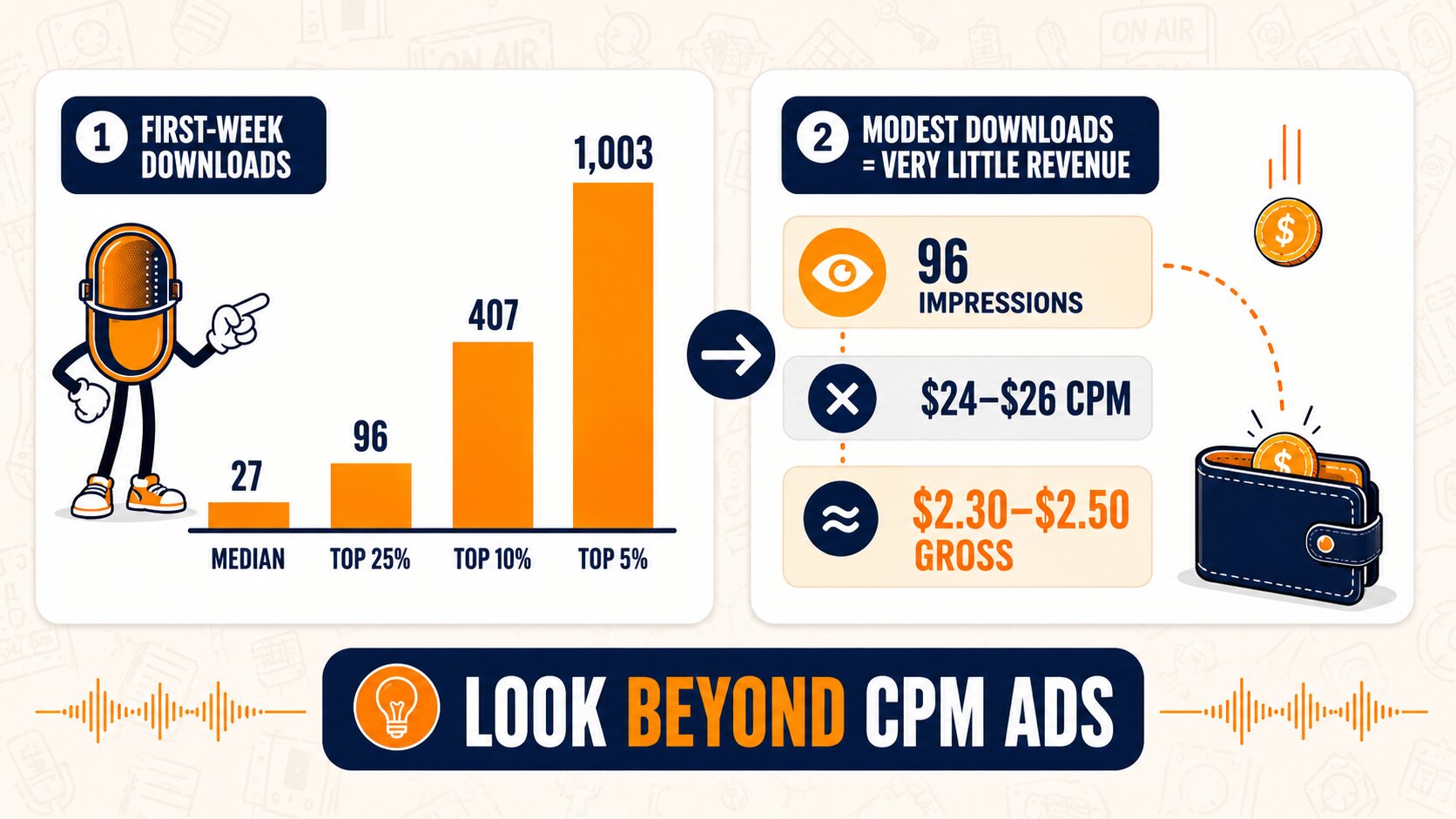
Modest download counts produce little CPM income. Among shows hosted by Buzzsprout in August 2026, 27 first-week downloads marked the median, 96 reached the top 25%, 407 reached the top 10%, and 1,003 reached the top 5%.
At Libsyn's $24 to $26 CPM rate for a 60-second host-read, 96 qualifying impressions price one placement at about $2.30 to $2.50 gross. Audience growth alone may not help an agent make money podcasting.
How a Real Estate Podcast Makes Money Beyond Ads
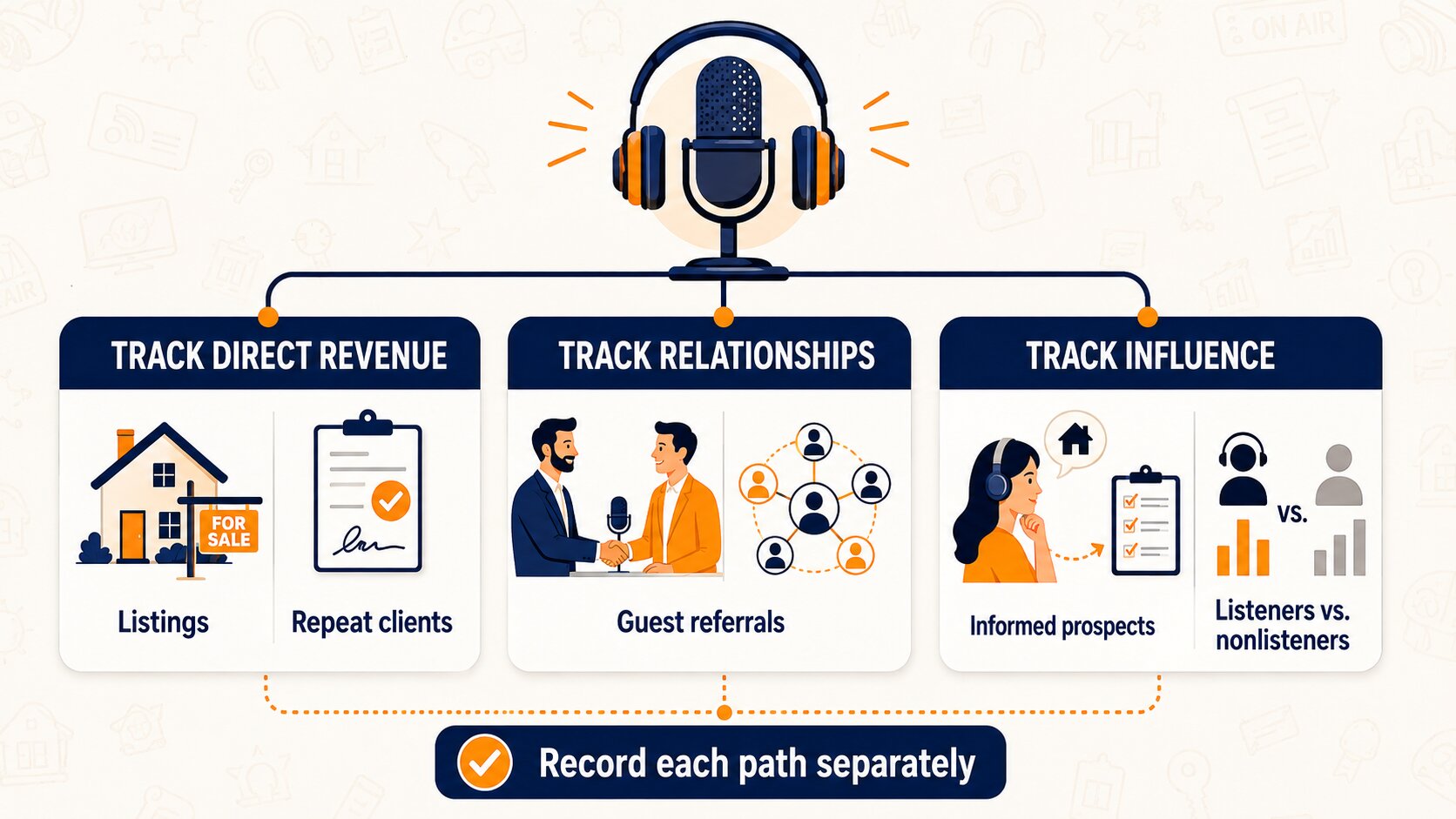
The useful podcast monetization methods for an agent are listings, referrals, repeat clients, and informed prospects. Record each separately.
Listings From Listeners
A listener becomes financially meaningful when the show contributes to a consultation, signed agreement, or closing. Give every episode one trackable next step, such as a valuation page or consultation form.
Use “podcast-sourced” only when the show created the first known contact. Use “podcast-influenced” when an episode helped someone who already knew you. Google explains how campaign parameters appear in Traffic acquisition reporting, but tagged links will miss direct calls, later searches, and offline conversations.
Referral Partners From Guests
Guests can become referral partners when you invite strategically and continue the relationship after recording. ICONS' Framework 02: Inviting Guests asks hosts to identify high-value relationships, including referral sources, co-deal partners, and long-term collaborators.
Use a defined process for choosing valuable real estate podcast guests and plan conversations around useful real estate podcast topics.
Results can appear before a show becomes large. Shae Spitz's early guest relationship led to a development opportunity that began at 70 acres and closed at 75 acres. The project had potential for 330+ homes, not 330 completed listings.
Renée Ruth reported that her first episode helped place her on a go-to agent list for referrals in Lynchburg. One guest can matter more than a large anonymous audience.
After the interview, apply ICONS' Framework 03: Hosting: use the after-chat, then follow up after release. Record any opportunity that follows.
Repeat Clients and Sphere Retention
A podcast gives past clients another reason to hear from you between transactions. Build episodes from questions homeowners already ask.
Pair the show with broader client-retention strategies for real estate agents. In your CRM, mark which past clients listened, replied, shared an episode, or returned with a real estate question.
Credibility That Improves the Listing Conversation
A prospect who has heard several episodes may arrive with more context about how you think. Track whether those prospects book, sign, or move through the consultation differently.
Add two fields to your appointment record: “Listened before booking?” and “Episode or topic mentioned.” Compare signed-client rates for listeners and nonlisteners. This gives you evidence of whether your content supports the authority-building role explained in podcasting for real estate brand building.
Podcast Monetization Math at 100 Listeners
At 100 qualifying downloads, one $24 to $26 CPM host-read is worth $2.40 to $2.60 gross. The useful comparison is that annual ad inventory against your actual net income from a documented podcast-influenced closing.
Use your own figures in this worksheet:
Input | Your value | Formula |
Qualifying downloads per episode | Enter yours | Downloads / 1,000 x CPM |
Gross 60-second CPM | $24 to $26 | Libsyn guide rate |
Episodes and filled ad slots per year | Enter yours | Episodes x filled slots |
Potential annual gross ad value | Calculate | Per-episode value x filled slots |
Net commission from influenced closings | Enter actual net | Gross commission less split, referral fee, and direct deal costs |
Annual podcast operating cost | Enter actual | Production, hosting, labor, and promotion |
Podcast-attributed net return | Calculate | Net commission + net sponsor income - operating cost |
Use the net amount on your brokerage statement, not a national “average commission.” Compare it with each channel in your real estate lead-generation mix.
Revenue is only half the equation. Add your actual cost to start and operate a podcast using our guide to how much it costs to start a podcast. Your time also belongs in that cost calculation, so use the guide to choosing a sustainable podcast episode length once published.
Selling Your Own Services on Your Own Show
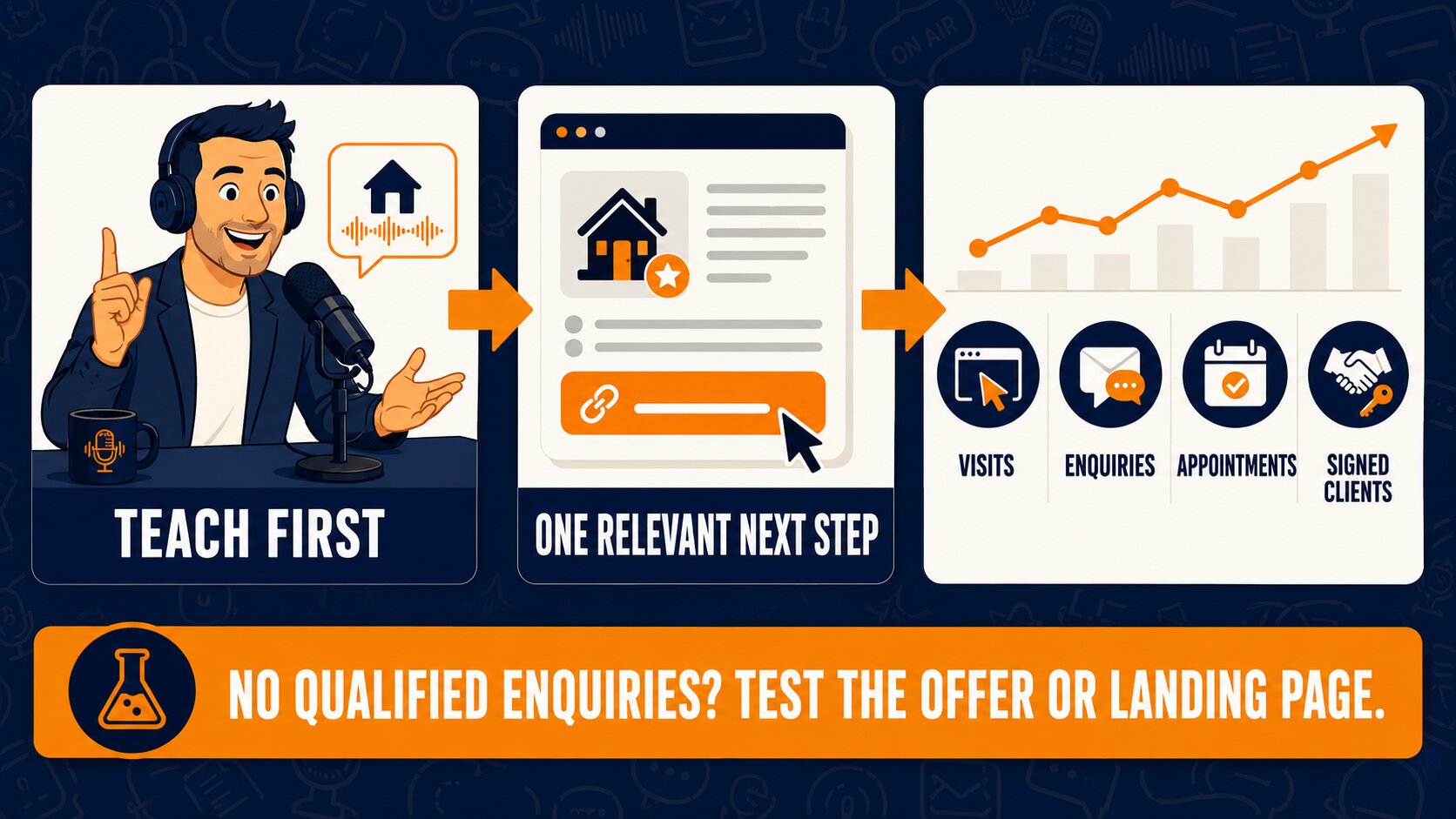
You can promote your service without turning each episode into an ad. Teach first, then give one relevant next step.
For a seller-focused episode, that might be: “If you want a pricing review for your property, use the link in the show notes to request one.” Keep every claim accurate and supportable because the FTC says truth-in-advertising standards apply to online promotions.
Track visits, enquiries, appointments, and signed clients from that action. If clicks bring no qualified enquiries across several episodes, test the offer or landing page.
Subscriptions and Patreon: Why Not for an Agent?
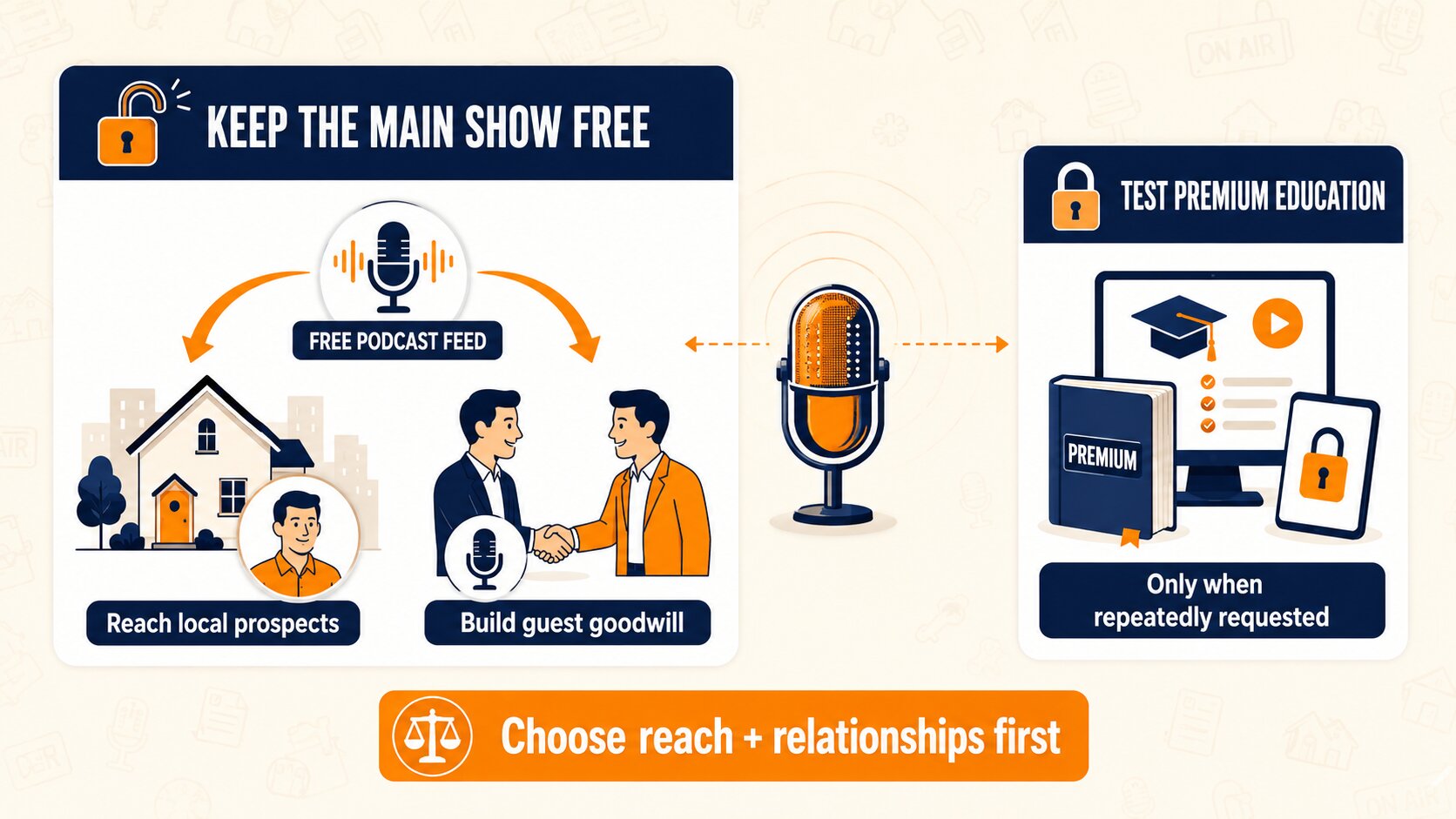
A paid feed is usually a poor fit when the show must reach local prospects and create guest goodwill. A paywall reduces access.
Strategic fit matters more than technical eligibility. Spotify's current rules, as of September, 2026, allow eligible hosted shows to use subscriptions after two published episodes and 100 Spotify listeners in the previous 30 days. Patreon can connect a paid show to Spotify through Spotify Open Access, but your core local content should remain easy to reach.
Keep the main show free when reach and relationships drive the return. Test repeatedly requested premium education as a separate product.
How to Tell Whether Podcast Monetization Strategies Are Working
Track the path from episode to business outcome in your CRM. Your records connect people, referrals, and closings to the show.
Use this attribution table after every qualified enquiry:
Evidence | What to record | What it shows | Limitation |
Episode-tagged link | Episode, campaign, landing page | A visit followed a podcast link | Misses calls and later searches |
CRM source field | Podcast, episode, or guest | The contact named the show | Depends on consistent entry |
Intake questions | First introduction and reason for contacting now | Separates first touch from trigger | Relies on recall |
Guest referral record | Guest, introduction, contact, outcome | Connects the relationship path | Does not prove the episode acted alone |
Closed-deal record | Source, influence, net commission, elapsed time | Calculates business return | Requires one attribution rule |
Google Analytics shows custom campaign source and medium data in its Traffic acquisition report. Also ask: “What first introduced you to us?” and “What prompted you to contact us now?”
Then run the fuller monthly process for measuring podcast success beyond downloads. ICONS' Framework 05: Distribution recommends focusing on numbers that change what you do next. For this article, that means reviewing attributed opportunities and net return alongside reach.
When Podcast Sponsorship Is Worth a Second Look
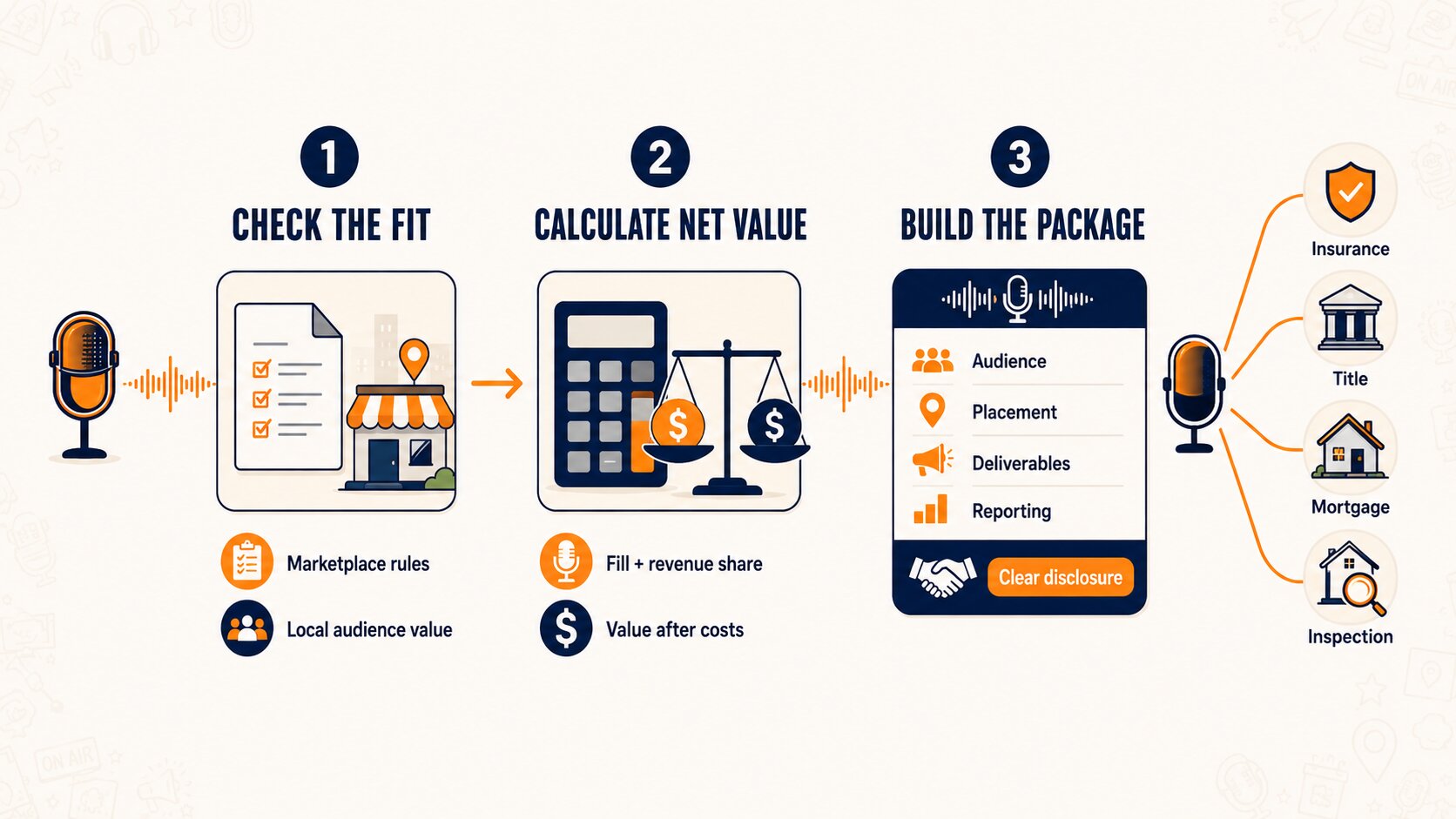
Revisit sponsorship when you meet a marketplace's rules or a relevant local business values your audience. Calculate the net value first.
For marketplace ads, verify expected fill and revenue share. For a local package, define the audience, placement, deliverables, and reporting. If a paid partner receives an endorsement, the FTC says a connection affecting credibility may require clear disclosure.
Shaune Corbett shows the direct-local route. His Real Estate Success DFW podcast secured four sponsors tied to the DFW real estate market, including insurance, title, mortgage, and inspection businesses. His documented result is four locally aligned sponsors.
FAQs About Podcast Money
Can You Make Money From a Real Estate Podcast?
Yes. Ads and subscriptions create direct podcast income, while attributable listings, referrals, repeat clients, and warmer consultations create business return.
How Many Downloads Do You Need to Get Sponsors?
There is no universal number. As of September 4, 2026, Buzzsprout Ads requires 1,000 downloads in 30 days, while Spotify uses audience, consumption-hour, episode, hosting, and market requirements.
How Much Do Podcast Ads Pay?
Libsyn's live guide lists average baked-in host-read rates of $18 to $22 CPM for 30 seconds and $24 to $26 CPM for 60 seconds. Your actual podcast ad revenue also depends on sold inventory and any revenue share.
How Long Before a Podcast Makes Money?
There is no universal timeline. Measure from the first episode or guest interaction to the attributed enquiry, referral, agreement, or closing.
Get Help Launching or Fixing Your Podcast
Choose the resource that matches the work you need.
Need a Step-by-Step Strategy?
Use the five ICONS Podcast Frameworks for foundation, guests, hosting, launch, and distribution.
Want Someone to Operate the Entire Show?
ICONS' done-for-you podcast production service covers guest booking, editing, publishing, promotion, and SEO articles.
Want Proof Beyond Downloads and Views?
Browse documented ICONS podcast success stories about referrals, sponsorships, and opportunities.
Want to Be Booked on Relevant Shows?
The Podcast Concierge service provides show matching, pitches, coordination, preparation, and reporting.
Final Words
A small real estate show can earn its place in your business without winning the advertising game. Run the CPM calculation honestly, then track the people and opportunities the dashboard cannot see. Effective podcast monetization strategies for an agent connect every episode to attributable relationships, qualified conversations, and net return.
Start Your Own Podcast
Monetization begins with the foundation, the guests you invite, how you host and follow up, the launch, and how you distribute and measure each episode. If you want those parts operated around real business outcomes, start your own real estate podcast with ICONS.