Most people think hosting a podcast is about having the best equipment or the perfect voice. It's not.
Hosting a podcast is about connection. It's about making your guest sound brilliant while you build the relationships that will transform your real estate business. It's about creating conversations that potential clients, partners, and other agents can't stop listening to.
And here's the truth: You don't need years of broadcasting experience to learn how to host a podcast. And you don't have to be Joe Rogan to host the best real estate podcast in your city.
Hosting is a skill you can build, one episode at a time. But skills develop faster with systems. That's what the ICONS Framework gives you. It gives you a repeatable process that works whether you're hosting episode one or episode one hundred.
This guide breaks down exactly how to host a real estate podcast. Whether you're launching your first show or refining your hosting skills to attract better listings and clients, this is your blueprint.
Want to see where great hosting fits into the bigger podcast strategy? Watch the 5-Part Real Estate Podcast Framework walkthrough for a quick look at the full system, then a deeper breakdown of how to prepare, structure your call, guide better conversations, and follow up with guests after the recording.
Why Learning How to Host a Podcast Matters for Real Estate Professionals
A great podcast host changes everything in real estate.
The difference between a podcast people forget and one they recommend comes down to hosting quality. Strong hosting builds authority in your market.
It strengthens relationships with potential sellers, buyers, and referral partners.
For real estate professionals, podcasting becomes a networking tool that works while you sleep, generating leads, establishing credibility, and opening doors to high-value connections.
Consider this:
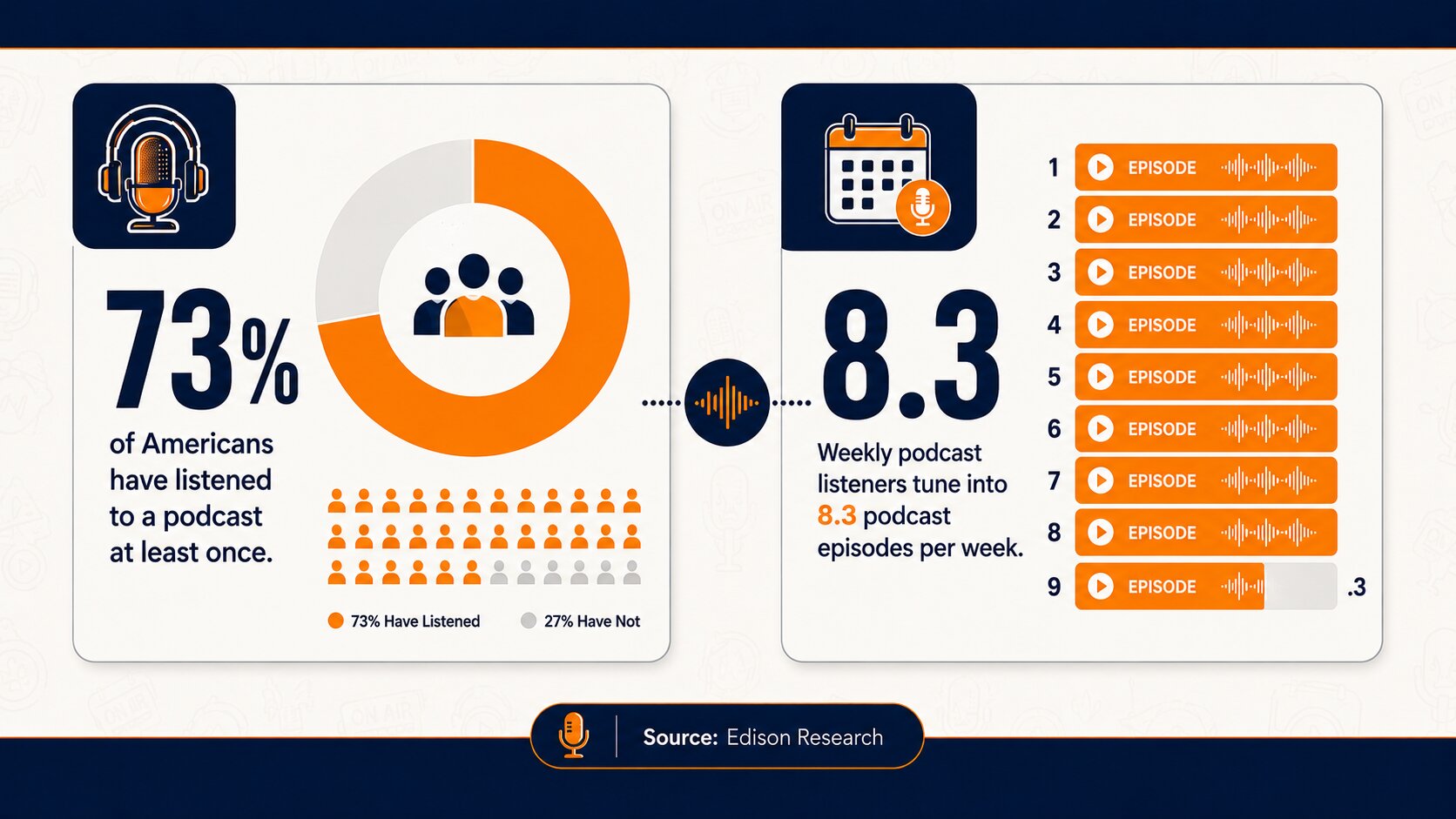
That's your potential client base actively consuming content. When you host well, you position yourself as the trusted advisor they turn to when they're ready to make a move.
Master the art of being a podcast host, and you're not just creating content. You're building a platform that attracts sellers who want to list with you, buyers who trust your market knowledge, and investors who see you as a valuable partner.
How to Be a Podcast Host: Mindset & Role
A podcaster creates content. A host creates connection.
That distinction is central to Framework 03: Hosting, part of our 5-part real estate podcasting framework. Its host-skill stack treats you as the connector, not the person pitching or trying to dominate the conversation. Your job is to stay present, respond to what the guest actually says, and guide the discussion toward something useful for the audience.
A great host does three things:
- Asks the questions their audience actually cares about
- Goes deeper when something valuable comes up
- Keeps the conversation moving while acting as the connector
That’s it. Everything else is reps. The first episodes feel awkward. Then it clicks. And over time, the relationships (and deals) start coming from the show.
The ICONS Podcast Hosting Framework: Step-by-Step System for Real Estate Podcasters
This framework gives you a repeatable system for every episode. Follow it, and you'll never wing an interview with a potential referral partner or market expert again.
I — Invest in Pre-Show Preparation
Preparation beats performance.
To prepare for your podcast call, here are things you should do:
Set up your space properly:
- Find a quiet environment away from open houses and ringing phones. Turn off notifications.
- Adjust your lighting and camera.
- Clean backgrounds matter—consider a backdrop with your branding or local market landmarks.
- Use headphones when recording (and tell your guest to do so) - 70% of podcasters use them to avoid audio problems!
- Have water nearby and hydrate before you start.
Here’s an example of what your setup can look like. For beginners, a simple setup like the one on the left works perfectly well. And over time, you can slowly upgrade your setup to the one on the right.
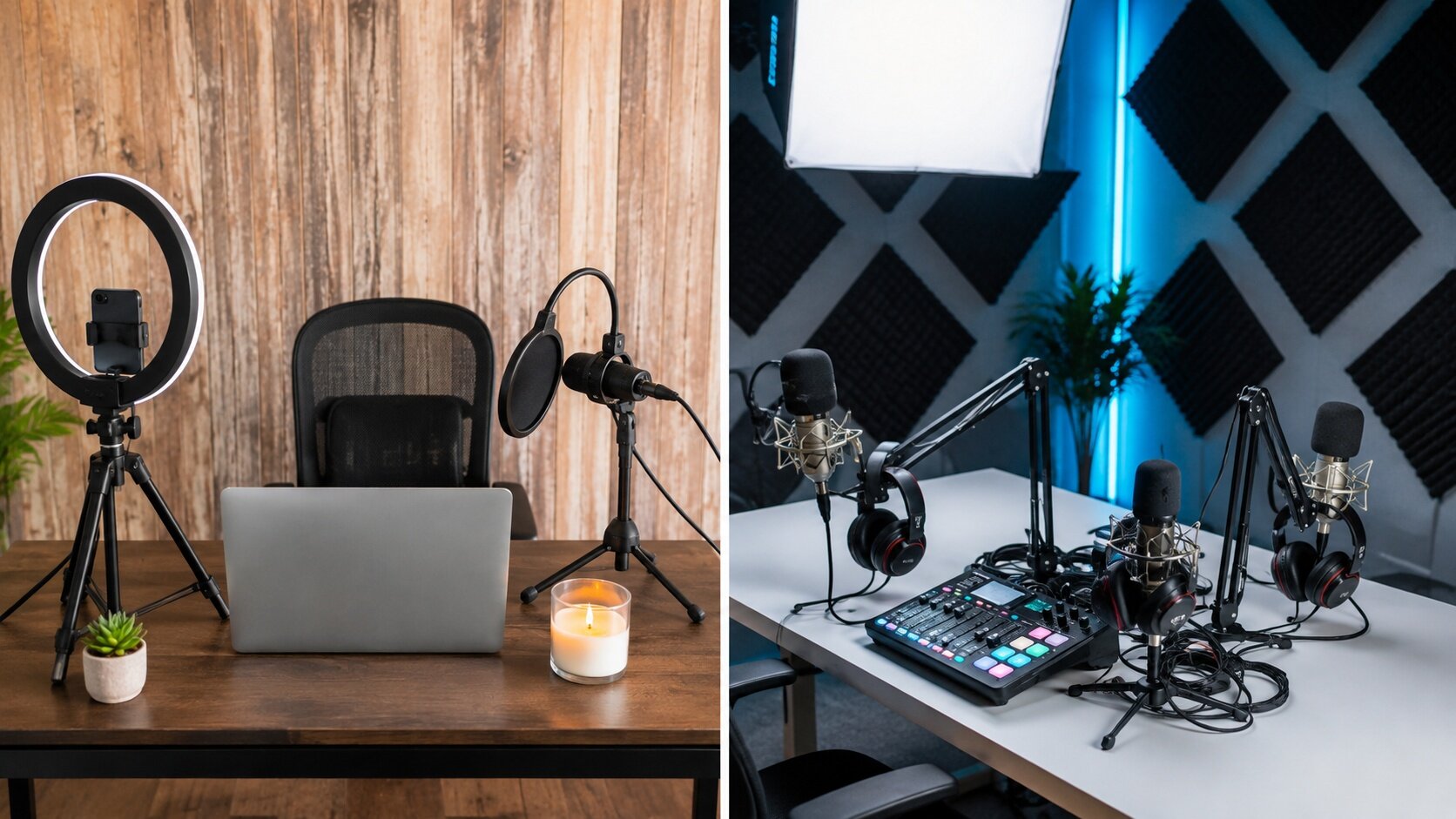
But remember that getting started is the most important part.
Research your guest thoroughly:
If you want to avoid surface-level conversations and go deeper into insights your audience actually cares about, you need to research your guest before you hit record.
Guest research checklist:
- Review their website and LinkedIn
- Look at recent transactions, deals, or projects
- Scan social media for current ideas or opinions
- Watch or read past interviews so you don’t repeat basic questions
- Identify a unique angle others haven’t covered
- Find the story behind their biggest deal or distinct client approach
- Review the calendar invite for suggested topics or questions
Prepare your questions strategically:
Use Sticky Notes (Windows) or Stickies (Mac) for talking points. Write open-ended questions that encourage conversation about their real estate journey, market insights, and strategies. Plan follow-up questions for important topics like lead generation, negotiation tactics, or market predictions.
Question Templates:
Type of Guest | Sample Question | Sample Follow-Up Question |
Top Producer | “You closed a high volume of deals last year. What systems made that possible?” | “Which one of those systems had the biggest impact early on?” |
Market Expert | “What trends are you seeing in the local market that most agents are missing?” | “How should agents adjust their strategy because of that?” |
Service Provider | “What’s the biggest mistake agents make when working with your service?” | “What does it look like when an agent does this right?” |
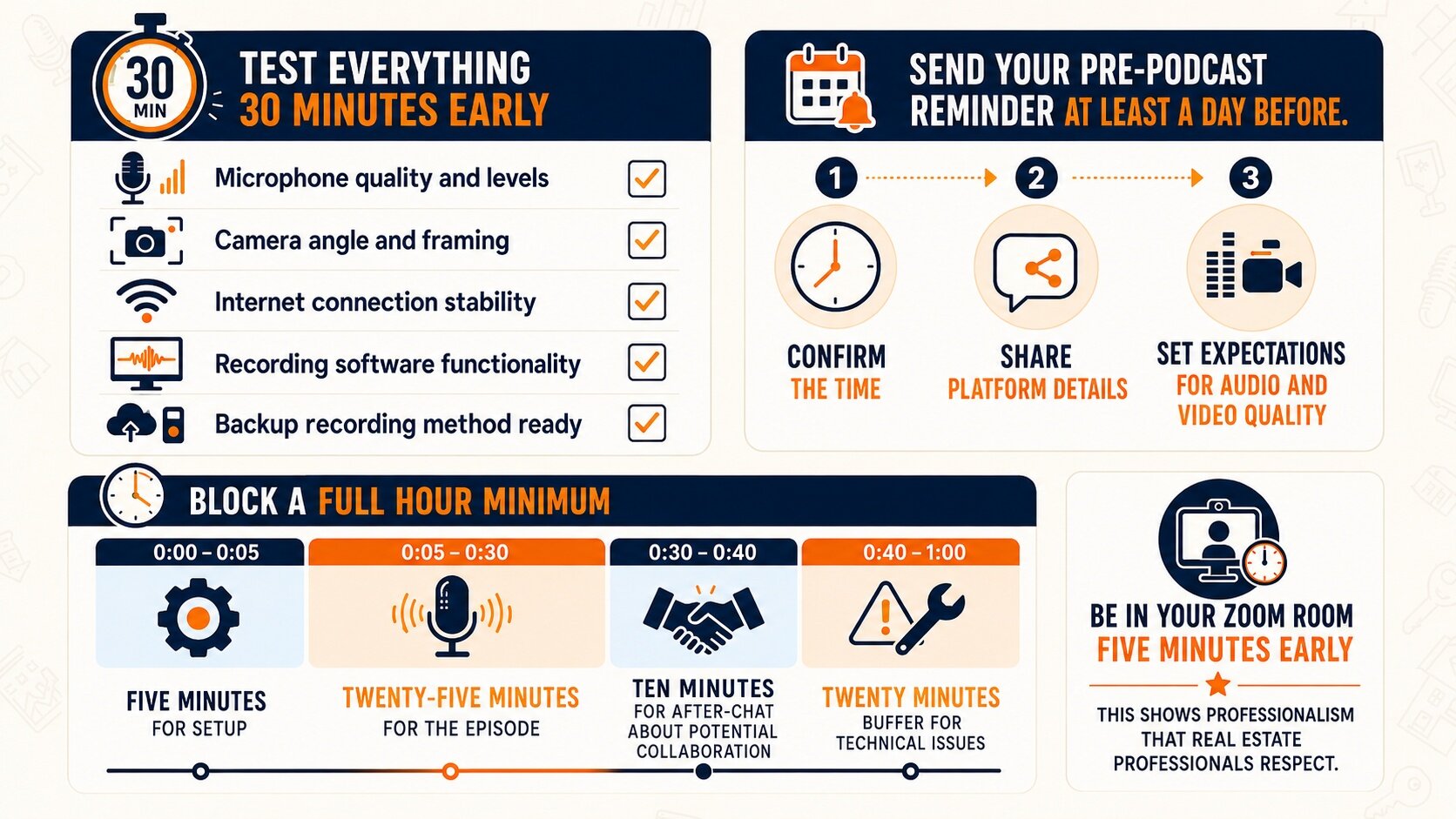
Test everything 30 minutes early:
- Microphone quality and levels
- Camera angle and framing
- Internet connection stability
- Recording software functionality
- Backup recording method ready
Send your pre-podcast reminder at least a day before. Confirm the time. Share platform details. Set expectations for audio and video quality.
Block a full hour minimum: Five minutes for setup, twenty-five minutes for the episode, ten minutes for a post-recording conversation about potential collaboration, and twenty minutes buffer for technical issues.
Finally, be in your Zoom room five minutes early. This shows professionalism that real estate professionals respect.
“A wise person once said, if you are on time, you are late. Make sure that you are in your Zoom meeting, or whatever other platform that you're using, at least five minutes before the scheduled podcast time. You want to be able to receive your guests if they're actually also before time. Sometimes they're so excited that they jump in the Zoom before you.”
— Tomas Fonseca, Co-Founder and Podcast Guru, Icons of Real Estate
C — Connect in the First 5 Minutes
Start recording immediately when the call begins.
With consent, record everything—initial chat + podcast + after-podcast conversation.
You'll save the full conversation and you'll never forget to hit record. Some of the best relationship-building moments happen when guests feel like they're "off the record."
Break the ice naturally:
Sample opening templates:
Keep it casual and warm. Positivism generates positivism. If you're smiling and happy, the other person will be smiling and happy. This authenticity translates through the microphone and makes your guests comfortable enough to share their best insights.
Set expectations clearly:
- Explain the flow: Your intro, their story and background in real estate, main questions about their expertise, wrap-up with ways listeners can connect.
- Double-check if they want to promote anything specific: a new listing, an upcoming open house, their coaching program, or a charitable cause they support.
- Let them know about the talk: "After we wrap the recording, let's chat for a few minutes. I'd love to hear your thoughts, get your feedback, and explore ways we might work together."
Then transition to:
O — Own Your 25-Minute Conversation
Introduction (1-2 minutes)
Keep your self-introduction brief. There's already a pre-recorded intro for your show.
Then introduce your guest with energy. Put them on the pedestal. Make sure they are smiling and blushing after what you just introduced them for.
“When you welcome the guest, it can't be just, ‘Hey, this is John Smith from Alabama.’ You need to put them on the pedestal. You need to make sure that they are smiling and blushing after what you just introduced them for. Always start with a killer guest introduction because it's going to get a good pace into the energy of the podcast, tell the audience what they can expect from the episode, and make the guest feel good.”
— Tomas Fonseca, Co-Founder and Podcast Guru, Icons of Real Estate
Guest Introduction Template:
“Welcome back to [Your Show Name], the podcast where top real estate professionals share the strategies behind their success. I'm [Your Name], and today I'm thrilled to welcome [Guest Name].
[Guest Name] is [their role/title] specializing in [niche/area], and they've [notable achievement #1]. What really impressed me was [notable achievement #2], and they've also [notable achievement #3]. Today, we're going to dive into [main topic you'll discuss].
[Guest Name], welcome to the show!”
Real Estate-Specific Introduction Examples:
“My guest today is Michael Chen, a commercial broker who's closed over $200M in deals in the past three years. He specializes in multi-family properties in emerging markets, and he's here to share his framework for identifying undervalued opportunities before the competition.”
Guest Story (5-7 minutes)
Start with one simple question: "What is your story? How did you get into real estate?"
Then follow up based on what they share:
- "What was your first transaction like?"
- "What motivated you to specialize in [luxury/commercial/new construction]?"
- "Was there a turning point that changed everything for you?"
Your job here is to use strong podcast interview skills: listen actively, ask natural follow-ups, and don't rush to your next prepared question. Let them paint the full picture of their journey. These personal stories make you relatable to listeners and help identify potential partnership opportunities.
Episode Content (15 minutes)
The core content of an episode is where real value is created. Questions should be prepared in advance but flexible enough to follow strong moments that come from active listening.
Core content questions you can focus on:
Core Question Focus | What to Ask |
Guest-sourced questions | Use talking points and questions the guest is confident answering, shared during booking. |
Expertise & industry insight | Explore their unique perspective, market trends, and common mistakes they see. |
Value & listener takeaways | Ask for actionable advice and lessons the audience can apply. |
Personal & reflective moments | Cover mindset, challenges, and experiences that build trust and relatability. |
While you may prepare up to seven questions, most strong episodes go deep on just three or four, guided by thoughtful follow-ups.
To make an effective core content segment, focus on these principles:
Practice active listening
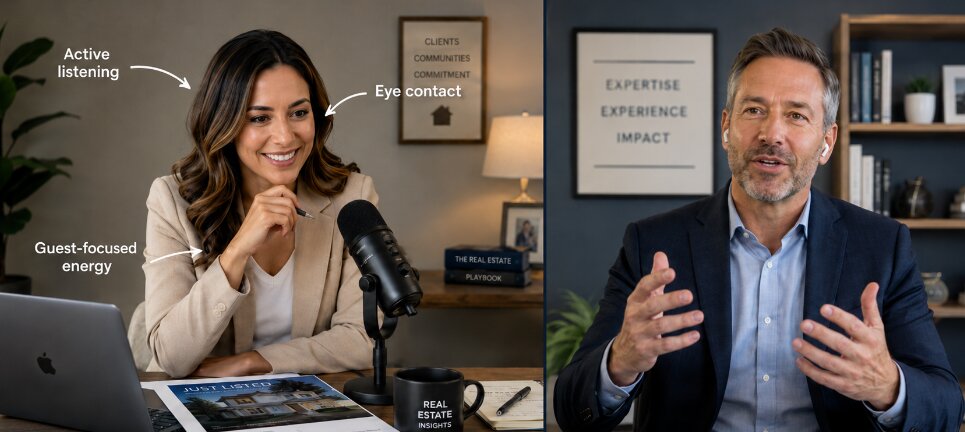
Give your guest full attention, using simple verbal cues, maintaining eye contact, and noting key points to revisit later.
“The best podcast host is not the one that has the best questions prepared. It's the one that listens best. When you listen best, you're going to listen to what the other side has to say, and that's where the best questions actually come in. Always make sure that you practice the act of listening, and while you still need to stay on track on what you want to do next, your ears still need to be in the moment.”
— Tomas Fonseca, Co-Founder and Podcast Guru, Icons of Real Estate
Here are examples of verbal cues you can use:
- "That's interesting"
- "I hadn't thought about that"
- "Tell me more about that strategy"
Use smooth transitions
Build naturally on what the guest just shared, keeping the conversation fluid and unscripted.
- "You mentioned [specific point about staging]. That brings me to a question about your marketing approach..."
- "Speaking of [pricing strategy], I'm curious about how you handle seller expectations..."
- "Building on what you just shared about [open houses], what's your take on virtual tours?"
Follow the 80–20 rule
Your guest should talk 70-80% of the time. You're facilitating the conversation, not dominating it. In real estate, this means you're positioning your guest as the expert while you ask the questions your listeners need answered.
Wrapping Up (2-3 minutes)
Recap 2-3 major takeaways from the conversation:
- "So the big lessons here are: [insight #1 about market strategy], [insight #2 about client service], and [insight #3 about building systems]."
Thank your guest genuinely:
- "This has been incredibly valuable. I know our listeners are going to implement these strategies immediately."
Give them space for final words:
- "Before we wrap, what's one final piece of advice for real estate professionals listening?"
Invite audience connection:
- "Where can our listeners connect with you if they want to learn more about [their specialty] or explore working together?"
Include your call-to-action:
- "If you found value in this conversation, subscribe to [Your Show Name] so you never miss an episode with top producers and industry experts."
- "Leave us a review and let us know what resonated with you from today's conversation."
- "Check out [Guest's website/social media] to learn more about their approach to [specialty]."
N — Never Skip "The Talk" After the Episode
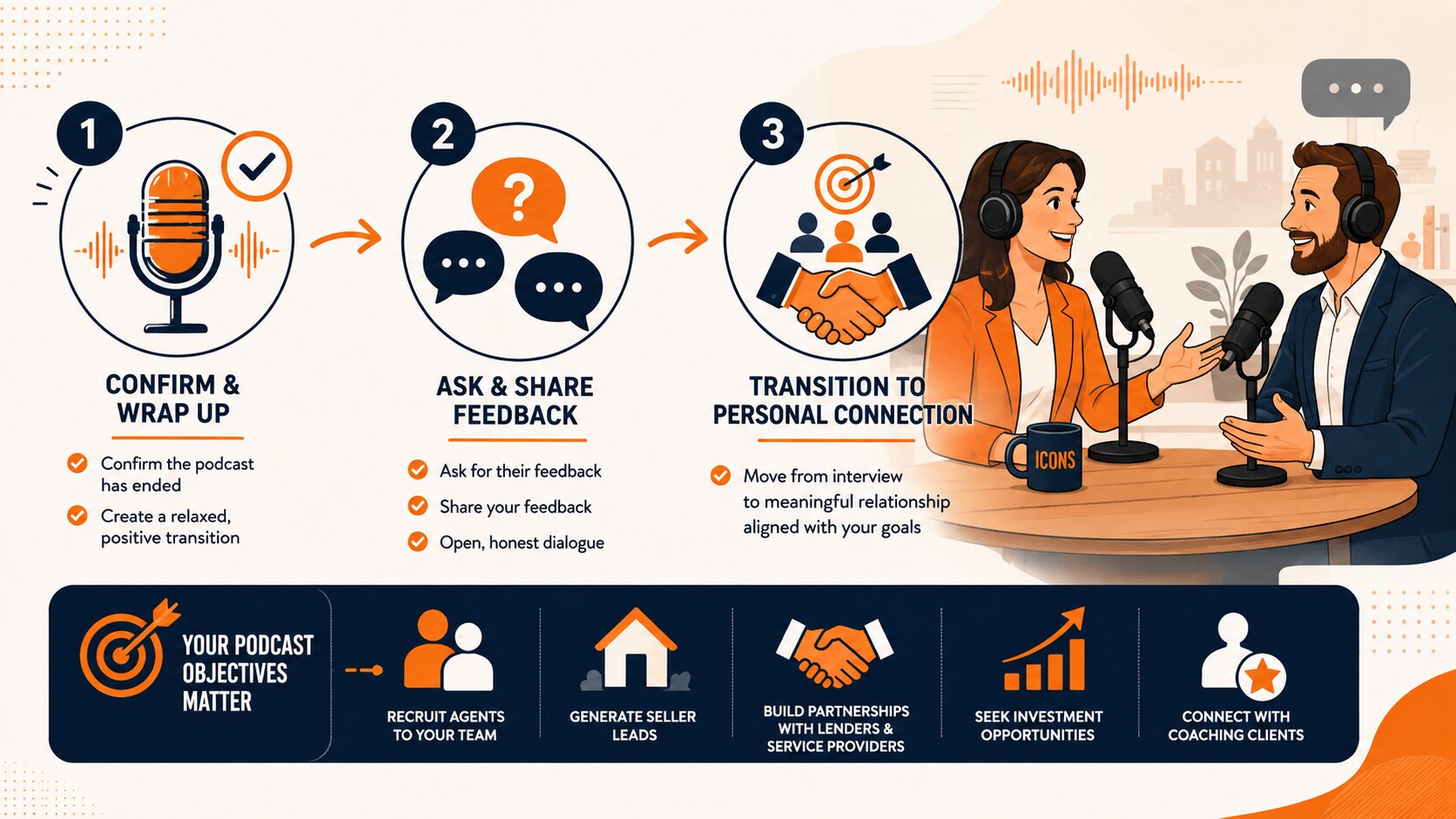
The after-chat is one of the most valuable parts of Framework 03: Hosting, part of our 5-part real estate podcasting framework.
Once the formal interview ends, the conversation can shift from interview to peer-to-peer, with guests opening up about the projects they're working on, the people they want to meet, and the goals they're pursuing. Don't rush this part. It is often where the business opportunity finally surfaces.
“It's good that when these guests are coming to your show, you have a follow-up action to go upon that. It can be inviting them to the community, it can be a follow-up call, but it's good to always go for it because they came here and right now you have their attention. Attention is a very high currency, a very valuable currency. You have their attention right now, so use it.”
— Tomas Fonseca, Co-Founder and Podcast Guru, Icons of Real Estate
You have their full attention right now. Use it wisely.
Confirm the podcast has ended: "Thank you for an incredible episode. Now that we've wrapped up the podcast portion, we can relax and chat."
Ask for their feedback:
- "How do you feel about the episode? Did we cover everything you wanted to share?"
- "Was there anything you'd like to change or add?"
- "Is there anything you mentioned that you'd prefer we edit out?"
Give your feedback. Share what stood out. Be genuine and specific:
- "Your point about [specific strategy] was gold. I'm definitely implementing that."
- "The story about [their big challenge] really shows listeners that we all face obstacles."
Transition to personal conversation.
This is where your podcast objectives matter as a real estate professional. Are you recruiting agents to join your team? Generating seller leads through authority positioning? Building partnerships with lenders and service providers? Seeking investment opportunities? Connecting with potential coaching clients?
“This podcast will be about content, and as you will see from our framework, it's not just about content. It's about building relationships. You're investing time and energy into this, probably a few dollars as well, and these moments are key to build a relationship and solidify the relationship. ‘Always have the talk’ means always try to seek the next stage of the relationship with the guest in front of you.”
— Tomas Fonseca, Co-Founder and Podcast Guru, Icons of Real Estate
"The Talk" Templates for Different Objectives:
Use Case | Sample Outreach Script |
Recruiting Agents | “I love your approach to [training/systems/culture]. We’re growing our team this quarter and I’d love to hear about your experience with team growth. Would you be open to grabbing coffee next week?” |
Referral Partnerships | “Your expertise in [luxury/commercial/new construction] complements what we do. I occasionally get leads outside my niche—would you be open to exploring a referral relationship?” |
Seller Lead Generation | “Before we hop off, if you know anyone in [target area] thinking of selling in the next 6–12 months, I’d appreciate an introduction. My focus is on [your unique value proposition].” |
Investor Partnerships | “You mentioned opportunities in [area]. I have some market insights that may be helpful—can we schedule 20 minutes to dive deeper?” |
Make your call-to-action clear:
It can be something like:
“Let's book some time to discuss [your mutual opportunity] in more detail. I believe there's a lot we can explore together. I'll send you a calendar link right after this call.”
This is not cold calling. This is creative lead generation. It's a creative way to create content as well as build your network, establish authority, and develop relationships that lead to transactions, partnerships, and referrals.
You're investing time into building relationships that compound over years, not just creating content that disappears after upload. Don't rush this part. It's often more valuable than the recorded episode itself.
S — Seal the Relationship with Follow-Up
Save and organize your recording immediately.
Wait for Zoom to convert.
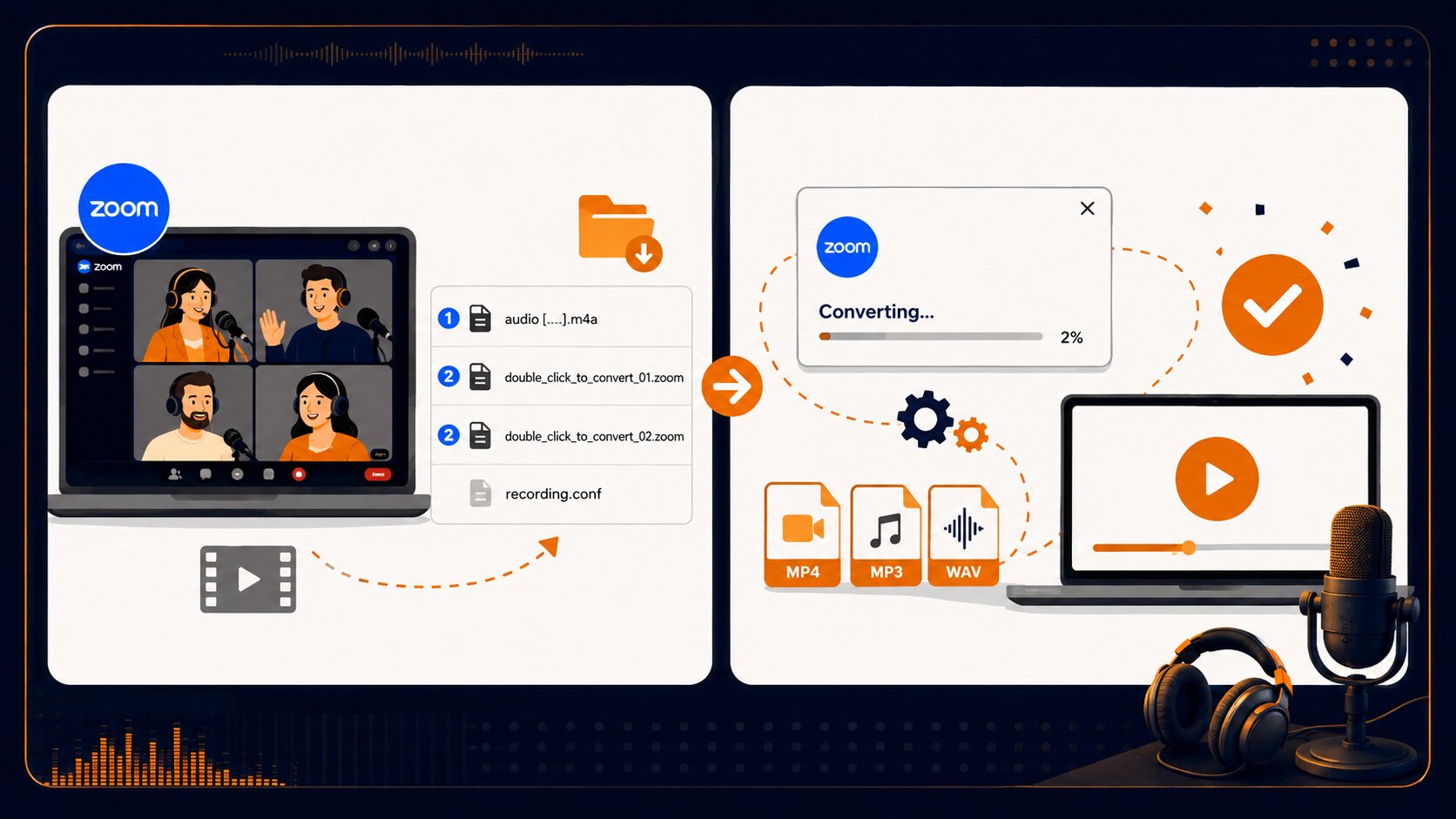
Go to Documents > Zoom folder. Rename the file using this format: (MM/DD/YY) - (Guest First Name - Last Name) - (Topic/Specialty)
Example: (02/15/26) - Sarah Martinez - Sphere of Influence Strategies
Take immediate notes while everything is fresh:
- Capture standout moments and quotable insights
- Note personal details about the guest (kids' names, hobbies, market they serve)
- Record potential follow-up topics or collaboration opportunities
- Save any commitments you made (sending resources, making introductions, scheduling follow-up calls)
Send a thank-you email within 24 hours.
Email Template:
Subject: Thank you for sharing your expertise on [Show Name]!
Hi [Guest Name],
Thank you for being such a fantastic guest on [Show Name]. Your insights about [specific topic they covered] were incredibly valuable, and I know our listeners are going to love the episode.
I especially appreciated when you shared [specific story or strategy]—that's the kind of practical advice that transforms real estate businesses.
Next Steps:
- We'll release your episode on [date]
- I'll send you the episode link and promotional materials a day before release so you can share them with your network
- Let's schedule that follow-up call we discussed about [opportunity you identified] here [Calendly link]
Looking forward to staying connected and exploring ways we can support each other's businesses.
[Your Signature]
Maintain ongoing connection using the 13 touch points:
This table shows how to turn one podcast conversation into an ongoing relationship. Used consistently, these touchpoints help you stay top of mind and create long-term business value.
Timing | Touch Point | Real Estate Application |
Within 24 hours | Follow-up email | Thank them and confirm next steps |
Before release | Episode release date announcement | "Your episode goes live on [date]—here's a preview + some promo materials you can share with your audience!” |
Release day | Personal message with episode link | "We're live! Here's your episode with social media copy you can use" |
After release | Post-release feedback request | "The episode is performing great! Here's the engagement we're seeing" |
During promotion | Social media tagging | Tag them when sharing clips and quotes from the episode |
Ongoing | Listener feedback sharing | "A listener just told me your advice about [topic] helped them close a deal!" |
As needed | Invitation to future episodes | "I'm doing a panel on [topic]—would you like to join?" |
Strategic | Asking for guest introductions | "Who else in your network would be great for the show?" |
Value-add | Exclusive content or resources | Send market reports, new listing opportunities, or relevant articles |
Events | Event invitations | Invite them to your open houses, networking events, or masterminds |
Regular | Newsletter inclusion | Feature their episode or insights in your email newsletter |
Special occasions | Milestone celebrations | Acknowledge their business anniversaries, big deals, or awards |
Holidays | Holiday greetings | Send personalized holiday messages (not generic e-cards) |
The ICONS Framework isn't just about creating good episodes. It's about building a system that creates relationships, generates leads, and establishes authority in your real estate market—one conversation at a time.
When done right, your podcast becomes the most powerful business development tool in your arsenal, working 24/7 to position you as the go-to real estate professional in your market.
Want the rest of the system? Explore our complete 5-part Real Estate Podcast Framework to see how ICONS approaches the entire process, including:
- Building a stronger foundation around your show, audience, topic, and goals
- Choosing better-fit guests who can bring value to your audience and your business
- Hosting stronger conversations with a repeatable structure that keeps guests engaged
- Following up strategically so one interview can grow into a long-term relationship
- Launching with a clear plan instead of simply publishing one episode and hoping it gains traction
- Repurposing every episode into content for social, email, YouTube, and other channels
See the full framework and put the pieces together
How to Be a Good Podcast Host: Best Practices for Real Estate Professionals
Match and manage energy intentionally.
“There's some really careful preparation that you can do because preparation beats performance. As you're getting confident along the lines of hosting your podcast, the more preparation you do can compensate for the potential lack of confidence that you have. Then obviously, the more confidence that you're going to have, the less preparation that you're going to need. Feel free to compensate with preparation when you're getting started.”
— Tomas Fonseca, Co-Founder and Podcast Guru, Icons of Real Estate
Set the tone early with your first greeting. If your guest is nervous (maybe it's their first podcast), ease them in gently with softball questions about their journey. If they're enthusiastic about a recent big sale or market trend, meet them there with matching energy.
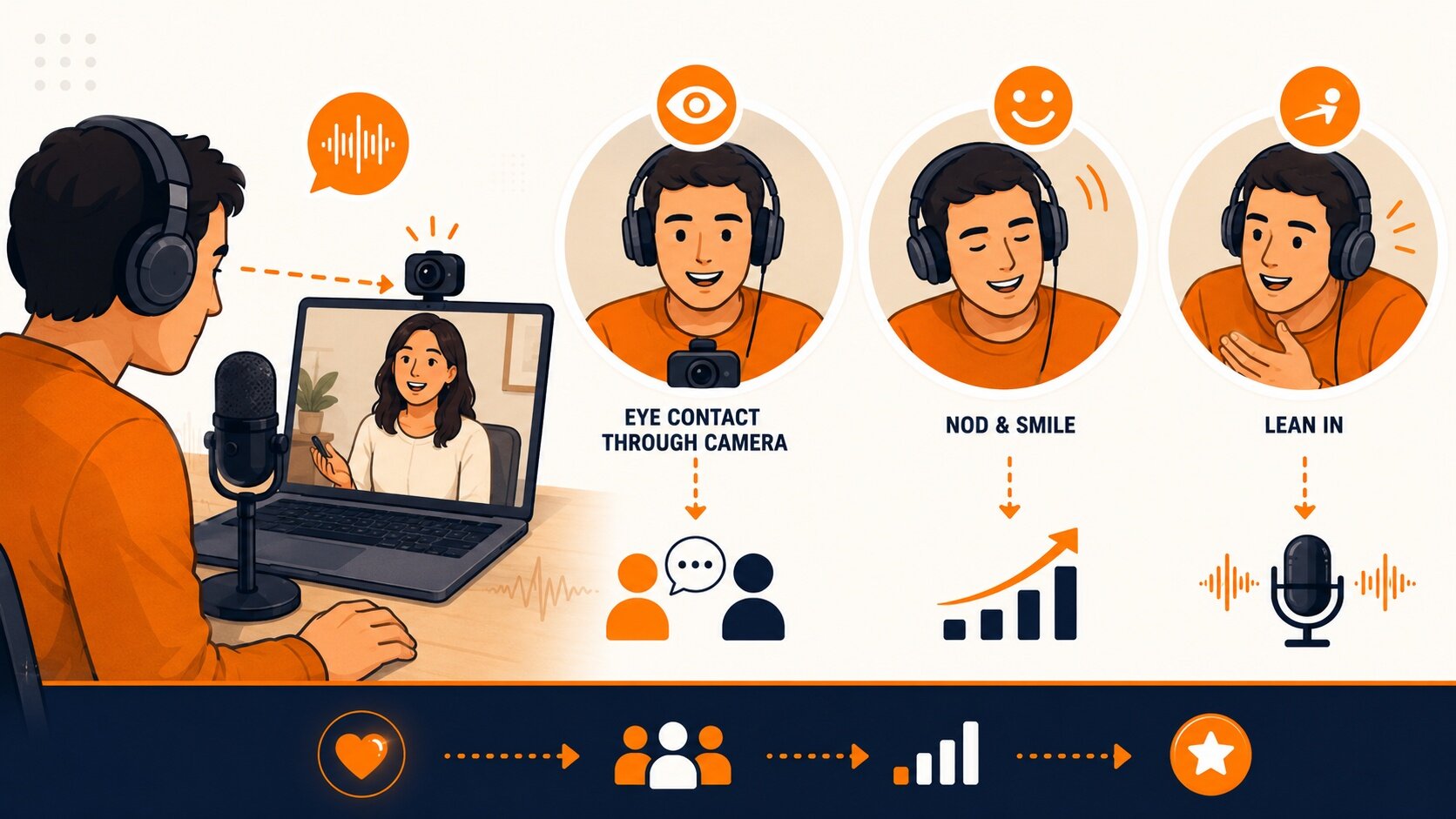
Body language matters even in audio podcasts.
Maintain eye contact through the camera. Nod and smile. Lean in when they share something particularly insightful. These non-verbal cues show your guest you're listening and engaged, which translates into their vocal energy and makes them share more openly.
Speak directly to your real estate audience.
Use phrases that acknowledge your listeners:
- "I know some of you listening may be wondering how this strategy works in a seller's market..."
- "If you're a newer agent feeling overwhelmed by lead generation, pay close attention to what [Guest] is about to share..."
- "Many of you have asked me about working with investors—this is exactly the conversation you've been requesting..."
Prepare thoroughly, but don't over-script.
“Always have more questions than you're going to ask. Usually you can have up to something like seven questions ready, but it's okay if you only ask three of them or four of them. It's even okay if you only ask two of them and then propel to more follow-up questions. Always have more materials than you need so you don't stress out and make up something on the spot that is actually not that accurate.”
— Tomas Fonseca, Co-Founder and Podcast Guru, Icons of Real Estate
Research your guest's recent transactions, market specialty, and business philosophy. Know your topics deeply. Understand current market trends, recent legislation affecting real estate, and industry challenges. But stay flexible on delivery. Rigid scripts kill natural conversation and prevent you from following fascinating tangents that often produce the best content.
Think of your preparation as building a safety net that lets you be spontaneous. The more prepared you are, the more freely you can go off-script when the conversation takes an unexpected but valuable direction.
Authenticity beats polish every time.
So talk like you would in a coffee meeting, not like a radio host or salesperson. Real estate is a relationship business, and your podcast should reflect that.
Share real experiences, admit when you don’t know something, and genuinely celebrate your guest’s wins. Listeners connect with hosts who sound like approachable, knowledgeable advisors—not scripted experts.
Real Estate Podcast Call Structure
Here's a complete framework for structuring every real estate podcast call from start to finish:
Stage | Goal | Sample Template | Duration |
Private Segment: Initial Chit-Chat (Pre-Recording) | Build comfort and align expectations before recording begins | "Hey [Guest Name], thanks for making time! How's the market treating you this week? I saw your post about [recent transaction/market insight]—that's exactly the kind of expertise our listeners need to hear." | 3-5 min |
Audience-Facing: Host Introduction | Establish your credibility and set the stage for value | "Hi everyone, I'm [Your Name], [your credential/specialty] here in [market]. Welcome back to [Podcast Name], where we bring you proven strategies from the top real estate professionals in [area/industry]. Today's conversation is one you'll want to take notes on..." | 30-45 sec |
Audience-Facing: Guest Introduction | Position the guest as an authority and create anticipation | "Today I'm joined by [Guest Name], who [achievement #1]. What really impressed me was [achievement #2], and [achievement #3]. We're going to dive into [main topic]. [Guest Name], welcome to the show!" | 45-60 sec |
Audience-Facing: Guest Story | Create emotional connection by exploring their real estate journey | "Let's start with your story. How did you get into real estate, and what's kept you in the business all these years?" Then follow their path with natural questions about challenges, breakthroughs, and turning points. | 5-7 min |
Audience-Facing: Main Episode Content | Deliver actionable value through focused questions, active listening, and market insights | "Building on what you shared about your first year, let's talk about lead generation. What's working for you right now that other agents should be doing?" Continue with prepared questions while staying flexible to pursue interesting tangents. | 15-17 min |
Audience-Facing: Last Remarks & Wrap-Up | Reinforce key takeaways and direct listeners to connection points | "Before we wrap up, what's one final piece of advice for real estate professionals listening? And where can people connect with you if they want to learn more about [specialty] or explore working together?" | 2-3 min |
Private Segment: After-Chat (Post-Recording "TALK") | Strengthen the relationship, explore collaboration, and create future opportunities | "Thanks again—this was fantastic. Now that we're off the record, I'm curious: what are you focusing on next quarter? And should we book time to explore some ideas I have about how we might work together?" | 5-10 min |
This structure ensures you're maximizing both the content value for listeners and the relationship value for your business. Every stage serves a purpose, and skipping any of them (especially the after-chat) means you're leaving opportunity on the table.
Podcast Hosting Tips for Beginners in Real Estate
Starting out? Focus here first.
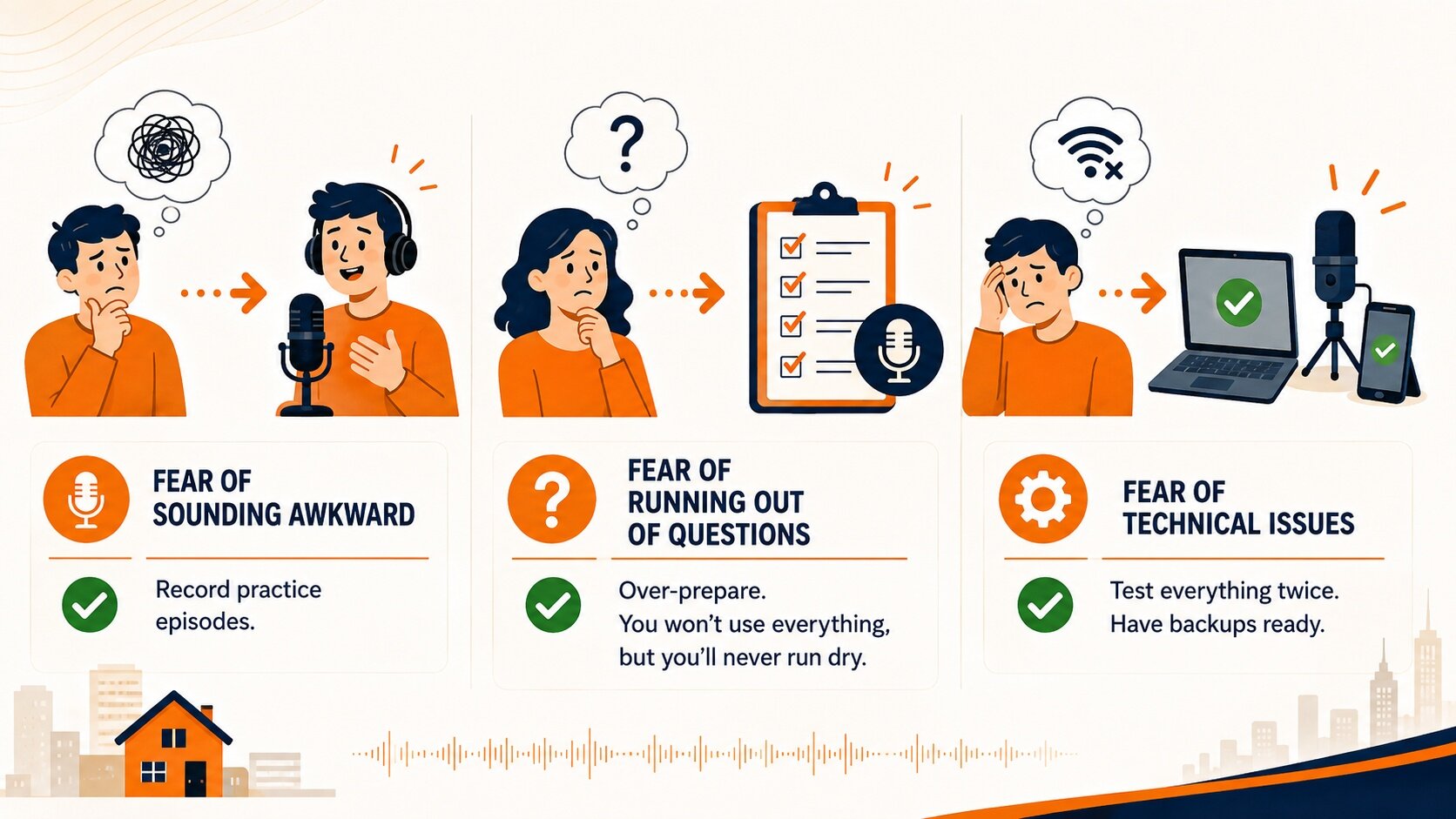
Common fears and how to overcome them:
- Fear of sounding awkward: Everyone sounds awkward at first. Record practice episodes.
- Fear of running out of questions: Over-prepare. You won't use everything, but you'll never run dry.
- Fear of technical issues: Test everything twice. Have backups ready.
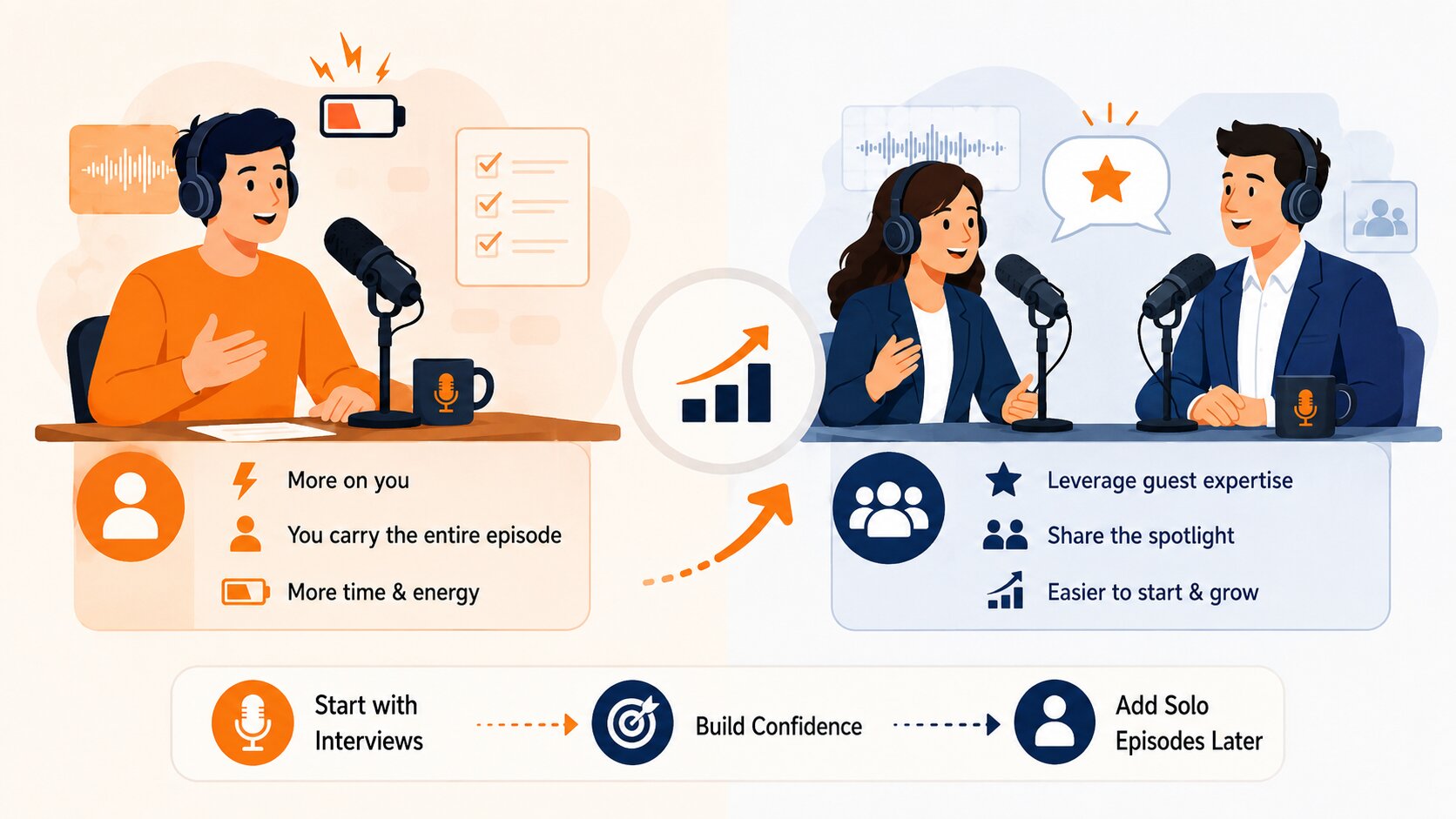
Solo shows vs. interview-based shows: Solo shows demand more from you as the host. You carry the entire episode. Interview-based shows let you leverage your guest's expertise. Start with interviews if you're new. Build confidence and then add solo episodes later.
Practice strategies that work:
- Record mock interviews with friends
- Listen to your recordings critically
- Study hosts you admire
- Get feedback from trusted sources
- Commit to your first ten episodes before judging your performance
Tools Every Real Estate Podcast Host Should Use
The right tools simplify your process.
Tool Type | Purpose | Suggested Tools | Price Range |
Microphone | Audio quality | On-hand headphones, Samson Q2U, Blue Yeti, Rode NT-USB | Free–$150 |
Hosting Platform | Distribution | Spotify for Creators, Buzzsprout, Anchor | Free – $40/mo |
Editing Software | Cleanup & polish | Audacity, Descript, GarageBand (Mac) | Free – $16/mo |
Zoom / Recording Software | Remote interviews | Zoom, Riverside, Zencastr | Free – $24/mo |
Note-taking App | Prep & follow-up | Notion, Google Docs, Apple Notes | Free – $10/mo |
Start simple. A decent USB microphone, Zoom for recording, and a basic hosting platform get you started. Upgrade as you grow. The best setup is the one you'll actually use.
Don't let equipment paralysis stop you from launching. Your first episodes won't sound like NPR. That's fine. Start now. Improve later.
Ready to build your setup the right way? Explore our full podcast equipment guide, from beginner setups to pro-level gear.
Real Estate Podcast Hosting Success Stories
Strong hosting doesn’t just grow an audience. It builds relationships that directly drive deals. These real estate professionals used podcast hosting to unlock opportunities that traditional prospecting couldn’t.
Shae Spitz — 330 Listings from One Interview
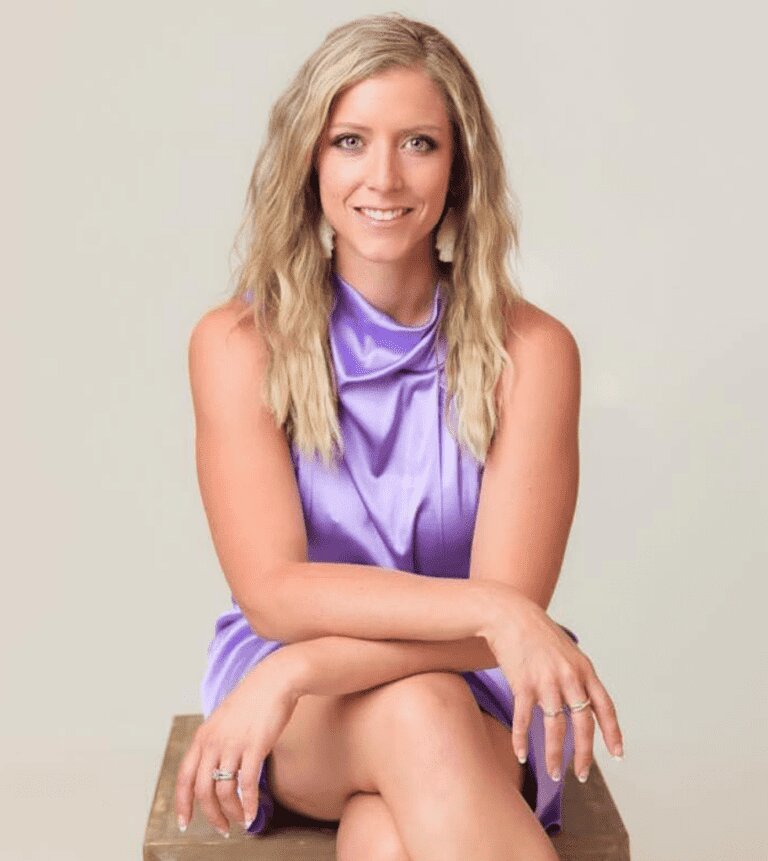
Host of The R.E.A.L. Moms Podcast, Shae focused on genuine connection over content. One guest relationship led to a 70-acre development deal, resulting in 330 potential listings. Her success proves that the real ROI of podcasting lives in the relationships built during and after the recording. See the full story
Kathy Byrnes — $100 Million in Funding
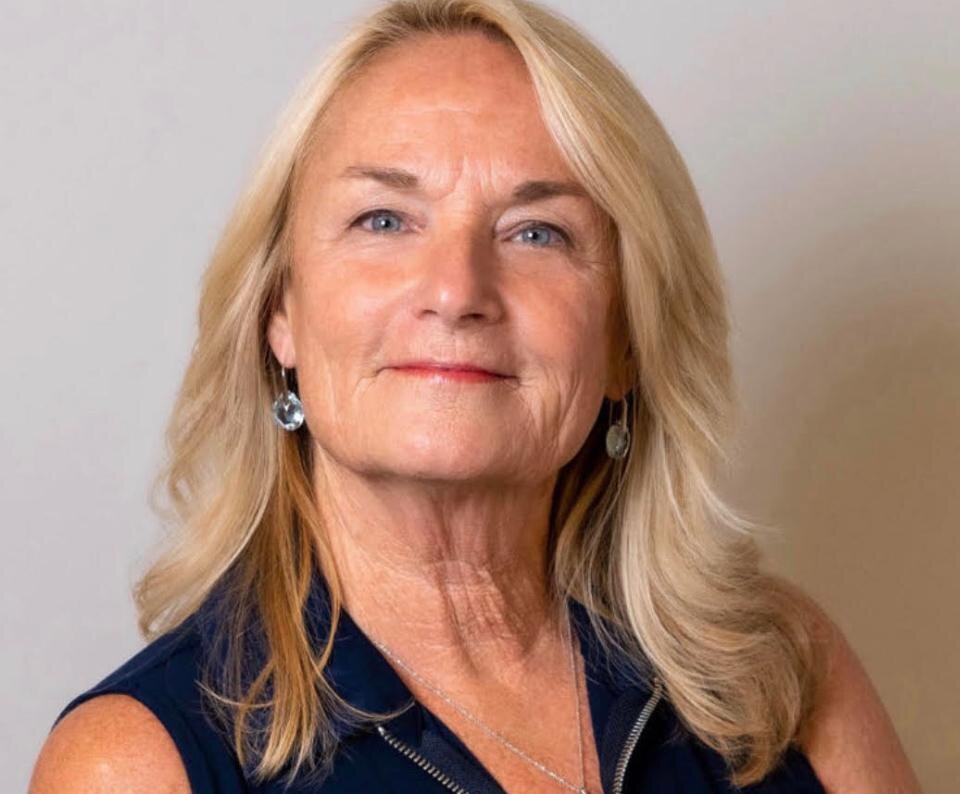
Hosting Real Estate Riches, Kathy used her podcast to interview investors and industry experts. One guest connection led to $100M in funding for real estate projects. By positioning others as experts, she elevated her own authority and accessed capital far beyond traditional networking. See the full story
Renée Ruth — Referral “Go-To” After One Episode

After publishing just one episode of The Platinum Agent Podcast, Renée was added to a highly sought-after referral list in her market. One conversation created immediate credibility and deal flow—proof that podcasting impact doesn’t require a big audience. See the full story
Want to see what podcasting can produce beyond downloads and views? Explore these real estate podcast success stories to see how real estate professionals have used meaningful conversations to strengthen relationships, build authority, and create real-world business opportunities.
Frequently Asked Questions
How do I host a podcast if I'm not a natural speaker?
Natural speakers aren't born. They're built through repetition.
Focus on preparation over performance. Script your intros and outros until they feel comfortable. Use notes for questions. Practice with friends before recording real episodes.
Your "unnatural" speaking style might actually be your strength. Authenticity beats polish. Listeners connect with real people, not perfect broadcasters.
What makes someone a good podcast host?
Good podcast hosts share specific traits.
They listen more than they talk. They prepare thoroughly without sounding scripted. They ask follow-up questions instead of moving robotically through a list. They make guests feel comfortable enough to share beyond surface-level answers.
Technical skills matter less than genuine curiosity. Master the basics, then focus on connection.
How long does it take to get good at podcast hosting?
Most hosts hit their stride around episode 20-30.
Your first ten episodes teach you the mechanics. Episodes 11-20 build comfort. After twenty episodes, you start developing your unique style.
Commit to at least twenty-five episodes before evaluating your progress. Early awkwardness is normal and temporary.
Do I need professional equipment to host a podcast?
Professional equipment helps. It's not required.
Start with a solid USB microphone, a quiet room, and reliable recording software. Invest in better equipment as your show grows.
Listeners forgive imperfect audio more easily than they forgive boring content. Focus on hosting quality first. Upgrade gear second.
Ready to Grow Your Real Estate Podcast?
Now that you know how to host a podcast, the next step is using it to create stronger relationships, more authority, and more opportunities in your market.
- Build a smarter podcast strategy with the 5-part Podcast Framework → attract better-fit guests, strengthen referral relationships, and turn each episode into content that keeps working after you publish.
- See what real estate podcasting can actually lead to → explore real examples of agents using podcast conversations to build authority, partnerships, referrals, and new business opportunities.
- Grow your visibility before launching your own show → apply to be a guest on the ICONS Podcast Network and turn your expertise into credibility, exposure, and an evergreen interview you can keep sharing.
- Launch your podcast without taking on another full-time job → get support with strategy, production, publishing, distribution, and content repurposing while you stay focused on clients and closings.
Learning how to host a podcast is only the beginning. The real value comes from what you do with each conversation after you hit record.