Having a podcast script can spell the difference between hosting a smooth-flowing podcast and an episode with lots of rambling. If you’re a real estate professional still trying to figure out how to use podcasting to promote your real estate business, this guide will show you:
- How to write a podcast script with a simple structure so you can sound more natural, stop rambling, and start delivering focused episodes that build trust with listeners (Helps you save hours on post-editing to remove irrelevant sections too.)
- How to start a podcast script with a hook that grabs attention in the first 30 seconds so listeners actually stick around
- A podcast script template for solo episodes, interviews, and market updates so you can stop staring at a blank page and start recording (no more excess improvising or retakes)
- Podcast script examples tailored for real estate agents so you can see exactly what a record-ready episode looks like
- Podcast segment ideas you can reuse weekly or fill your content calendar for months so you never run out of content that could potentially drive real business outcomes, referrals, listings, and authority in your local market.
Whether you're launching your first episode or refining your show after 30 recordings, you'll find a repeatable framework, plug-and-play templates, and real estate-specific examples that will make writing your podcast script simple.
What You'll Get in This Guide
- A simple script structure that keeps you from rambling
- Free copy/paste podcast script templates for solo episodes, interviews, and market updates
- A real estate podcast script example you can record today
- Segment ideas to fill your content calendar for months
What Is a Podcast Script (and What It Isn't)
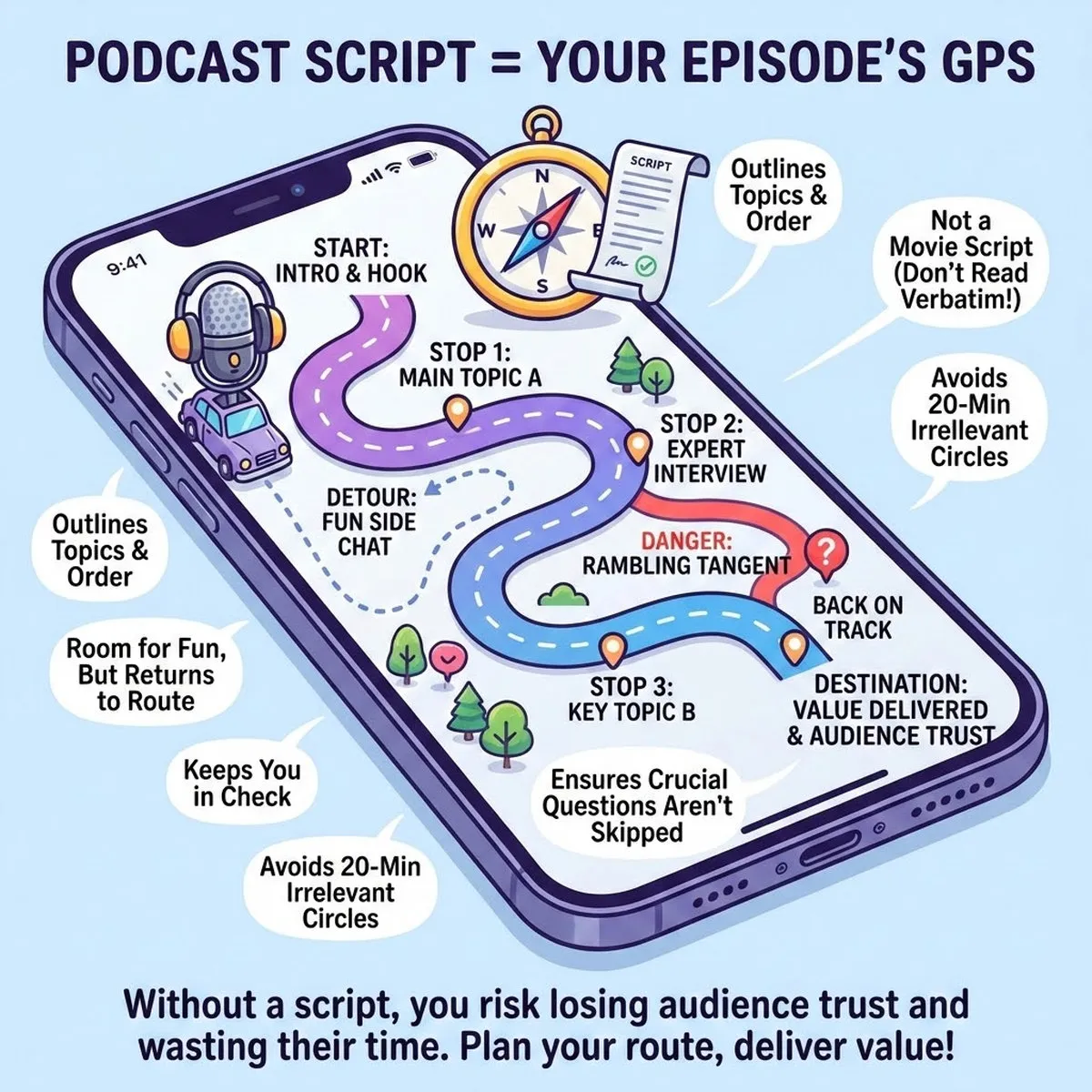
After launching 600+ podcast episodes at Icons of Real Estate, we believe in never coming to a podcast without a plan, so a podcast script is a must-have.Think of a podcast script as your episode's GPS. It outlines what you're going to chat about and the order you'll hit each topic.
Now, this isn't like a movie script where you read every single word. But you need it to keep your podcast in check.
Because even if you're an expert (or interviewing one), a podcast script keeps you from rambling in circles or burning 20 minutes on something totally irrelevant. It gives you space for those interesting side chats that make podcasts fun, but it also brings you back on track so you don't miss the topics that matter most.
Without a script, you risk losing your audience's trust. You might skip crucial questions, spend too much time on tangents, or worse, leave your listeners feeling like they wasted their time.
That's why we do pre-research on what the audience cares about before every episode. The script is our way of making sure we deliver value, keep things tight, and give people a reason to keep coming back.
Script vs. Outline vs. Bullet Points
The level of detail in your podcast script depends on your experience and comfort level. Most real estate agents find success with a hybrid approach, somewhere between a word-for-word script and loose bullet points.
Script Type | Best For | Pros | Cons |
Word-for-Word | New hosts, complex topics, regulatory content | Maximum control, precise messaging | Can sound stiff, takes longer to write. Not recommended |
Hybrid Script | Most agents (recommended) | Natural delivery with structure | Requires practice to balance |
Bullet Outline | Experienced hosts, interviews | Conversational, flexible | Risk of rambling, missing points |
When to Go Word-for-Word vs. Semi-Scripted
Use a full script for your podcast’s intro and outro, your call-to-action, and any content that requires precision, like market statistics or legal disclaimers.
For the main body of your episode, a hybrid approach works best: write out your key points in full sentences, but allow yourself to elaborate naturally.
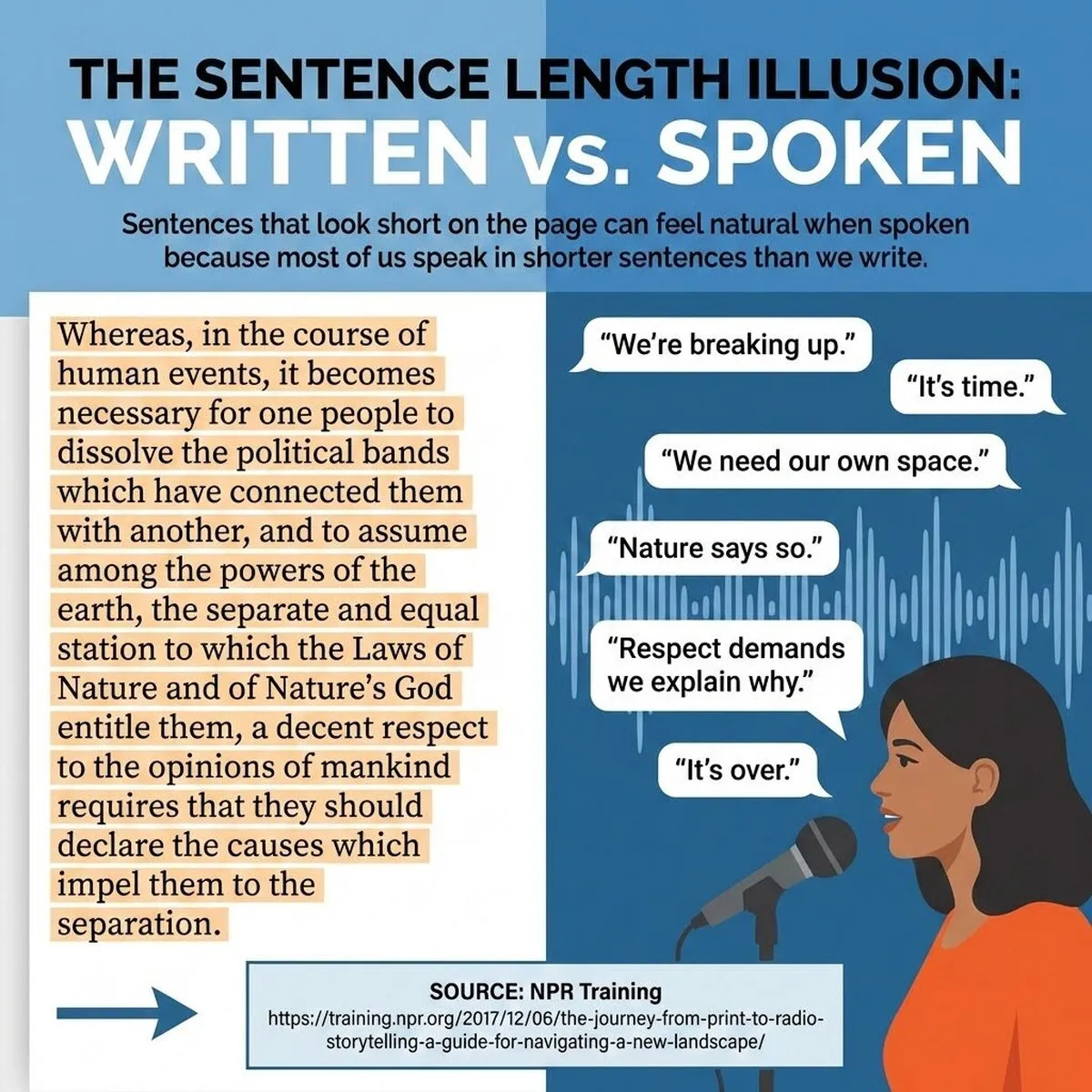
When outlining, try to keep your sentences short. As NPR Training notes, sentences that look short on the page can feel natural when spoken because most of us speak in shorter sentences than we write.
Why Real Estate Agents Should Script Their Episodes
Podcasting actually gives you 2 opportunities for the price of one.
- The opportunity to create expert content.
- The opportunity to build relationships with other experts (and potential clients or referral sources).
But all of this relies on your ability to design a structure that lets you and your guests entertain while giving value to your audience.
Consistency Builds Trust (and Repeat Listeners)
Listeners subscribe to shows that deliver reliable value. When you nail a consistent episode structure, you create familiarity that makes it easier for your audience to engage.
That consistency comes down to:
- A recognizable intro
- Predictable segment flow
- A clear call-to-action in every episode
👉🏻 Download this relevant podcasting resource for free: 5 Podcast Frameworks to Grow Your Real Estate Business
Faster Recording + Cleaner Edits
A well-prepared script dramatically reduces post-production time.
When you know exactly what you want to say, you eliminate the "ums," the false starts, and the twenty-minute tangents that eat up editing hours.
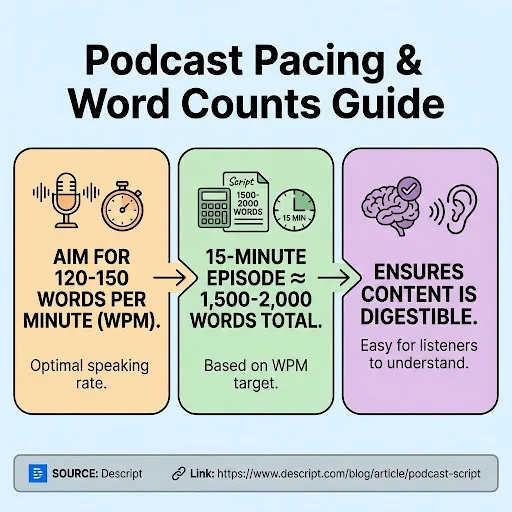
Research from Descript suggests that expert podcasters aim for 120-150 words per minute, which ensures content is digestible. A 15-minute episode works out to approximately 1,500-2,000 words, a manageable target when you have a clear outline.
Clear CTAs That Lead to Calls, Referrals, and Listings
Without a script, you could forget to include your call-to-action, or you deliver it awkwardly at the last second.
As discussed in our Podcast Hosting Framework (1 of our 5 Podcasting frameworks), your CTA should be scripted word-for-word, to gently steer the guest toward a future collaboration.
"Let's book some time to discuss your goals in more detail. I believe there's a lot we can explore together." |
Clear CTAs That Lead to Calls, Referrals, and Listings
Without a script, you could forget to include your call-to-action, or you deliver it awkwardly at the last second.
As discussed in our Podcast Hosting Framework (1 of our 5 Podcasting frameworks), your CTA should be scripted word-for-word, to gently steer the guest toward a future collaboration.
For example:
"Let's book some time to discuss your goals in more detail. I believe there's a lot we can explore together." |
By writing this in advance, you ensure every episode drives listeners (and your guests) toward the next steps.
Business Wins from Scripting Your Podcast
- Record episodes in half the time with fewer retakes
- Deliver consistent value that builds listener loyalty
- Sound authoritative without sounding rehearsed
- Never forget your call-to-action again
- Repurpose scripts into blog posts, social content, and email newsletters
Related reading:
Ultimate guide to building your real estate podcast
Podcast equipment (beginner to professional)
The Anatomy of a High-Converting Podcast Script
Every effective podcast script template follows a proven structure.
Here at Icons of Real Estate, the script is divided into three distinct phases to build rapport, deliver value, and transition into a business opportunity.
Phase | Duration | Core Objective |
Initial Chit-Chat | 5 Minutes | Build rapport and relax the guest. |
Podcast Episode | 25 Minutes | Deliver content and showcase expertise. |
The After-Chat | 10 Minutes | Convert the guest into a referral partner. |
I talk more about this high-converting podcast framework here in this short video:
Phase 1: Initial Chit-Chat (Pre-Recording)
Before hitting record, be 10 minutes early to “receive the guest” if they arrive early. Use this time to establish a personal connection.
Use Icebreakers
Use mini scripts or guides for icebreakers to make the guest feel comfortable, like:
"Hey [Name], how's your day going? Anything exciting on your agenda?" |
Plan Confirmation
Double-check the questions and ask if the guest has specific items they wish to promote.
The "Anchor"
Explicitly confirm that you will chat for a few minutes after the recording to get their feedback.
"And by the way, after we wrap up the recording, let's chat for a few minutes. I'd love to hear your thoughts on how it went and any feedback you might have." |
Phase 2: The On-Air Episode (25 Minutes)
Hook (First 15-30 Seconds)
Your hook determines whether listeners stick around or skip to the next podcast.
Start with an opening line, a question, bold statement, or short clip from the episode that sparks interest.
For a real estate podcast, this might be:
"Three buyers lost out on their dream home this week for the same preventable reason. In the next ten minutes, I'll make sure you're not the fourth." |
Intro: Quick Credibility + "Why Listen"
Once you have their attention, you need to deliver three things fast.
State your podcast name. Briefly introduce yourself. And tell them what they're about to learn, or what the value proposition is.
Let me show you both the hook and intro in practice.
If you watch the start of this video up till 1:18 on the timestamp, you will see my interview with Taylor Klein, who closed her first 12 real estate deals in her first year.
The hook opened with her transformation story. Five months in and zero money. That's the relatable struggle, for many of the listeners.
But then she did "that thing."
And suddenly, everything clicked. 12 deals closed.
Here, we’re teasing the breakthrough - the thing she did that made her succeed – that listeners will learn in this episode.
Then the transition happens naturally. I introduce myself as the host, mention the show, and introduce the guest.
Why Your Podcast Introduction Needs Preparation
Now, here's what separates good podcasters from great ones.
You shouldn't rely on a full script for the entire interview. That kills the conversation. But the introduction? That should be carefully prepared.
Do your pre-show due diligence. Research your guest. Know their story. Then craft an introduction that includes these four elements:
- Name and Title: Clearly state the guest’s name and their professional role (e.g., "Founder of XYZ Company" or "Renowned Real Estate Agent").
- Notable Achievements: Highlight specific awards, successful projects, or unique contributions they have made to the industry.
- The Value Proposition: Briefly mention what the audience will take away from the show by indicating what the guest is there to share. For example, "insights on building a high-performance team" or "strategies for luxury marketing".
- A Warm Welcome: End the introduction by officially welcoming them to the show to kick off the conversation
Here are different examples of introducing your guest.
Guest Type | Introduction Style |
High-Performance Leader | "Blake Cory is the founder of Mega Team Builder Mastery Coaching... he's coached thousands of agents... Now this blueprint is coming to you!" |
Local Authority | "Christina Swyers is a 2x Icon Agent... she is proud to call herself the 'digital mayor' of her town. Welcome to the show, Christina!". |
Industry Veteran | "Marc Stein is the CEO of Links Residential... Marc has been able to personally close over 1,000 transactions. Doing good now for our ICONS of Real Estate Podcast". |
Guest Story
Transition into the guest's journey by asking, "What is your story?". This builds an emotional connection by highlighting milestones and challenges they have overcome.
Core Content (The Interview)
Here's where most podcasters mess up. They treat interviews like rigid, scripted, Q&A sessions.
Here’s how you can make them flow:
✔️ Focus on open-ended questions that actually link back to your guest's story.
✔️ Use transitions that feel natural.
Ask Open-Ended Follow-Up Questions
Have your main questions prepared. But stay flexible.
Instead of simply reading the questions, waiting for answers, and moving on, dig deeper into what your guest actually says. That's where you create something more dynamic and engaging.
Why Follow-Up Questions Matter
Benefit | What It Does |
Deeper Insights | Dig into topics a standard question would miss. |
Active Listening | Prove you’re truly listening, not just waiting to speak. |
Narrative Completion | Complete the story and build emotional connection, especially in guest segments. |
Professionalism | Show respect for your guest’s expertise and create a cohesive, natural conversation. |
Key Tips to Effectively Follow Up
- The "Bridge" Technique. Use the guest's previous response as a bridge to your next topic. If they mention a struggle, ask how that specific experience shaped their current approach. Connect the dots.
- Curiosity-Driven Transitions. Show genuine curiosity. Ask how a specific turning point influenced their trajectory. Let your interest guide the conversation.
- Summary for Clarity. If your guest uses technical or dense language, summarize their point and ask for clarification. Your audience needs to stay on the same page.
- Avoid Over-Scripting. Jot down key talking points. Use digital tools like Sticky Notes if you need to. But don't read word-for-word.
Use Transitions That Keep Listeners Engaged
Smooth transitions keep listeners engaged and help them follow your narrative. Include these in your podcast template:
- "Now that we've covered X, let's dive into Y..."
- "This brings me to my next point..."
- "Speaking of which, here's something most agents miss..."
- "But here's where it gets interesting..."
- "Let me share a quick story that illustrates this..."
Outro + Next Episode Teaser
Your outro must leave a lasting impression. Do not ramble or try to cram multiple different calls to action. This can end up confusing the listeners. And confused listeners don’t take action.
Keep your podcast outro concise at 15-30 seconds.
- Recap the key takeaways (optional)
- Let your guest share one final piece of advice, and how the audience can get in touch with them.
- Then give one action. Just one. (You can have this at the end, together with your outro music)
You can send your audience to your lead magnet, a consult, or a local offer.
As per our Podcast Hosting Framework, effective CTAs might include:
- "DM me 'MARKET' on Instagram for my free monthly market report"
- "Visit [website] to download the buyer's checklist we discussed today."
- "Leave a review on our show page to be entered into a giveaway for a free real estate consultation, a free e-book, or access to an exclusive bonus episode"
- “If you found this helpful, follow us on Instagram @RealEstateSuccess for more daily tips and insights, and feel free to reach out with your own real estate stories."
- “For more great insights or to access the 5-step house-selling framework mentioned in today's episode, visit our website at RealEstateSuccess.com"
👉🏻 For a more in-depth guide on how to host your podcast, download our proprietary Podcast Hosting Framework - 1 of our 5 Podcast Frameworks here
Here’s the outro in action:
Phase 3: The After-Chat (The "Conversion" Script)
The recording's end is where the "real magic" happens for your business. Do not stop recording the session (for personal records) so you can catch these insights.
Rapport Check
Ask, "How do you feel about the episode we just recorded?" and provide constructive feedback to the guest.
Deeper Business Dive
Transition into a personal conversation about your journey as a realtor and ask about their current business focuses or challenges.
The Relationship CTA
This is the strongest, most direct CTA, that transitions the guest into a business partner or client.
Gently steer the guest toward a deeper collaboration using the word-for-word script:
"Let's book some time to discuss your goals in more detail. I believe there's a lot we can explore together!" |
Podcast Script Checklist
- □ Hook that grabs attention in first 30 seconds
- □ Brief credibility statement (who you are, who you help)
- □ 3 main points maximum (problem → solution → next step)
- □ Transition phrases between segments
- □ Recap of key takeaways
- □ End CTA (one clear next step)
- □ Outro with next episode teaser
How to Write a Podcast Script Step-by-Step
Step 1: Choose ONE Episode Goal (and One Listener)
Every episode should focus on a single outcome.
- Are you trying to attract first-time buyers?
- Establish yourself as the go-to agent for investors?
- Nurture existing clients for referrals?
Choose your primary listener, picture one specific person, and speak directly to them.
"Today's episode is for you if you're thinking about selling but wondering whether to wait for spring..."
Step 2: Pick a Format
Your format determines your script structure. Here are the common options:
Episode Type | Description | Pros | Cons |
Solo tip episodes | You and the mic | Quick to produce; low cost; full creative control | Risk of sounding monotonous; relies on your charisma |
Market updates | Data-driven insights | Builds authority; timely and valuable to the audience | Requires research time; data can quickly become outdated |
Interviews | Featuring local experts or past clients | Adds credibility; diverse voices; networking opportunities | Scheduling challenges |
Case studies | Deal breakdowns | Demonstrates real results; trust-building | Potential confidentiality issues; time-intensive prep |
Q&A episodes | Answering listener questions | High engagement; audience loyalty | Dependent on submissions, may lack structure |
Each format has a different podcast script template, we'll cover them in the Template Library section below.
Step 3: Write the Hook + Promise
How to start your podcast script: Begin with a hook that creates curiosity, then deliver a promise that tells listeners exactly what they'll get.
Example Hook:
"In the next 10 minutes, you'll learn the three inspection issues that kill deals in [Your City], and how to avoid them."
This sets clear expectations and gives listeners a reason to stay.
Already recorded your episode? Pull the best line or snippet from your guest interview and use that as your opening hook instead.
Step 4: Outline 3 Key Points (Keep It Tight)
Structure your content using this framework:
- Point 1: The Problem , What challenge does your listener face?
- Point 2: The Solution , What should they do about it?
- Point 3: Common Mistake + Fix , What do most people get wrong?
Step 5: Add Proof + Real Estate Examples
Abstract advice doesn't stick. So add local examples, anonymized client stories, and specific scenarios.
Give them something concrete, like:
"Last month, a seller in [Neighborhood] almost lost $30,000 because..."
Step 6: Write for the Ear (Not the Page)
Audio writing differs dramatically from print. According to NPR's guide to radio writing, sentences need to be far shorter and information needs to unfurl more slowly. It's often said that our ears can only handle one fact or idea per sentence.
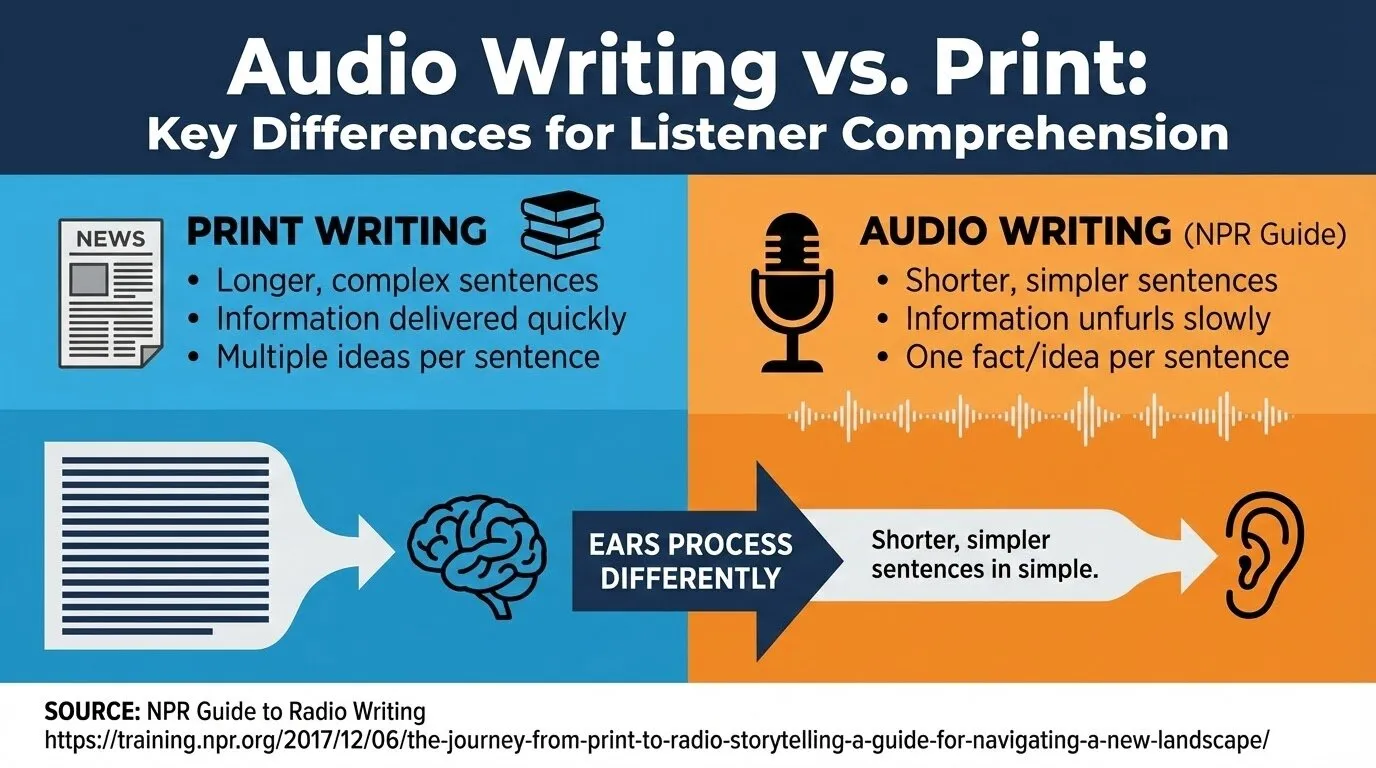
Follow these key principles:
- Use short sentences, very short
- Use contractions ("don't" instead of "do not")
- Minimize numbers, ears hate numbers
- Use simple words ("car" not "vehicle")
- Repeat key phrases for emphasis
Step 7: Add Your CTA + Tracking
- Script your call-to-action word-for-word.
- Include a soft CTA mid-episode ("By the way, if you want my checklist for this, the link is in the show notes") and a direct CTA at the end.
- Use trackable links or unique keywords so you know which episodes drive leads. "DM me 'PODCAST' on Instagram" or "Visit mysite.com/episode15" makes tracking simple.
Step 8: Read It Out Loud + Tighten
According to Teach With Digital Scholarship, your own ears can be one of your most valuable tools as an audio writer. Read back what you've written aloud to see if it feels natural. This is one of the easiest ways to shorten sentences and find more succinct phrasing.
Cut 10-20% of your content. Mark pauses and emphasis points. If you stumble reading a sentence, rewrite it.
Script Format Comparison
Format | Time Investment | Best For |
Full Script | 2-3 hours for 15 min episode | New podcasters, complex topics. (Not recommended - as it can lead to a stiff interview) |
Hybrid | 1-2 hours for 15 min episode | Most real estate agents, new podcasters(Encouraged) |
Bullet Outline | 30-60 minutes for 15 min episode | Experienced hosts, interviews |
👉🏻 For more guidance on structuring your show, explore our 5 Podcast Frameworks. This covers all the different things you need to launch a podcast and is designed specifically for real estate professionals.
Free Podcast Script Template Library (Copy/Paste)
Choose one podcast script template and reuse it weekly. Consistency in format lets you focus on content rather than structure. The templates below are specifically designed for real estate professionals, just fill in the brackets and record.
1. Podcast Intro Script Template (30-45 Seconds)
INTRO SCRIPT TEMPLATE
[HOOK - Bold statement or question] "What if I told you [surprising fact relevant to your market]?" [INTRO - Podcast name and host] "Welcome to [Podcast Name], I'm [Your Name], and I help [who you help] achieve [what they want]." [EPISODE PREVIEW] "Today, we're diving into [topic], you'll learn [benefit 1], [benefit 2], and [benefit 3]." [OPTIONAL: SPONSOR/CTA] "This episode is brought to you by [sponsor or your own service]." |
2. Solo Episode Podcast Script Template (10-15 Minutes)
A 10-minute podcast script typically contains about 1,000 to 1,500 words, depending on speaking speed. According to Sarah Lawrence College, a 15-minute episode will have approximately 2,250 - 2,400 words.
SOLO EPISODE TEMPLATE (10-15 MIN)
[0:00-0:45] HOOK + INTRO - Attention-grabbing statement/question - Podcast name, your name, quick credibility - Episode promise: "By the end, you'll know..." [0:45-1:30] CONTEXT + WHY THIS MATTERS - Why this topic? Why now? - Who is this episode for? [1:30-4:30] POINT 1: [Problem/Concept] - Explain the issue - Real estate example or story - Key takeaway [4:30-7:00] POINT 2: [Solution/Strategy] - Action steps - Local market example - Common questions answered [7:00-9:30] POINT 3: [Mistake/Advanced Tip] - What most people get wrong - How to avoid it - Pro tip from your experience [9:30-10:30] RECAP + STRONG CTA - Summarize 3 key points - Clear call-to-action (one thing) - How to reach you [10:30-11:00] OUTRO - Thank listener - Tease next episode - Subscribe/review request |
SOLO EPISODE EXAMPLE VIDEO
Here is an example of a solo episode that I made here in Icons of Real Estate, where I talk about “Why you need a podcast in 2025.”
3. Interview Podcast Script Template (With Pre-Call Notes)
INTERVIEW EPISODE TEMPLATE
[PRE-CALL CHECKLIST] □ Guest bio researched □ Questions sent at least 72 hours ahead □ Guest goals confirmed (what do they want to promote?) □ Story beats identified (their journey, challenges, wins) [INITIAL CHIT-CHAT - 5 min before recording] "Hey [Guest], how's your day going? Before we start, I wanted to mention I saw [something from their social/website], love to hear about that!" [0:00-1:00] INTRO + GUEST INTRODUCTION "Welcome to [Podcast Name]! Today I'm joined by [Guest Name], who is [credibility/title]. [Guest] has [notable achievement]. Welcome to the show!" [1:00-5:00] GUEST STORY "Let's start with your journey, how did you get into [their field]?" - Follow up: "What was the turning point?" - Follow up: "What challenges did you face?" [5:00-18:00] MAIN CONTENT - 5-7 Questions Q1: [Topic question linking to their expertise] Q2: [Practical advice for listeners] Q3: [Common mistake in their field] Q4: [Current market/industry insight] Q5: [Personal success story] [GUARDRAIL LINES - for redirecting] "That's great! To bring us back to [topic], how does that impact...?" "I'd love to explore that more, but first..." [18:00-20:00] LIGHTNING ROUND (optional) - Best book/resource? - One piece of advice? - Your plans for the next 2 years? [20:00-22:00] CLOSING + GUEST CTA "Where can listeners connect with you?" "What's the best way to work with you?" [22:00-23:00] OUTRO - Thank guest - Recap value for listeners - Your CTA + next episode tease - Outro music |
INTERVIEW EPISODE EXAMPLE VIDEO
Here is an example of the interview podcast template in action.
In this episode, I interviewed the founder of Big Block Realty, Sam Khorramian, who overcame numerous business failures to create Big Block Realty.
4. Local Market Update - Podcast Template (Agents' Favorite)
MARKET UPDATE PODCAST TEMPLATE (8-12 MIN)
[HOOK] "[City] home prices just did something we haven't seen in [timeframe]. Here's what it means for you." [INTRO - 30 seconds] Standard podcast intro + "Today's market update for [Month/Year]" [THE 3 NUMBERS] "Let's look at three numbers that tell the whole story:" Number 1: [Key Metric - e.g., Median Price] - What it is: "Median home price is now $X..." - What it means: "This tells us..." Number 2: [Key Metric - e.g., Days on Market] - What it is: "Average days on market is now X..." - What it means: "For buyers, this means..." Number 3: [Key Metric - e.g., Inventory] - What it is: "We have X months of inventory..." - What it means: "This is a [buyer's/seller's] market because..." [BUYER ACTION STEP] "If you're buying right now, here's what I'd do..." [SELLER ACTION STEP] "If you're thinking about selling, my advice is..." [CTA] "Want my full [Month] market report? DM me 'MARKET' on Instagram or visit [link]." [OUTRO] Standard close + tease next month's update |
MARKET UPDATE EXAMPLE VIDEO:
Here is an example of an interview episode that’s under the “local market update” umbrella.
It’s from the Podcast Big Huntsville Podcast by Carl Thomas, who is part of our podcasting network here at Icons of Real Estate.
5. Neighborhood Guide / Listing Spotlight - Template
Note: Be mindful of fair housing guidelines, focus on lifestyle features, amenities, and community characteristics rather than demographics. Avoid any language related to protected classes.
NEIGHBORHOOD GUIDE TEMPLATE
[HOOK] "Looking for [lifestyle attribute - walkable, family-friendly, etc.]? Today we're exploring [Neighborhood], and I'll share why locals call it [nickname/reputation]." [INTRO - 30 seconds] Standard intro + "This is [Episode #] in our Neighborhood Guide series." [LOCATION + VIBE] - Where is it? (Directions, boundaries) - What's the feel? (Architecture, streets, energy) [LIFESTYLE FEATURES] - Local amenities (parks, restaurants, shops) - Commute times to major employers - Recreation and entertainment [MARKET SNAPSHOT] - Price range for typical homes - What's available right now - How quickly homes sell [INSIDER TIP] "Here's something the listing won't tell you..." (local secret, best coffee shop, etc.) [WHO THIS IS FOR] "This neighborhood is perfect for you if..." [CTA] "DM me 'NEIGHBORHOOD' for my complete guide to [Neighborhood], or schedule a tour at [link]." [OUTRO] Standard close + tease next neighborhood episode |
6. Client FAQ / Objection Crusher - Template
FAQ / OBJECTION CRUSHER TEMPLATE
[HOOK] "'Should I wait until spring to list?' I hear this question every week. Here's my honest answer." [INTRO - 30 seconds] Standard intro + "Today we're answering the questions I hear most." [QUESTION 1] - State the question exactly as clients ask it - The short answer (direct) - The full explanation (with local context) - What I tell my clients [QUESTION 2] - Same structure [QUESTION 3] - Same structure [BONUS: The question they SHOULD be asking] "Here's what most people forget to ask..." [CTA] "Got a question for the show? DM me on Instagram or email [address]. Your question might be featured next week!" [OUTRO] Standard close |
👉Want help putting these podcast script templates into action? Try our podcast production services from ICONS of Real Estate.
Podcast Script Example (Real Estate Episode Sample)
Here's a fully developed podcast script example you can model to translate templates into real episodes for your own show.
Example A: "3 Mistakes Buyers Make This Month" (10-12 min)
RECORD-READY SCRIPT: BUYER MISTAKES EPISODE
[HOOK - Word for Word] "Three buyers in my office lost their dream home this month. Same three mistakes. In the next ten minutes, I'll make sure you don't become number four." [INTRO] "Welcome to [Podcast Name], I'm [Your Name], helping [City] buyers and sellers navigate this crazy market. Let's dive in." [POINT 1 - Outline] Mistake: Waiting for prices to drop • Current data shows... • Story: Client who waited 6 months, lost $X • What to do instead: calculate true cost of waiting [POINT 2 - Outline] Mistake: Skipping pre-approval • Why sellers reject these offers • Story: Lost to a cash offer by 24 hours • What to do instead: get fully underwritten approval [POINT 3 - Outline] Mistake: Lowballing in competitive markets • Current seller expectations • Story: $5K under asking = didn't even get a counter • What to do instead: strategic offer positioning [SOFT CTA] "By the way, I've got a buyer's checklist that covers all this, link in show notes." [CTA - Word for Word] "Here's what I want you to do: If you're thinking about buying in [City] this year, let's talk before you start scrolling Zillow. Reach out at [phone/email/DM] and we'll map out your strategy so you don't end up as cautionary tale number four." [OUTRO - Word for Word] "Thanks for spending this time with me. If this helped, share it with a friend who's thinking about buying, they'll thank you later. Next week, we're talking about what sellers need to know about spring prep. I'm [Your Name], and I'll see you then." |
Example B: Interview Intro + Closing CTA (Word-for-Word)
INTERVIEW INTRO + OUTRO SCRIPT
[GUEST INTRO - 20-30 seconds] "Today's guest built a real estate team from zero to 50 agents in just six years. Blake Cory is the founder of Mega Team Builder Mastery Coaching and leader of a top-ranked team in Southern California. He's coached thousands of agents on the exact blueprint he used, and now he's sharing it with us. Welcome to the show, Blake!" [Guest Story] "Blake, take us back to the beginning. What made you decide to build a team in the first place? And what were those first few months actually like?" [Main 3 questions] Question 1: "You went from zero to 50 agents in just six years. Walk us through the biggest shift that made that possible. What changed?" Question 2: "Most agents struggle with hiring their first team member. What's the biggest mistake you see them make, and how do you fix it?" Question 3: "If someone's listening right now and they're thinking about building a team, what's the one thing they need to do in the next 30 days?" [CLOSING SEGMENT - 2 minutes] Host: "Blake, this has been incredible. Before we wrap up, where can listeners connect with you?" [Guest response] Host: "Awesome. And for everyone listening, Blake just dropped some serious knowledge. Here are your three takeaways:" • [Key point 1] • [Key point 2] • [Key point 3] "If you want to learn more about building your own team, check Blake out at [website]." "And if you're looking to launch your own podcast to attract talent and build authority, head to iconsofrealestate.com/podcastnetwork to see how we can help." "Thanks for listening. Don't forget to subscribe, and I'll catch you next week when we [tease next episode]. I'm [Your Name], talk soon!" |
Real Estate Podcast Segment Ideas You Can Reuse Weekly
Running out of episode ideas? These proven podcast examples give you recurring segments that fill your content calendar for months:
Deal Breakdown
Walk through a recent transaction from start to close.
- What worked?
- What almost killed the deal?
- What did you learn?
Anonymize client details but keep the drama, listeners love behind-the-scenes stories.
Neighborhood Minute
A 5-minute deep dive into one area you serve.
Cover:
- Lifestyle
- Price points
- Neighborhood “vibe”
- Insider tips
- Other tidbits only residents would get exposed to, and that won’t be easy to google
Stack these episodes, and you've built a comprehensive local guide that ranks in search.
Ask an Agent - Q&A
Answer questions submitted by listeners via DM, email, or social media. This drives engagement and gives you endless content ideas directly from your audience.
Myth vs. Reality
Tackle common misconceptions:
- "You need 20% down."
- "Spring is the only time to sell."
- "All agents are the same."
Set the record straight and position yourself as the expert who tells the truth.
Local Business Spotlight (Referral Flywheel)
Interview local business owners, lenders, inspectors, contractors, restaurateurs. You provide value to your audience, build relationships with potential referral partners, and create content that business owners will share with their networks.
More Segment Ideas to Add to Your Rotation:
- "Investor Corner" , Investment property analysis, cap rates, and strategies
- "First-Time Buyer Fridays" , Basics for newcomers to the market
- "Inspection Surprises" , Lessons learned from home inspections
- "Offer Strategy Minute" , Tactics for competitive situations
- "Client Story (Anonymized)" , Success stories that showcase your approach
- "Market Movers" , News and events affecting local real estate
Common Podcast Scripting Mistakes (and Fixes)
Even experienced agents make these scripting errors. Here's what to watch for when learning how to write a script for a podcast:
Mistake | What It Sounds Like | Fix |
Sounding like a sales pitch | "Call me for all your real estate needs!" | Lead with value, mention services only after delivering insights |
Overwriting (too dense) | Packing 10 stats into one minute | One idea per sentence; ears hate numbers |
No CTA, no next step | Episode ends abruptly with no direction | Script one clear CTA; read it word-for-word |
Writing for readers, not listeners | Long complex sentences with jargon | Short sentences, contractions, simple words |
Too many points | Covering 7 topics in 10 minutes | Stick to the Rule of 3, max 3 main points |
Forgetting context | "As I mentioned last week..." (new listeners are lost) | Treat each episode as someone's first |
Use the 5 Podcast Frameworks to Plan Scripted Content Faster
Creating a podcast script becomes dramatically easier when you have a framework guiding your content strategy. The ICONS of Real Estate Podcast Frameworsk provides real estate professionals with proven structures for generating endless episode ideas and maintaining consistent quality.
Here's how frameworks accelerate your scripting process:
- Topic Selection: Frameworks give you category buckets to draw from, so you never wonder "what should I talk about?"
- Segment Planning: Pre-built structures mean you just fill in the blanks with local examples
- CTA Placement: Strategic points for calls-to-action are already mapped out
- Content Calendar: Plan months of episodes in one sitting
- Quality Consistency: Every episode follows proven patterns that work
🎯 Download the 5 Podcast Frameworks (FREE)
Get the complete ICONS of Real Estate Podcast Frameworks (5 Frameworks that tackle different podcasting needs)
FAQs
Most real estate agents benefit from a hybrid approach, script your intro, outro, and CTAs word-for-word, but use bullet points for main content. According to Spotify for Creators, podcast scripts can be as minimal or detailed as you want, depending on your experience level and how much structure you prefer. New hosts often need more detail; experienced hosts can work from lighter outlines.
For a fully scripted episode, plan for 1,000-1,500 words for 10 minutes or 1,500-2,250 words for 15 minutes. According to Sarah Lawrence College's podcast guide, podcasts typically run at 150-160 words per minute. If you're using a hybrid script with bullet points, your document will be shorter, perhaps 1-2 pages, because you'll be expanding on points verbally.
The best interview podcast script template includes a pre-interview checklist (guest goals, story beats, promotion needs), a word-for-word guest introduction, 5-7 core questions with follow-up prompts, guardrail lines to redirect back to the main topic, and a closing segment that drives listeners to take action. See our complete Interview Template above, which is based on one of our 5 Podcast frameworks, the ICONS Podcast Hosting Framework.
Next Steps for Real Estate Podcasters
You've got the templates. You've got the examples. Now it's time to put them into action. Here are your next steps:
Resource | What You'll Get |
Get listed, connect with other podcasters, and access exclusive resources | |
Build authority by appearing on other shows, a shortcut to credibility | |
Discover shows in your market, and find collaboration opportunities | |
Launch your podcast the right way with professional production help | |
Get proven structures for endless episode ideas |
See What Other Agents Have Achieved
Shae Spitz , Columbus, NEB: Generated 330 listing opportunities from one podcast recording. Learn more about Shae’s story →
Kathy Byrnes , Mooresville, NC: Built authority with 60+ episodes of the Real Estate Riches Podcast, specializing in waterfront properties. One podcast episode eventually led to a $100 million funding. Learn more about Kathy’s story →
Kevin Tremmel , Southwest Florida: Grew his 239 Real Estate Roundtable podcast into a lead generation and business development engine. Learn more about Kevin’s story →
Ready to Launch Your Real Estate Podcast?
Get the templates + strategy applied to your market.
Join the Network | Book Production Help | Apply as a Guest
Conclusion
At Icons, we prefer a podcast script to go with a mix-and-match approach. Don't read everything word-for-word. This method gives you a solid framework so you sound confident, but still lets your personality come through. Nail your hooks, intros, and CTAs by scripting them out precisely, and then just use bullet points to guide you through the main discussion.
Here's your action plan:
- Pick one template from this guide.
- Write your podcast script for next week's episode.
- Record it.
- Publish it.
- Then improve next week.
Consistency beats perfection, the agents building real authority through podcasting are the ones who show up week after week, not the ones waiting for the perfect script.
Download the 5 Podcast Frameworks for more structure, or join the ICONS Podcast Network to connect with other real estate podcasters who are growing their businesses one episode at a time.
If you need help launching your own podcast, from conceptualization, planning, creating multimedia assets, your interview script, booking guests, and more, connect with our podcast production team.
Additional Resources:
Real Estate Podcasting: The Complete Guide for Agents and Brokers