Learning how to get podcast guests is one of the most valuable skills you can develop as a real estate agent who’s growing a podcast.
Finding podcast guests does more than fill your content calendar.
Unlike solo shows where you shoulder the entire content burden, featuring podcast guests transforms each episode into a relationship-building exercise.
- It positions you as a connector in your local market
- Expands your reach through borrowed audiences,
- And creates tangible opportunities for referrals, partnerships, and listings.
Here’s the difference between solo shows and guest episodes.
Solo Episodes | Guest Episodes |
You shoulder the entire content burden | Guests share the workload and bring fresh perspectives |
Limited to your own audience | Access to borrowed audiences and expanded reach |
Transactional content delivery | Relationship-building exercise with every conversation |
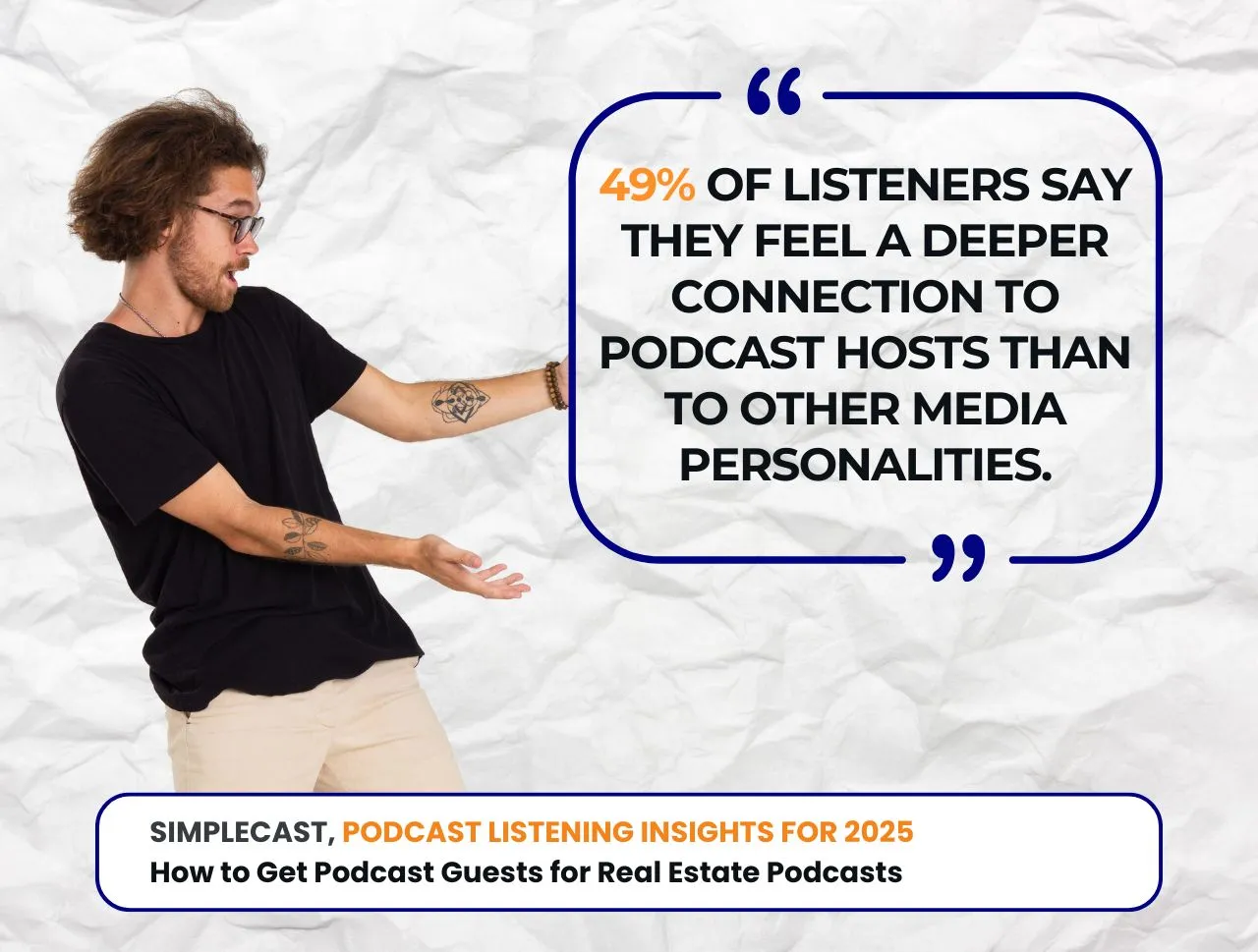
Unlike solo shows where you're carrying everything yourself, featuring podcast guests transforms each episode into a relationship-building exercise.
The Dual Purpose for Real Estate Agents
For real estate agents specifically, booking podcast guests serves two goals at once:
- You create content that showcases your market expertise
- You cultivate relationships that drive long-term business growth
Every agent, mortgage broker, inspector, attorney, or investor you interview becomes a potential referral partner who now has a deeper connection to you and your brand.
Click here to scroll immediately to how to book podcast guests, or read through the intro for foundational info.
📥 Free Resource: To access our How to Find And Book Guests For Your Podcast Framework, download the ICONS of Real Estate 5 Podcast Frameworks free resource. Get in-depth guidance on guest booking, content strategy, and building a podcast that sells houses.
Why Guest-Based Podcasts Work Especially Well for Agents
Real estate is fundamentally a relationship business.
Great real estate agents build solid, trusting relationships with clients, people who send them business, and folks in the community. Hosting a podcast with guests is a smart, simple way to really tap into that, making it easy to start and strengthen those key professional connections.
Here’s the math:
Record one podcast per week featuring an expert guest = 52 potential referral partners annually.
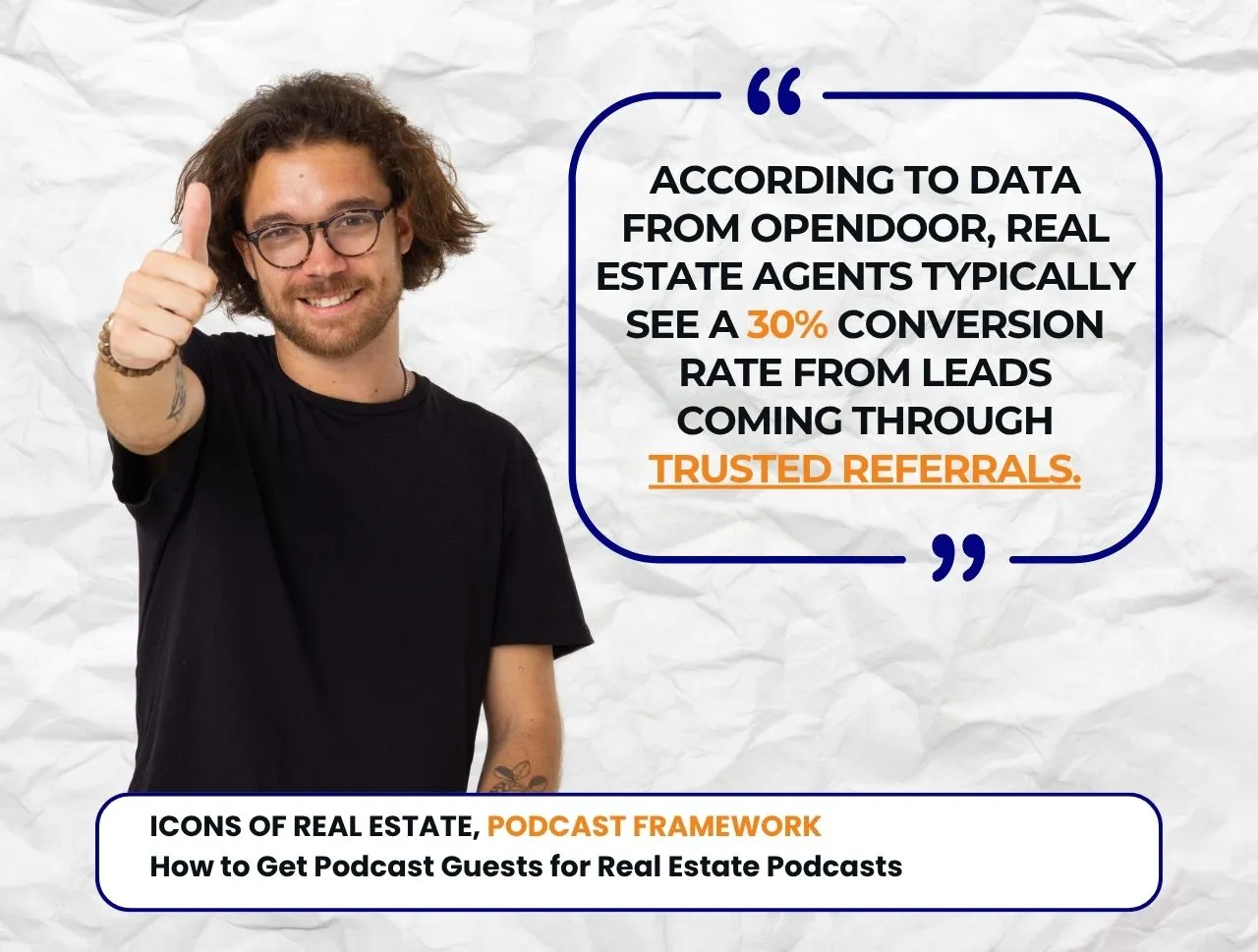
Even if only 40 of those 52 guests become active referral relationships over five years—and each sends just one referral on average—you've generated significant additional business purely through podcasting.
But here's where the compounding effect kicks in: your network doesn't reset each year.
The investor you interviewed in Year 1 is still sending people your way in Year 3. Meanwhile, you're adding 52 new connections every year on top of that.
Year 1 might bring 8 referrals. Year 2 adds another 8—now you have 16 total. By Year 5, you've got 40 referrals stacking up, plus all the secondary connections those people brought you.
How Podcast Guests Drive Listings, Referrals, and Local Authority
When you interview a local lender on your show, two things happen simultaneously.
- First, you provide your audience with genuinely useful information about financing options in your market.
- Second, that lender now has a vested interest in sharing your episode with their network—instantly exposing your brand to their entire client base.
This multiplier effect compounds over time.
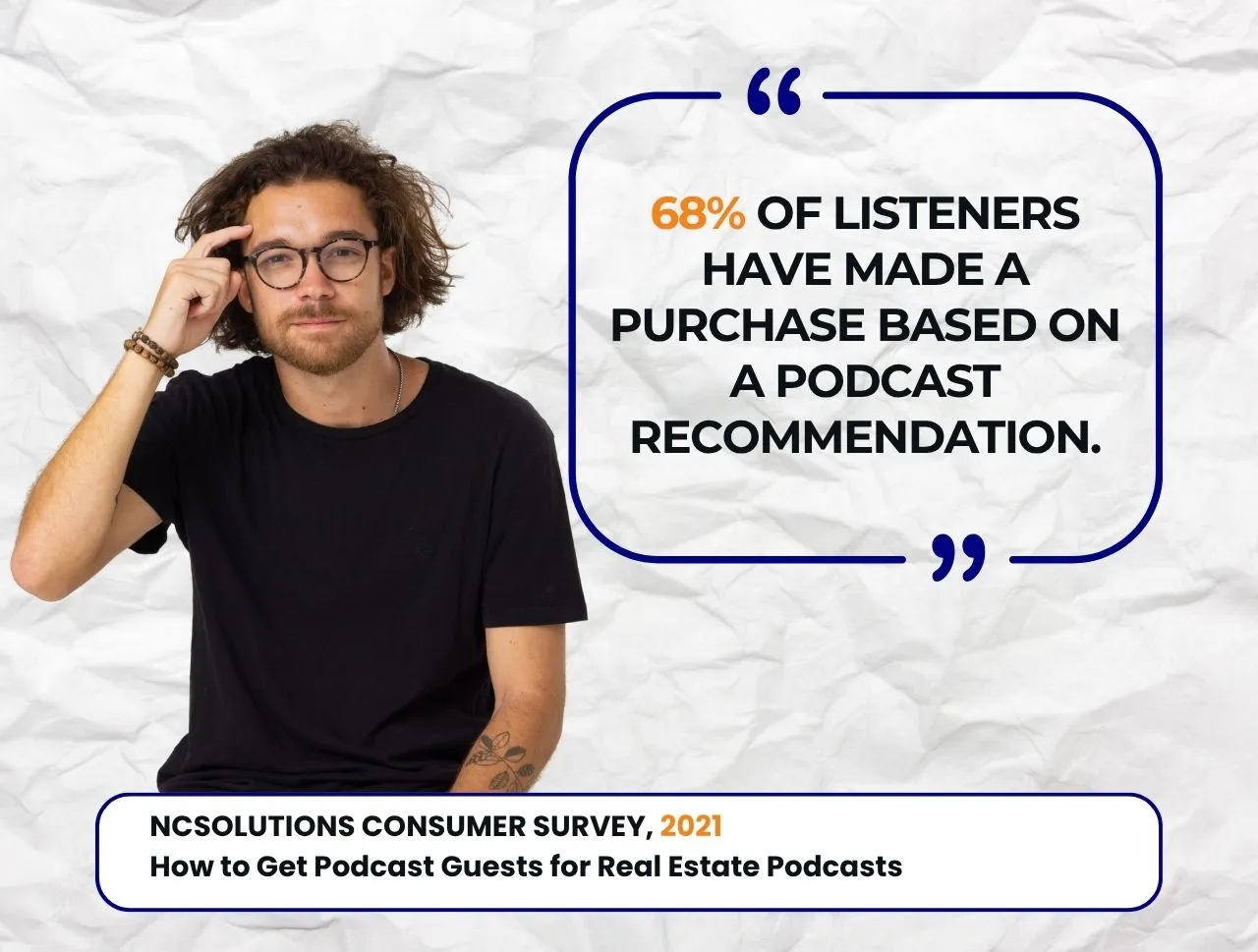
When listeners hear you interview a credible guest, they're not just consuming content, they're receiving what feels like a personal recommendation. That's purchase-level trust being built in real-time.
When your guests share episodes with their networks, each new listener becomes a potential lead who's already primed to trust you.
They've heard your voice, experienced your expertise, and consumed 20-30 minutes of value before ever reaching out.
Why Podcast Guests Matter for Real Estate Agents
Look, you could fill your podcast calendar with solo episodes until you're blue in the face. But here's what you'd be missing: the strategic firepower that comes from bringing the right people onto your show.
Every guest represents a real opportunity to grow your business. Through them, you can:
- Build credibility
- Expand reach
- And generate tangible business outcomes
Here's why bringing the right people onto your show actually matters.
It Builds Credibility with Buyers and Sellers
Modern credibility is no longer built through cold calls or transactional pitches.
It's built by positioning yourself as a trusted advisor who understands the community, the market, and the people within it.
For example, when an appraiser breaks down valuation methods or a mortgage broker explains rate trends on your show, buyers and sellers see you're connected to the professionals who matter.
Guest on Your Show | What Buyers/Sellers See |
Home inspector | You understand property quality |
Mortgage broker | You're connected to financing experts |
Real estate lawyer | You know the legal gatekeepers |
Staging expert | You care about presentation |
Eventually, listeners gain confidence in your platform, and you become the connector who brings valuable experts together.
It Expands Reach Through Guest Audiences
Every guest you interview walks in with an audience already built.
- A local attorney might have 500 LinkedIn connections.
- A mortgage broker runs a client newsletter.
- An investor has an active Instagram following.
Each one becomes a distribution channel when they share their episode.
Interview 4 guests per month. Each shares to their network, and you've multiplied your reach without spending a dollar on ads.
It Creates Referral and JV Opportunities
The interview is just the opening move.
The actual relationship-building happens in what Icons of Real Estate calls the "After Chat"—that 10-minute window after you stop recording.
This 10-minute window after recording lets you:
- Thank the guest
- Discuss potential collaborations,
- Establish the groundwork for ongoing referral partnerships.
Think of your podcast as a networking event you completely control. You choose the guests. You set the agenda. You get their undivided attention.
Compare that to the usual ways agents try to build relationships:
Method | Time With Contact | Outcome | Follow-Up |
Industry Mixer | 3-5 minutes (if you're lucky) | Business card exchange | Awkward cold email later |
Cold Calling | 30 seconds (before they hang up) | Rejection | None |
Sponsoring Events | Brief interaction, crowded room | Brand visibility, no depth | Generic thank you post |
Social Media DMs | One message in their flooded inbox | Read receipt (maybe) | Crickets |
Podcast Interview | 30-40 minutes of undivided attention | Collaborative content + relationship | Natural reason to stay connected |
One of these builds actual relationships. The others collect dust in your CRM.
Here's what that looks like in practice:
Shae Spitz hosts the R.E.A.L. Moms Podcast. She interviewed a real estate agent for an episode. They had a good conversation. Built rapport. Stayed connected.
Later, that guest reached out about a 70-acre development deal. One conversation turned into 330 potential new home listings.
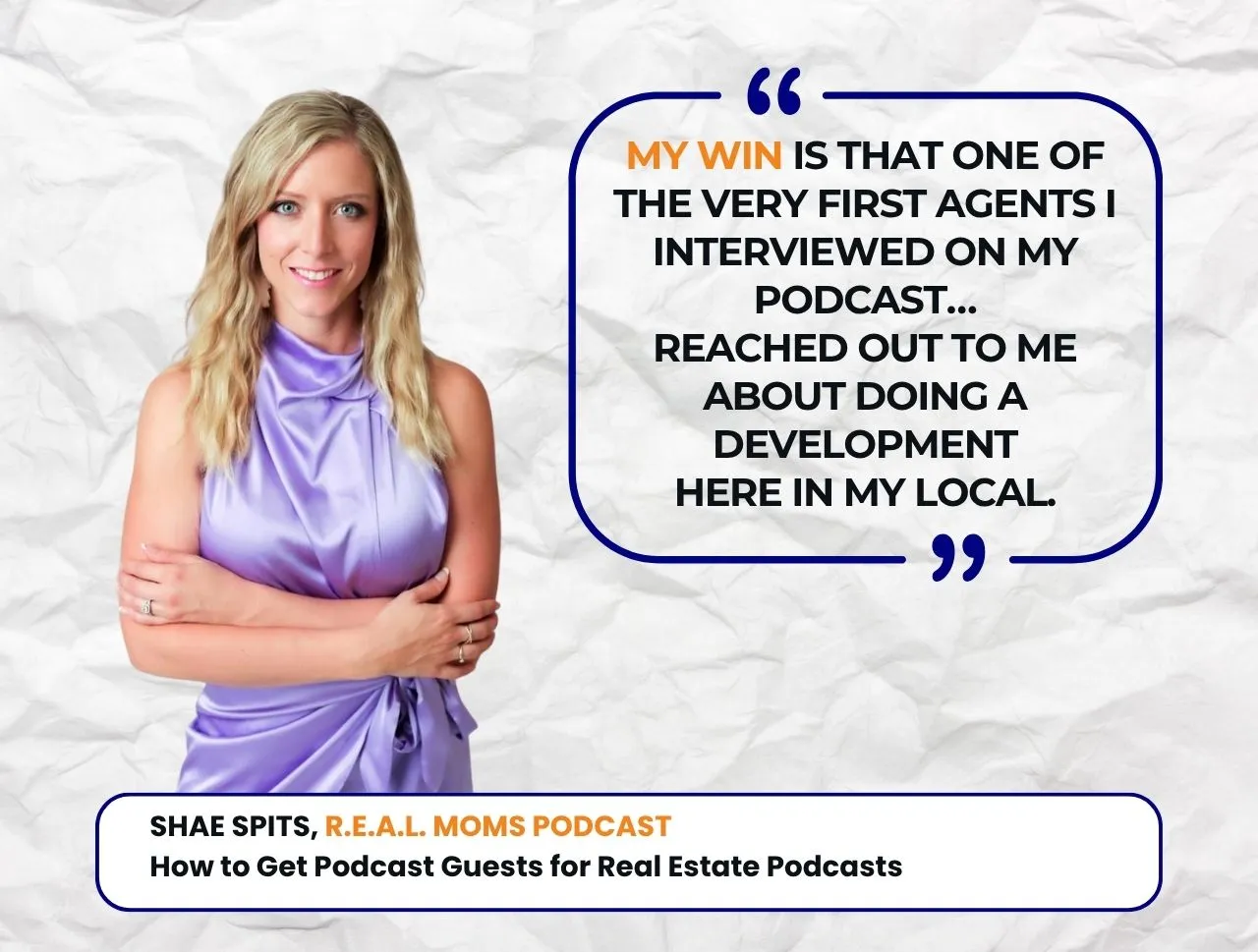
This is the compounding return of podcast interviews. You’re building a network that puts you top on mind when opportunities rise.
Want the full breakdown of how one podcast recording opened the door to 330 listings? Watch Shae's story here.
How to Find Podcast Guests in Real Estate
Your existing network and daily business activities (e.g. transactions, networking events) already connect you with dozens of potential guests:
Look Into Your Past Clients and Sphere of Influence
Open your phone contacts right now, and look for the following people:
- Past clients with interesting purchase
- “Friends” in related industries (Home inspectors, mortgage broker)
- Professional acquaintances (Contractors, insurance agents etc.)
Pull 5 names per list. That’s 15 episodes already.
Here’s a template you could use to reach out to past clients:
Hi [Client Name],
[Rapport/Connection]
I hope you’re doing well! I was just thinking back to
[mention a specific detail about their transaction, e.g., the way you navigated that competitive bidding war for your new home].
[Why/Mission]
I’ve recently launched a podcast called
[Podcast Name], where my mission is to
[mention mission, e.g., demystify the home-buying process for our community].
Your journey was so [inspiring/unique/resilient] that I immediately thought of you as a perfect guest.
[Value]
I believe hearing your firsthand experience would give so much confidence and insight to others who are just starting their real estate journey.
It’s a great way to celebrate your milestone while helping others avoid common pitfalls.
[Logistics]
It would be a very relaxed, [X]-minute conversational interview via Zoom—no complex setup or prep required on your part.
Would you be open to a brief chat or a recording session on [Option 1] or [Option 2]?
Warmly,
[Your Name]
[Podcast Name]
2. Ask for Recommendations From Previous Guests
The best source for new guests are the people who’ve already been on your show, because:
- They know what you’re building
- They’ve experienced your interview style
- And if they had a good time, they’re naturally going to want to help.
So reach out to them, but only when the timing makes sense. Maybe right after their episode drops and you're sharing positive listener testimonials with them. Be specific and suggest categories like industry experts or community figures to help spark their memory.
And if they do provide a referral, be sure to send a thank-you note once that new guest is booked.
Ask for Recommendations From Previous Guests
The best source for new guests are the people who’ve already been on your show, because:
- They know what you’re building.
- They’ve experienced your interview style.
- And if they had a good time, they’re naturally going to want to help.
So reach out to them, but only when the timing makes sense. Maybe right after their episode drops and you're sharing positive listener testimonials with them.
Pro Tip: Be specific and suggest categories like industry experts or community figures to help spark their memory.
And if they do provide a referral, be sure to send a thank-you note once that new guest is booked.
3. Research Local Professionals: Lenders, Inspectors, Attorneys, Builders
Featuring these experts provides valuable information to your audience while building stronger referral relationships with key partners.
Benefit | Why It Matters |
Comprehensive Coverage | Each expert covers their area—attorneys explain contracts, lenders break down loans, inspectors spot issues |
Built-In Credibility | Licensed professionals make your show more credible |
Practical Takeaways | Listeners get advice they can actually use |
Network Expansion | Guests share episodes with their clients |
Local Relevance | Area-specific tips beat generic national advice |
Ongoing Relationships | Today's guest is tomorrow's referral source |
Examples of strong local professional categories include:
- Mortgage brokers who can explain financing options
- Home inspectors who can discuss red flags and maintenance tips
- Real estate attorneys who can clarify contract terms
- Contractors and builders who can advise on renovations
- Title company representatives who can demystify closing processes
4. Look Into Investors, Developers, and Relocation Experts
If you want big-picture insights that position you as market authority, you can also target these three categories:
- Local investors – Have them share their criteria for choosing properties, market analysis techniques, or how they built their portfolio starting with one property
- Developers – Ask about upcoming projects, neighborhood transformation, or what they look for in growth areas
- Relocation specialists – Get them to explain what out-of-state buyers need to know about your market, schools, commute times, or lifestyle differences
Beyond content value, inviting these experts opens business doors you can't access through traditional networking.
Kate Barry proved this with her podcast Failures to Fortunes. She interviewed local investment experts, turned three of those conversations into brokered deals, and hit 60% of her annual five-deal goal within two months of launching her show.
Here's Kate on how she turned podcast guests into closed deals:
Look At Other Real Estate Podcasters and Agents in Adjacent Markets
Inviting non-competing agents as guests creates mutual growth.
- Suburban family home specialists can guest on your urban condo show
- Out-of-state agents bring fresh market perspectives
- Specialists in different property types (luxury vs. first-time buyers) offer comparative insights
Why this works for both parties:
You Get: | They Get: |
Expert content from professionals who know the business | Exposure to your engaged audience of potential clients |
Access to their established listener base | Positioning as a regional expert |
Cross-market insights your audience can't find elsewhere | Content they can share across their channels |
Action step: Identify three real estate podcasters in non-competing markets. Message them this week proposing a guest swap.
Join Real Estate Facebook and LinkedIn Groups
Beyond your immediate network, several channels provide consistent access to qualified guests.
Industry-specific social media groups connect you with professionals actively seeking visibility opportunities.
This is because platforms like Instagram, Facebook, and LinkedIn can give you a sneak peek into a person’s personality. You’ll discover:
- What topics are they passionate about?
- How do they engage with their own audience? Are they responsive and approachable?
- Do their shared content align with the themes of your podcast?
You can manually go through the people who are most active in the group, and DM them personally. Or if the community guidelines allow it, you can even post to attract qualified leads.
Here’s a template that clearly define your podcast mission, and highlight the specific value your guest will gain by participating:
Here’s the template in action:
Use Podcast Directories and Networks
Podcast matching platforms can streamline guest discovery.
For example, the ICONS of Real Estate HUB specifically connects real estate podcasters with industry experts and fellow agents seeking guest opportunities.
Through this network, real estate agents can get high-fit guests aligned with their expertise without the endless research and cold outreach.
You can also apply to be a guest on the HUB and get featured on podcasts that amplify your expertise – whether that’s luxury, commercial, residential, investing, etc. Tap into the audience of established podcasts…
Guest Source Comparison Table
Guest Source | Advantages | Best For |
Past Clients | Built-in trust, authentic stories | First-time buyer/seller episodes |
Local Professionals | Expert credibility, referral potential | Educational content |
Investors/Developers | Market insights, investment angles | Investor-focused shows |
Adjacent Market Agents | Cross-promotion, comparative insights | Audience expansion |
Social Media Platforms | Authentic conversations with rising experts | Social presence and community reach |
Podcast Networks | Vetted guests, streamlined booking | Consistent guest pipeline |
How to Qualify the Right Podcast Guests: A Checklist
Not every willing guest is the right guest.
Effective qualification ensures your episodes deliver value to your specific audience while supporting your business goals.
Relevance to Your Local or Niche Audience
Identifying your Ideal Guest Avatar is crucial for maximizing interview benefits. Ask yourself: Will this guest's knowledge directly benefit my target listeners?
- Do they have the same audience as you?
- How would your audience benefit from listening to them?
Authority and Experience
Guests should bring genuine expertise that elevates your content.
Before confirming a guest for your real estate podcast, take these steps:
- Review their professional background - Check credentials, years of experience, notable roles, client results, and any awards or recognition.
- Scan their LinkedIn profile - Verify career history, current focus, and measurable achievements. Look for consistency and credibility.
- Evaluate their published content - Read articles they’ve written or media features they’ve appeared in to confirm thought leadership and subject-matter depth.
- Listen to past interviews or podcasts - Assess how clearly they explain ideas, their confidence on mic, and whether they speak with authority and relevance.
- Visit their personal or company website - Identify standout accomplishments, recent projects, and proof of active expertise.
Promotion Potential
Strong guests actively share their appearances.
Look for guests with:
- Established audiences
- Active social media presence
- Email newsletters
- Professional networks
They will amplify your episode after publication.
One key sign that they have promotional potential is if they provide explicit agreement to share the content.
You can ask a direct vetting question:
If they agree, it means they’re invested in your collaboration, which helps increase the show’s reach and engagement.
Red Flags for Real Estate Podcasts
Avoid guests who:
❌Lack relevant experience for your audience
❌Seem primarily interested in self-promotion without providing value
❌Have histories of unprofessional behavior or controversial statements
❌Are unwilling to commit to basic preparation requirements
❌Represent direct competitors to your core business
How to Reach Out to Prospective Podcast Guests
Once you found a prospective guest that you think would be a great fit based on your research, you can now send them a personalized outreach message. Here’s how:
1. Do More Research!
Before reaching out, thoroughly research your prospective guest. Explore their website, social media profiles, and recent interviews - then mention this in your message to build rapport.
- Note specific achievements, projects, or interests they've shared publicly
- Understand their expertise and how it aligns with your podcast
- Make note of unique accomplishments to mention in your outreach
Why this matters: Mentioning something specific and personalizing your message means you’re not sending the same message to 100+ other people. Guests respond positively when they feel valued and genuinely wanted, not like just another name on a list.
2. Craft a Warm, Personalized Introduction
Your introduction should be genuine and enthusiastic. But keep it concise and avoid overwhelming them with too much information.
- Briefly describe your podcast's mission and audience
- Explain why their perspective would be valuable
- Make clear connections between their expertise and your audience's interests
Here’s a template you can use to personalize your outreach:
Here’s the template in action:
3. Explain What's In It for Them
Tailor your outreach by clearly highlighting what’s in it for them. When people instantly see the benefit, response rates jump, friction drops, and conversations open faster.
You can highlight:
- Exposure to an engaged audience of potential clients/followers
- Opportunity to showcase expertise on a trusted platform
- Alignment with your podcast's mission
- Cross-promotion on social media and email newsletter
- Connection with like-minded professionals
Who You’re Reaching Out To | Potential Message Example |
Investors | “You’ll connect with aspiring investors looking for mentors and deal partners in Colorado.” |
Developers | “Showcase your projects to locals, buyers, and investors following Huntsville’s growth.” |
Local Professionals (Agents, Lenders, Attorneys, Contractors) | “Get in front of investors and buyers who actively need your services.” |
Other Podcast Hosts | “Let’s cross-promote, share audiences, and grow together.” |
Past Clients | “Share your success story and inspire others just starting their journey. |
4. Offer Flexible Scheduling Options
Busy guests don't have time to go back and forth. Offer specific options instead of asking "when are you free?" Say something like: "I have Tuesday at 3 PM or Thursday at 1 PM open—does either work for you?"
Let them know it's a casual Zoom call, about 20-40 minutes, and they don't need to prepare anything formal. The easier you make it, the more likely they'll say yes.
Here’s a sample line you could include:
Better yet, you can share your Calendly booking link to make things seamless.
5. Engage Their Curiosity
Spark your potential guest’ interests by giving them a peek of some of the questions you’d love to talk about. Share a few sample questions.
If you’re inviting a city planner or an urban development official, you could ask questions like:
- "Everyone sees the cranes going up—but what's the 20-year vision most people don't know about?"
- "With all these new apartments, are we actually building what Huntsville needs, or just what developers want to build?"
- "Is there any chance we're getting that skybridge downtown, or is that just wishful thinking?"
6. Follow Up Thoughtfully and Respectfully
Most people won't respond to your first message, and it's almost never personal. Busy professionals get hundreds of emails, and yours can easily get buried or forgotten.
Wait about a week before following up, and keep the tone friendly and respectful.
If they decline, accept their decision with grace and keep the door open for future opportunities.
7. Embrace Multi-Channel Outreach
Email isn't your only option. Here's how to use other platforms to increase your chances of getting a response:
Step 1: Start with Social Media Engagement
Before you send any message, engage with their content first. Like or comment on 2-3 recent posts (Instagram, LinkedIn, Facebook). Make your comment thoughtful and specific—not just "Great post!"
Example: "This insight about [specific point] is spot-on—I've seen the same thing happening in [neighborhood]."
Step 2: Choose the Right Platform
Pick where they're most active:
- LinkedIn: Best for professionals, investors, developers
- Instagram: Good for agents, younger entrepreneurs, lifestyle-focused guests
- Facebook: Often works for local business owners and community figures
Step 3: Send a Brief, Personalized DM
Keep it short (3-4 sentences max). Reference their recent post or achievement. Mention your podcast in one sentence. And then ask if they'd be open to a quick email with details
Here’s a Sample LinkedIn Message:
You can also acknowledge the previous email that you’ve made:
8. Show Appreciation and Enthusiasm
People can tell when you actually care versus when you're just mass-emailing everyone. If you're genuinely excited about having them on, let them know. Enthusiasm is contagious, and when someone feels like you specifically want them (not just any guest), they're way more likely to say yes.
Example Closing:
Outreach Templates: Plug-and-Play Messages to Invite Podcast Guests
Use these ready-to-customize email templates to invite guests to your podcast with confidence and professionalism.
Simply fill in the bracketed sections with your specific information and personalize the content based on your research about the guest.
Applying the Template: Industry Expert Outreach Example
Below is an example of how we’ve taken the outreach framework above and tailored it specifically for industry experts, making the message highly relevant, personalized, and value-driven.
Best for: Real estate professionals, market analysts, economists, appraisers, or established industry authorities
Quick Customization Checklist
Before sending any template, make sure you've:
- Filled in all [bracketed sections] with your specific information
- Personalized the "I came across your work through..." section with genuine research
- Customized the sample questions to match the guest's expertise
- Verified your contact information is current
- Proofread for any remaining placeholders or errors
- Added a compelling subject line that mentions the guest's name or expertise
Pro Tip: The more specific and personalized you make these templates, the higher your response rate will be. Take the extra 5-10 minutes to research each guest and customize accordingly—it makes all the difference!
🎯 Want to save time and boost replies? Download our crafted guest booking template with proven outreach scripts to help you book better guests, faster, with less back-and-forth. |
How to Prepare Your Podcast Guest For Recording Day
So you got a yes from your ideal guest. You can't just send a "great, talk soon!" and hope for the best.
You need a system, a process that takes that initial spark of interest and turns it into a confirmed, prepared, and genuinely excited guest. Here's a 6-step process to make sure they actually show up, know what to expect, and deliver their best conversation.
1. Streamline Scheduling with Automation
Time is the currency we're all short on. Your guest said yes because they saw value, but if you start the back-and-forth dance of "when are you free?" you're burning that goodwill fast.
Use a scheduling tool like Calendly to avoid the email tennis.
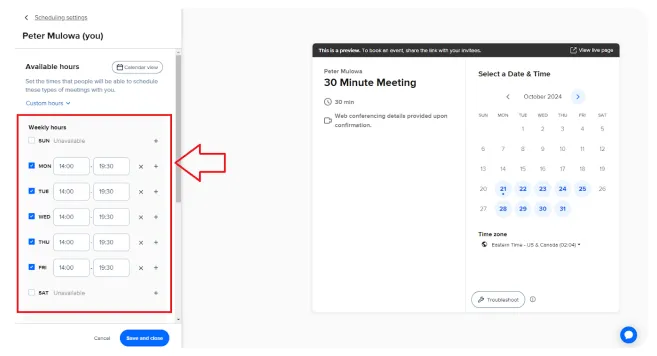
Instead of asking when they're available, give them options. Share your booking link and let them pick a time that actually works for their calendar.
Pro tip: Build in buffer time before and after the recording. You'll want 10-15 minutes to settle in, test audio, and have a real conversation before you hit record. |
2. Deploy the Podcast Guest Questionnaire
Know what your guest cares about most before they arrive. Without it, you risk a weak interview.
To achieve this, integrate a podcast guest questionnaire directly into the scheduling stage of your workflow. Rather than sending it as a separate manual document, you should include it as a mandatory intake form within your booking tool, such as Calendly, so the guest must complete it to finalize their recording time.
Keep it simple—focus only on key details to build an engaging episode. Here are some things you could ask:
Category | Questions to Ask |
Discussion Focus | • What's your experience in [their field]? • What's the one area in your field you're most passionate about? |
Alignment | • Who do you believe benefits the most from your knowledge?< • How do you explain complex topics to your audience? |
Audience Value | • What message do you hope listeners would take away from you? • What are three talking points you'd love to address? • Name three questions you'd be a genius at answering. |
Expectations & Motivations | • What do you hope to achieve from this podcast? • What excites you most about being a guest? |
Promotion | • Would you be open to promoting your episode on social media? • Is there anything you'd like to promote? A book, product, event? |
Example: Say you're interviewing a mortgage broker. In the form, they say they're passionate about helping first-time buyers grasp creative financing options.
That's your focus. Build the episode around it. You move past basic questions to what truly matters to them.
3. Provide the Preparation Package
Here’s what kills a good interview: A guest who shows up nervous and unclear about what's happening.
So send them a prep email at least 24 hours before the recording. Nothing overwhelming, just enough so they walk in confident.
Here's what to include:
- Episode Structure: Are you doing a Q&A? A casual conversation? A mix? Tell them. If you're planning to start with their origin story and then shift into actionable advice, let them know. Clarity reduces anxiety.
- Audience Context: Describe who's listening. Are they first-time homebuyers? Seasoned investors? Real estate agents looking to level up? When your guest knows who they're talking to, they adjust their language and examples accordingly.
- Sample Questions: Give them 3-5 questions you plan to ask. Not the full script, just enough so they can think about their answers ahead of time. You still want spontaneity, but you also want substance.
Also, let them know they can reach out for any last minute concerns. And send them a brief note of encouragement regarding the upcoming conversation.
Here’s a sample prep email you could send:
Example Prep Email:
4. Confirm Technical and Logistical Requirements
Bad audio kills credibility. You can have the best content in the world, but if people can't hear it clearly, they're gone.
Send your guest a simple technical checklist.
- Environment: Find a quiet space. Close the door. Turn off the ceiling fan. Tell the family you're recording.
- Equipment: Use headphones. If you have a microphone, great. If not, your laptop or phone mic works if you're in a quiet room.
- Platform: We'll be using Zoom. Here's the link: [insert link]. Please test your audio before we go live.
🎯 Pro tip: If your guest is new to podcasting, offer a 5-minute tech check call before the actual recording. It's a small gesture that eliminates last-minute panic. |
5. Establish the Recording Day Routine
Recording day is game day. You want a routine that puts everyone at ease and sets the tone for a killer episode.
Arrive Early for the Warm-Up
Log in 10 minutes before the scheduled time. Use this to welcome your guest and chat informally. Ask about their day. Comment on something from their intake form. Laugh. Build rapport. Build the foundation for a natural conversation.
When people feel comfortable with you before you hit record, they open up. They share stories they wouldn't share otherwise.
The "After-Chat" Agreement
Before you start recording, set an expectation: "After we wrap, let's chat for 10 minutes. I'd love to hear your thoughts on how it went and explore ways we might collaborate down the road."
This does two things. One, it tells them you value their feedback. Two, it plants the seed for an ongoing relationship, not just a one-time transaction.
🎯 Once you've booked your guests, you need to make sure you can actually host a conversation worth listening to. The In-Depth Podcast Hosting Framework walks you through how to structure episodes, ask questions that get real answers, and keep your audience engaged from start to finish. Download it free here. |
6. Nurture the Relationship Post-Recording
Here's where most podcasters completely drop the ball. You finish the recording, say thank you, and... that's it. The guest goes back to their life. You edit the episode. You publish. Done.
But the real opportunity starts after the recording. This is when you turn a guest into a partner, an advocate, and maybe even a repeat collaborator. Here’s how you can do that:
Send a Thank-You Email Within 24 Hours
Keep it short. Keep it genuine.
Provide Promotional Assets
When the episode goes live, make it stupid easy for your guest to promote it. Send them:
When the episode goes live, make it stupid easy for your guest to promote it. Send them:
- A direct link to the episode
- A pre-written social media post (they can edit it if they want)
- Quote cards or graphics featuring them from the episode
- Suggested captions for Instagram, LinkedIn, Facebook
Example:
Stay in Touch
Don't let the relationship go cold. Comment on their posts. Share their content. If you see an article or resource that aligns with what they talked about, send it their way.
And if an opportunity comes up in a few months, a panel discussion, a joint webinar, another episode, you're not starting from scratch. You're reaching out to someone who already knows you, trusts you, and enjoyed working with you.
Common Mistakes Real Estate Agents Make When Booking Guests
Inviting Guests Without Audience Relevance
Some agents chase celebrity guests for views and ego validation. While this might generate massive views, those vanity metrics rarely translate to closed deals.
After 626+ podcast episodes, I’ve discovered that:
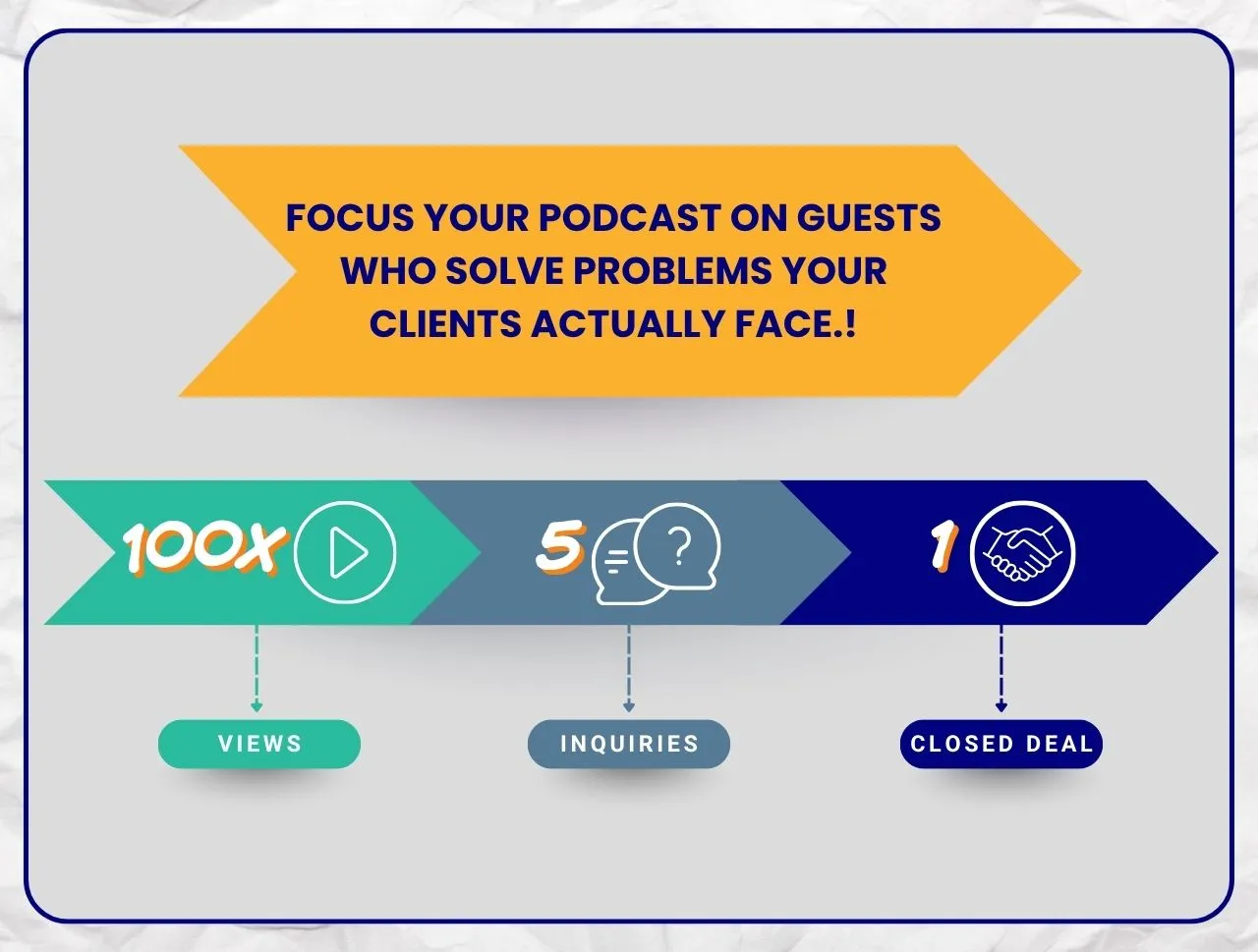
The right local expert with 100+ targeted listeners is better than a famous name attracting 1000+ irrelevant viewers.
In short: quality > quantity
Focus your podcast on guests who solve problems your clients actually face. Eventually, what might seem like a “measly” 100 (but relevant) views could turn into 5 inquiries, into 1 closed deal.
Poor Pre-Interview Preparation
Many agents treat guest preparation like they'd schedule any appointment: send a calendar invite and show up.
But podcasting needs a different approach.
Skip the prep work and your guest arrives nervous. Your content falls flat. Technical glitches derail the conversation.
Here are 5 common preparation mistakes and their fixes.
Use it as your pre-interview checklist:
Problem to Avoid | How to Fix It and Why |
Guest arrives anxious | Send episode structure beforehand to reduce anxiety about the unknown |
Content falls flat | Share listener demographics early so guests tailor expertise to your audience |
Interview stays surface-level | Ask them what specific themes allow them to provide most value to your audience. |
Audio quality issues | Confirm tech requirements ahead to prevent avoidable recording disruptions |
Conversation feels stiff & scripted | Share topics not scripts to keep dialogue authentic and spontaneous |
Overcomplicating the Booking Process
Getting busy professionals to participate is tough because of complicated scheduling, too much paperwork, and drawn-out approval processes.
To land these high-quality guests, you need to make your system super easy and quick for them.
You can do this through platforms like Calendly, Doodle, or Google calendar that allows you:
- Sync your calendar
- Account for timezone
- Share a single link to book their ideal schedule
Consistency is Key.
Posting episodes often helps people remember you.
The more episodes you make, the more value your podcast builds over time.
Plan ahead by booking guests 4–6 weeks early.
You can also record 2–4 interviews in one week to cover a whole month.
The agents who do well with podcasts treat it like real business work, not a hobby.
FAQs About How To Get Podcast Guests
How many guests should a real estate podcast book ahead of time?
Maintain 4-6 weeks of guest bookings to ensure consistent content flow. This buffer protects against cancellations and allows adequate preparation time.
Can podcast guests help generate listings?
Absolutely. Guest relationships create referral pipelines that generate listings both directly and indirectly. The ICONS framework calculates that 52 annual guests could yield 8+ referrals per year with typical conversion rates.
Should real estate agents pay podcast guests?
Generally, no. For real estate podcasts targeting local or professional audiences, guests receive value through exposure, content they can repurpose, and relationship development. Paying guests can diminish authenticity.
Ready to Grow Your Real Estate Podcast?
ICONS of Real Estate provides the frameworks, network, and production support to help you build a podcast that sells houses.
→ Download the Free Podcast Framework
→ Join the Podcast Network
→ Explore the Podcast Hub: